Researchers examined whether water, sipping patterns, and spiciness shape how much people eat, with findings that complicate familiar advice about drinking water at mealtimes.
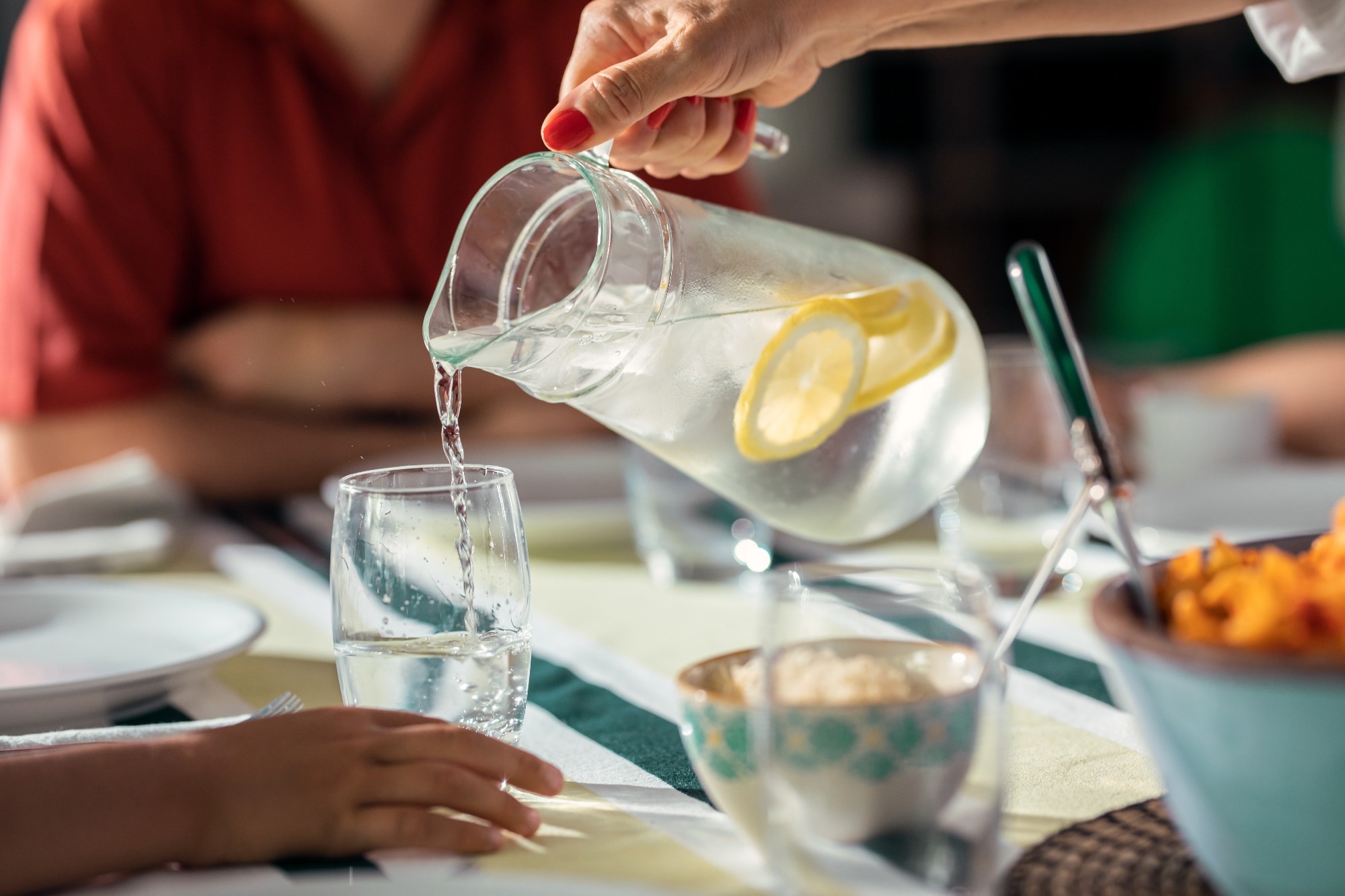
Paper: Water intake, switching between bites and sips, and drinking behavior are associated with food intake across meals varying in spiciness: A secondary analysis of two randomized crossover studies. Image Credit: Josep Suria / Shutterstock
A recent paper published in the journal Appetite suggests that drinking water during a meal and alternating sips with bites of food are associated with increased rather than reduced food consumption, contrary to popular belief. However, the study extends the latter finding beyond pasta to two additional dishes, although its relevance to other types of meals remains uncertain.
Background
People often believe that increasing water consumption can help manage body weight and reduce energy intake, including during meals. In fact, among the 42% of 48,026 participants in a US survey who reported attempting to lose weight, increasing water consumption was the third most commonly reported strategy, behind only restricting their food intake and increasing their exercise.
This advice seems sensible, given that drinking water before and during meals can distend the stomach and promote a feeling of fullness. However, there is little evidence for this outcome, with newer research suggesting that, at least in adults during a pasta meal, higher water intake is associated with greater food intake. Evidence concerning water consumed before meals may differ, particularly in older adults.
Spiciness and water intake
Although other beverages may be more effective, water is also consumed to relieve spiciness by reducing the burning sensation that capsaicin produces in the mouth. Prior research by these authors showed that increasing meal spiciness reduced food and energy intake in the earlier experiments. Given this, they hypothesized that drinking water while eating such meals might counteract this spiciness-associated reduction in food intake.
In addition, the authors sought to account for the fact that individuals might drink between bites of a spicy meal but not with other meals, potentially allowing them to eat more. This could limit the potential utility of increasing meal spiciness to regulate food intake.
Switching and food intake
The authors suggest that individuals who drink water during a pasta meal might eat more, in part because they switch between eating and drinking. This behavior has previously been associated with greater food intake and one-year gains in adiposity among children with a high familial risk of obesity, suggesting that this eating pattern may be associated with obesity risk.
The extent to which this applies across different foods remained uncertain, however. The authors also aimed to examine whether switching and drinking behaviors were associated with food intake alongside other small-scale eating-related behaviors, such as eating rate, bite size, and orosensory exposures.
Sample characteristics
The authors drew on data from two earlier randomized crossover studies they conducted with participants eating mild or spicy versions of either beef chili or chicken tikka masala. Participants could eat freely from 650 g portions served with 450 g of room-temperature water. Participants were video-recorded to allow researchers to assess their drinking behavior.
Pooling the data, they conducted a secondary analysis of 172 meals from 86 participants. The mean age was 37 years, with 71% being female and 71% White. Most were university-educated and had an annual household income of less than $100,000 USD. Approximately 44% were classified as having overweight or obesity using BMI calculated from self-reported height and weight.
The secondary analysis showed that participants consumed a mean of 236 g of water and alternated between bites and sips about 8.5 times per meal, though model-estimated means were 7.3 switches with mild meals versus 8.7 switches with spicy meals.
Participants consumed, on average, 9.8 sips of water per meal, at about 30 g per sip, for a drinking rate of about 44.2 g/minute. Total water intake and sip number did not increase with spiciness, although drinking rate and switching frequency were higher during spicier meals.
Spiciness changed some drinking behaviors, but not water intake
The researchers had previously found that increasing meal spiciness slowed eating and reduced food intake. In this secondary analysis, they found that this reduction in food intake was not moderated by water intake, the frequency of switching between food and water, or other drinking behaviors, with all interaction p-values greater than 0.73.
More water, more food intake
However, across all meals, every additional 100 g of water consumed was associated with 39 ± 9 g of additional food and 49 ± 12 kcal of additional energy (p < 0.001). A 1-standard deviation (SD) increase in water intake, equivalent to 129 g of water, was associated with 50 g more food and 63 kcal more energy consumed.
Higher switching, more food intake
Participants who switched more frequently between bites of food and sips of water also tended to eat more. Each additional switch was associated with 4.4 ± 1.8 g more food (p = 0.02) or 5.8 ± 2.3 kcal of energy (p = 0.01), corresponding to 31 g more food and 41 kcal more energy consumed per 1 SD increase in switching, equivalent to seven additional switches.
Conversely, faster drinking was associated with lower intake. For instance, a 10 g/minute increase was associated with 16.2 ± 2.9 g less food and 20.4 ± 3.7 kcal less energy, with both p-values less than 0.001. Neither sip number nor sip size was significantly associated with food or energy intake.
The water and switching associations were examined in separate mixed models that accounted for meal spiciness, study visit, experiment, and sex. Sensitivity analyses excluding outliers and participants who consumed almost the entire portion, and additionally adjusting for eating rate, did not change the findings.
Post-meal fullness
After the meal, greater water consumption, more frequent switching, and more sips were all associated with feeling fuller, even after accounting for food intake and pre-meal ratings. This was not the case with faster drinking.
Though satiety responsiveness was linked to lower water consumption, it was not independently associated with food intake.
Similarly, greater self-reported reliance on physical satisfaction when deciding to stop eating was associated with increased switching but not with food intake independently.
Putative mechanisms
The authors suggest potential explanations for these findings. By itself, gastric distension after drinking may not reduce food intake because water leaves the stomach quite rapidly.
Prior research has established a “thirst-related inhibition of eating,” in which, for instance, uncomfortable mouth sensations connected with thirst may independently affect the desire to eat. Drinking during meals could relieve sensations that might otherwise inhibit eating, potentially allowing eating to continue.
Water also lubricates the mouth and the food, facilitating swallowing and potentially faster eating, though this may vary with drier foods. However, the association between water and food intake remained after adjustment for eating rate in the meals studied.
The authors also suggest that increased switching could delay sensory-specific satiety by introducing changing sensory experiences in the mouth, potentially delaying meal termination. However, sensory-specific satiety was not directly measured in this study.
According to them, such mechanisms might explain the increased food intake associated with mealtime water consumption. However, they caution that these are hypothesis-generating findings from an exploratory secondary analysis. Moreover, these observations of association do not indicate causality. The unexpected relationship between faster drinking and lower intake might also reflect longer meal duration rather than an effect of drinking speed itself.
Limitations
The studies used for this secondary analysis were not designed for the current study's aims; therefore, the results are exploratory. Water intake and switching were observed rather than experimentally assigned, so causal relationships cannot be determined. The meals were moist, homogeneous, and warm, which limited generalizability. The dataset may have been too small to reliably detect moderation effects or associations involving individual characteristics. The sample was mostly White, female, and well educated, which may also limit the study's generalizability.
The controlled laboratory setting further limits ecological validity. The outcomes of the original studies were not preregistered, and no correction for multiple comparisons was applied. Sip size also showed poor consistency within participants.
Conclusion
The findings challenge the widespread dietary advice that drinking water during meals necessarily increases fullness and reduces food consumption, and provide support for prior studies suggesting the opposite. They do not establish that drinking water causes greater intake or address the potentially different effects of consuming water before a meal.
Switching was associated with greater meal intake in this study and has separately been associated with increased adiposity among children at high familial risk of obesity. Further controlled studies are needed to determine whether changing water intake or switching behavior affects food consumption.
Funding disclosure: The work was partly supported by an unrestricted gift from the McCormick Science Institute. The authors stated that the funders had no role in the research or publication decisions and declared no conflicts of interest.
Journal reference:
- Cunningham, P. M. & Hayes, J. E. (2026). Water intake, switching between bites and sips, and drinking behavior are associated with food intake across meals varying in spiciness: A secondary analysis of two randomized crossover studies. Appetite. DOI: 10.1016/j.appet.2026.108698, https://www.sciencedirect.com/science/article/pii/S0195666326002606
 Rising antimicrobial resistance in children threatens life-saving antibiotic effectiveness