Sponsored Content by LonzaReviewed by Ify IsiborMay 1 2026
In high-throughput biologics manufacturing, many instruments, such as analyzers, are under significant strain despite their sensitivity. They are expected to work consistently and without failure or disruption.
Analyzers have a crucial role in bioprocess analytics, often providing manufacturing-critical information (such as cell density and viability, pH, pCO2, and metabolite levels) in a timely manner to help ensure smooth production.
In the worst-case scenario, just one faulty analyzer can slow or halt a line. This can result in teams losing the high-frequency data that supports reliable operations, making biomanufacturing downtime prevention crucial in high-throughput environments.
How frontline engineering facilitates continuous manufacturing
Lonza’s frontline engineering sub-team primarily supports a range of analytical equipment used by manufacturing operators.
Many high-throughput facilities rely on multiple analyzers operating continuously under GMP conditions. These instruments are precise but inherently sensitive: small issues – such as a missed calibration, debris on a probe, or an error in software protocol – can lead to unreliable data and increased delays.
As a result, analyzers can easily become production bottlenecks. Therefore, the team at Lonza plans for redundancy, closely monitors performance, and builds routines to maintain analyzer stability. If maintenance slips, data can become unreliable, inducing delays or even product losses.
To help navigate these risks, the team at Lonza deploys a multifaceted approach to ensure analyzers remain functional.
Proactive maintenance
The aim of frontline engineering is to avoid problems before they occur. Lonza runs disciplined, routine maintenance to maintain the accuracy and availability of analyzers:
- Routinely cleaning tubing, probes, and other internal components to prevent the buildup of debris
- Routine performance checks and calibrations ensure instrument precision
- Weekly data backups protect the integrity if a power failure or data loss were to occur
- Semi-annual part replacements to prevent unexpected breakdowns
These actions may seem simple, but they have a significant impact: clean sensors read correctly; calibrated instruments deliver consistent trends; regular data backups retain data integrity and traceability; planned replacements reduce the chance of unexpected breakdowns or surprise failures.
Engineers at Lonza remind customers that data can start drifting or become unreliable if routine maintenance is not performed on time. This influences manufacturing production by causing delays or, in the worst-case scenarios, product losses.
Surveillance and rapid response
Even with strong prevention strategies, surprises can still occur at manufacturing sites from time to time.
One night, a call came in at 2 a.m.: a cell count was needed by 5 a.m., but the analyzers were locked by a protocol error. The Lonza team quickly mobilized, validated the error path, performed manual checks, reset the protocol, and confirmed data integrity before releasing results. The team ensured the operation without disruption.
On another occasion, gradual performance degradation across multiple analyzers was observed over the course of a weekend, culminating in a Monday morning shutdown. The fast response blended targeted cleaning cycles, diagnostics, part replacements, and cross‑validation against backup instruments to rapidly restore service and avoid disruptions to production.
Frontline engineering work necessitates technical skill and intuition. At times, an analyzer may look perfect on the surface, but its results are atypical. That's when engineers must dig deeper.
Bioprocess analytics trends, maintenance history, and system logs help to rapidly isolate root causes. The goal is not just maintaining or fixing an instrument; it’s protecting manufacturing continuity and operator confidence in trustworthy, timely numbers.
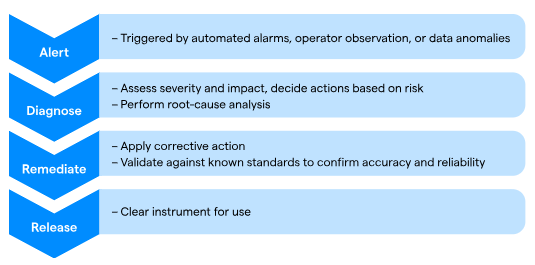
Figure. Rapid-response workflow diagram (alert → triage & diagnose → remediate & validate → release). Image Credit: Lonza
Preventive rigor and rapid responses provide operations with a stable platform for decision‑making. Engineers reduce downtime, maintain reliable data streams, and help keep schedules, especially when new customer projects require onboarding new equipment.
Implementing new analyzers benefits from broad experience
When a tech transfer needs a different platform – as customers may validate using different analyzers – the frontline engineering team also leads the end-to-end implementation so manufacturing can rely on the new system from day one. That includes:
- Platform onboarding: Purchasing and readying new systems, followed by Installation Qualification (IQ) and Operational Qualification (OQ), confirms that the unit is correctly installed and operates as intended.
- Lifecycle documentation: Authoring and/or assembling all required documentation, including data integrity forms, criticality assessments, risk assessments, design specifications, and SOPs for both operators and system administrators
- GMP release and handover: Coordinates release for use under GMP and ensures the line is ready to run with the appropriate training, procedures, and access controls in place.
- Post-release monitoring: Tracking effectiveness checks and early performance signals so issues can quickly be identified and resolved, minimizing any impact on the manufacturing process.
New systems are especially demanding because failure modes are unfamiliar, making experience and problem-solving competence important. The Lonza team quickly triages, leverages experience from similar analyzers, and closes gaps with specific documentation and training, so operations remain on schedule and confident in the equipment.
Conclusion
As biomanufacturing scales, the role of frontline engineers becomes increasingly important. With higher throughput and increasingly diverse products, there is greater potential for issues to emerge, which must be resolved quickly.
Frontline engineering is designed to address such challenges: it combines fast problem-solving, vigilance, and prevention to keep critical equipment ready and production moving.
The combination of preventive rigor and rapid response is crucial to preventing biomanufacturing downtime, helping ensure production stays on track as throughput increases and operational complexity grows.
When customers use Lonza for their manufacturing, they might not see the company’s work in the background, but they can trust in its continuous, high-quality production.
Acknowledgments
Produced using materials originally written by Talal Sohail from Lonza.
About Lonza
Lonza is one of the world’s largest contract development and manufacturing organizations (CDMOs) dedicated to serving the healthcare industry. Working across five continents, our global team of approximately 20,000 colleagues works alongside pharma and biotech companies to turn their breakthrough innovations into viable therapies. We support our customers in bringing life-saving and life-enhancing treatments to patients worldwide with a combination of cutting-edge science, smart technology, and lean manufacturing.
Our company generated sales of CHF 6.5 billion with a CORE EBITDA of CHF 2.1 billion in Full-Year 2025.
Find out more at www.lonza.com.
Sponsored Content Policy: News-Medical.net publishes articles and related content that may be derived from sources where we have existing commercial relationships, provided such content adds value to the core editorial ethos of News-Medical.net, which is to educate and inform site visitors interested in medical research, science, medical devices, and treatments.