Imagining a song triggers similar brain activity as moments of silence in music, according to a pair of studies recently published in JNeurosci. The results reveal how the brain continues responding to music, even when none is playing.
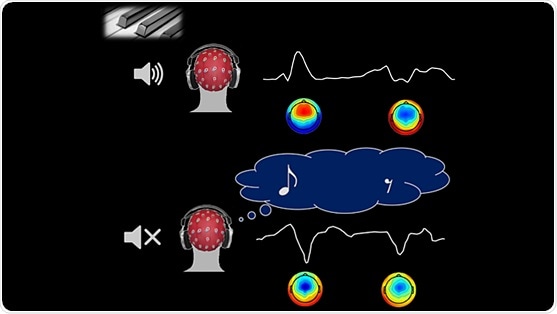
Image Credit: Society of Neuroscience
When we listen to music, the brain attempts to predict what comes next. A surprise, such as a loud note or disharmonious chord, increases brain activity. Yet it is difficult to isolate the brain’s prediction signal because it also responds to the actual sensory experience.
Di Liberto, Marion, and Shamma used EEG to measure the brain activity of musicians while they listened to or imagined Bach piano melodies. Activity while imagining music had the opposite polarity of activity while listening to music, meaning when one was positive, the other was negative. The same type of activity occurred in silent moments of the songs when statistically there could have been a note, but there wasn’t. There is no sensory input during silence and imagined music, so this activity comes from the brain’s predictions. The research team also decoded the brain activity to determine which song someone was imagining. The researchers find music is more than a sensory experience for the brain. Instead, the brain keeps making predictions even when music is not playing.
Source:
Journal references:
 Brain Health WA resource aims to reduce dementia risk