Scientists reveal how evolution within our own tissues can drive disease, protect cells, and uncover hidden therapeutic targets for future precision medicine.
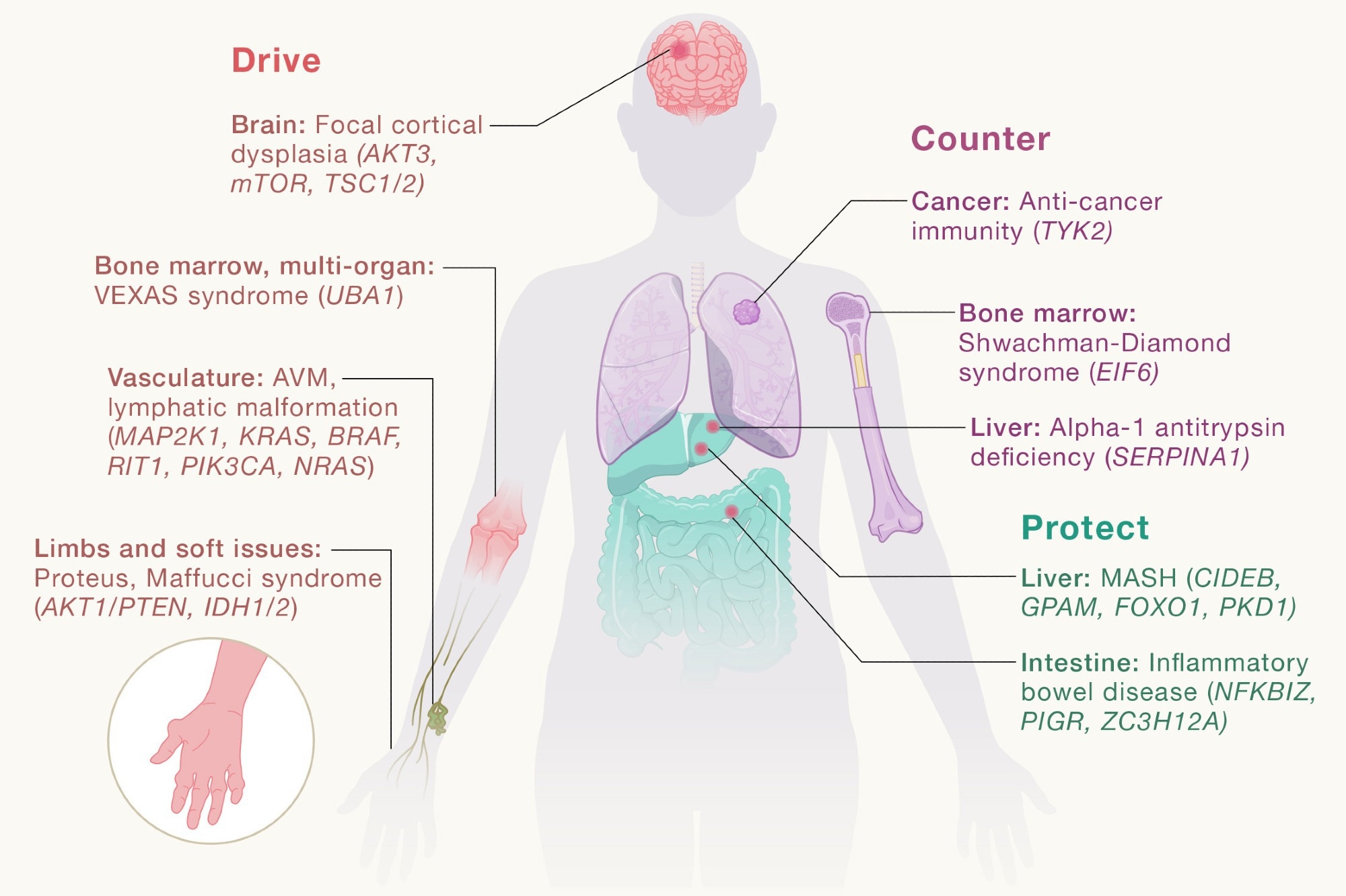
Somatic genomics uncovers the outcomes of evolutionary competitions within our tissues, which can drive disease, counter monogenic disease, or protect from common diseases
In a recent study published in the journal Cell, researchers reviewed current evidence on somatic mutations in disease and their potential applications in biomedical discovery.
Somatic mutations, i.e., genetic changes that occur in cells after conception, are widespread in healthy tissues. While most mutations are functionally inconsequential and do not modify cellular phenotype, some occur in critical regulatory elements and coding regions in the genome and have phenotypic effects. Darwinian selection can act upon such phenotypic variation, leading to the expansion or disappearance of clones with altered fitness.
Consequently, normal tissues can show clones with positively selected somatic mutations, called driver mutations. These driver mutations overlap between malignant and normal tissues in many organs, indicating that the earliest events in cancer can be detected in normal tissues. Nevertheless, many driver mutations in normal tissues are absent or less frequently seen in cancers and may not necessarily contribute to malignant transformation.
Disease processes constitute additional selective pressure on mutant clones. Studies suggest that diseases often select for a different set of driver mutations than observed in cancers and healthy tissues and that clones grow to larger sizes in disease tissues than in healthy tissues. In the present study, researchers discussed how somatic mutations can shape disease biology, sometimes contributing to pathology but, in other cases, conferring adaptive advantages to affected cells, while emphasizing that mutations that benefit individual clones do not always improve tissue- or organism-level health, and outlined potential implications for clinical translation.
Factors Shaping Somatic Mosaicism and Clonal Expansion
Organ-specific architecture could determine the extent of somatic diversity. The hematopoietic system has few spatial and geographic limitations; blood mutations with the highest fitness benefits can expand without space constraints. In contrast, hepatocytes are limited by lobular boundaries that may act as structural constraints on clonal expansion and can become fibrotic barriers in chronic liver disease.
Further, inflammation is among the selective pressures that can elevate clonal hematopoiesis of indeterminate potential (CHIP). Inflammation has been shown to promote clonal expansion of tet methylcytosine dioxygenase 2 (TET2) mutant cells in rodents via tumor necrosis factor (TNF)-α and interleukin (IL)-6 activity. Some chemicals function as carcinogens by elevating mutagenesis.
Carcinogens can also select clones via promoter mechanisms. Many carcinogens, thought to be mutagens, promote cancer by altering the selective landscape of tissues, facilitating clonal expansion. Pollution could promote lung cancer initiation by increasing inflammation via IL-1β, leading to the expansion of preexisting mutant Kirsten rat sarcoma virus oncogene homolog (KRAS) clones rather than directly generating those mutations.
Somatic Mutations as Drivers of Human Disease
Somatic mutations have emerged as drivers of diseases with idiopathic etiologies, including certain autoimmune and neurological disorders, viz., autoimmunity and focal epilepsies. Malformations of cortical development often present with intractable epilepsy and are largely driven by somatic mutations acquired during development, mostly activating mutations in the phosphoinositide 3-kinase (PI3K), protein kinase B (AKT), and mechanistic target of rapamycin kinase (mTOR) pathway.
Arteriovenous malformations are vascular anomalies where veins and arteries are inappropriately linked without a normal capillary bed. They are often caused by somatic variants in the rat sarcoma, mitogen-activated protein kinase (RAS, MAPK) pathway. Maffucci syndrome and Ollier disease are non-hereditary skeletal disorders characterized by hemangiomas and enchondromas, both of which are associated with somatic mutations in isocitrate dehydrogenase 1 (IDH1) or IDH2.
Adaptive Somatic Mutations and Disease Protection
Somatic mutations can counter or protect against disease.
Many adaptive somatic mutations may counteract or mitigate disease-related cellular stress, offering potential treatment opportunities. In inflammatory bowel disease (IBD), highly recurrent somatic mutations have been identified in genes involved in IL-17 signaling in intestinal tissues. Modeling revealed that these mutations rendered intestinal cells resistant to the detrimental effects of IL-17-mediated inflammation at the cellular level, though their net impact on disease progression in patients remains under investigation.
While CHIP mutations can aggravate diseases and predict leukemogenesis, they can be protective in some cases. In the context of bone marrow transplantation, CHIP in donor marrow can benefit recipients by increasing survival and reducing relapse rates in certain clinical contexts. CHIP has also been reported to be associated with improved responses to immunotherapy in some cancer types. Further, adaptive somatic mutations have been detected in the cirrhotic liver.
Somatic mutations in AT-rich interaction domain 1A (ARID1A), polycystin 1 (PKD1), and lysine methyltransferase 2D (KMT2D) can elevate cellular fitness and protect cells from injuries. They can also promote liver regeneration after insults such as chemical toxins or surgical resection by enhancing clonal survival and expansion of affected hepatocytes, although these adaptive advantages at the clonal level may not always translate into improved outcomes for the whole organism. Adaptive somatic mutations can arise under selective pressure exerted by germline mutations that cause monogenic diseases. In these cases, somatic mutations counter germline mutations and may partially restore cellular function in affected tissues.
Somatic Genomics as a Discovery Framework
Somatic genomics could be an alternative, complementary approach to germline genetics. Cancer genome studies represent some of the earliest and most extensive somatic genomics efforts, providing a roadmap for non-malignant conditions. Despite the underexplored landscape of somatic mutations in most diseases and tissues, preliminary studies indicate that somatic mutations may reveal biologically relevant pathways and potential therapeutic targets, particularly when patterns of positive selection across clones are analyzed to identify genes under evolutionary pressure in diseased tissues.
Proposed Framework for Somatic Genomics, Driven Target Discovery
The authors propose a four-step framework for systematic target discovery leveraging somatic genomics. This framework includes 1) selection of cells based on phenotypic or cellular markers, 2) sequencing somatic mutations, 3) deciphering selection patterns to identify candidate genes, and 4) validation of genetic findings to nominate drug targets.
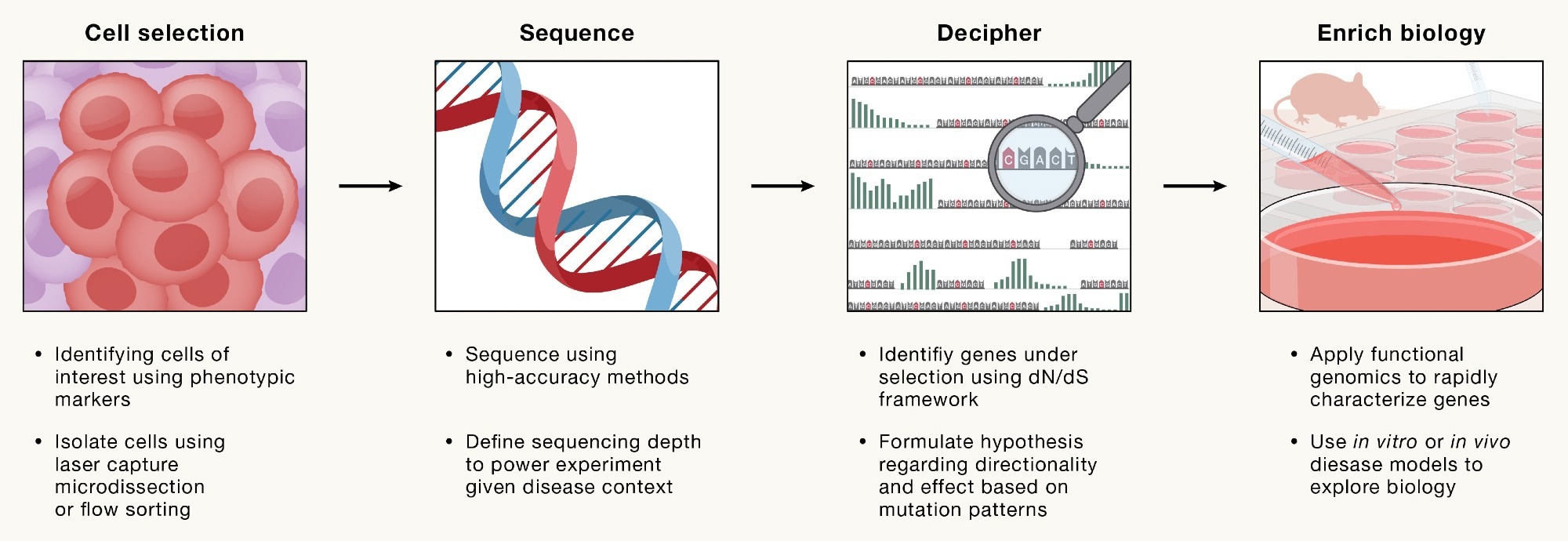
A four-step framework to systematically identify somatic gene targets that impact disease and inform therapeutic strategies
Together, somatic genomics offers a promising strategy for uncovering disease mechanisms and identifying therapeutic targets, though careful experimental validation and interpretation of clone-level versus organism-level effects will be required before clinical translation.
 New PET imaging approach detects nearly all kidney cancer lesions