A controlled blast study found that standard unisex armor reduced peak pressure in both male and female manikins, but larger air gaps around the female torso increased impulse exposure, raising new questions about how well current armor fits and protects different body shapes.
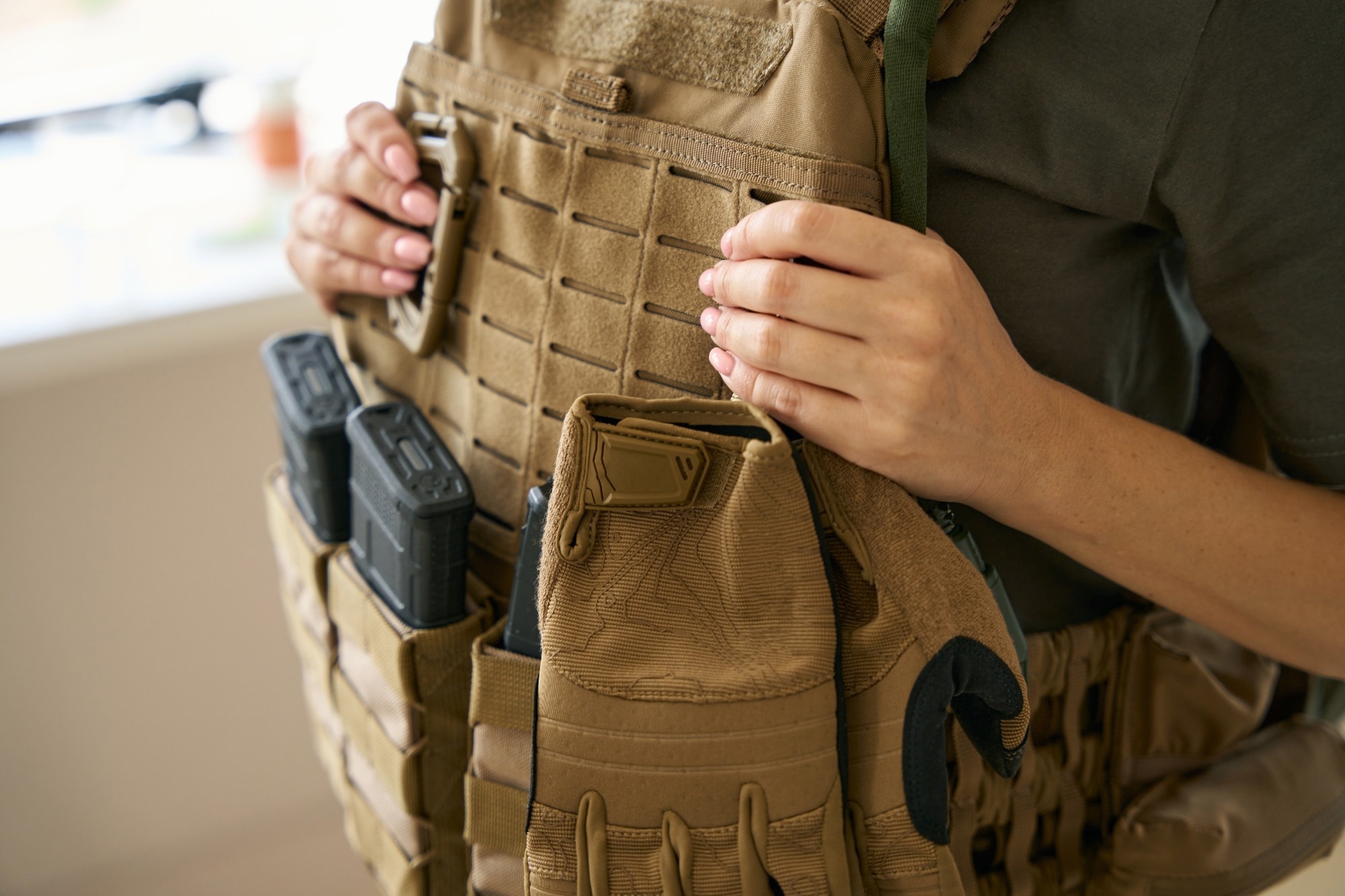
Study: Sex-based effects of shock energy exposure in warfighters. Image Credit: Svitlana Hulko / Shutterstock
In a recent study published in the journal Scientific Reports, researchers investigated the performance of standard body armor under blast conditions in male and female warfighters. While the armor reduced peak pressures for both, notable differences between sexes emerged. The female body shape created larger air gaps between the armor and torso, leading to increased energy entrapment and higher impulse exposure.
These findings raise concerns about how well unisex armor protects against blast exposure across different body shapes under controlled blast conditions, with potential implications for blast exposure and injury risk. Orientation to the blast further influenced outcomes, highlighting potential limitations of current unisex armor designs.
Body armor has long been designed around the male torso, but today, women are increasingly present on the battlefield. Many female warfighters still rely on unisex armor scaled down from male designs, often resulting in poor fit across the bust, waist, and upper torso.
This can reduce coverage, shift during movement, and cause discomfort or breathing difficulty. It can also create air gaps between the armor and body, which may alter pressure transfer during blast exposure.
Together, these issues may reduce protective effectiveness for some female personnel. However, the influence of sex-based anatomical differences on armor fit and performance remains unclear.
Blast Armor Study Design and Air Gap Testing
In the present study, researchers used a controlled experimental setup to examine differences in blast exposure and armor performance between female and male warfighters. They tested anatomically representative female and male manikins fitted with commercially available Small Arms Protective Insert (SAPI) plates. The manikins included realistic features such as silicone skin, rib structures, and, in the female model, breast anatomy. Sensor arrays were placed at key torso locations, including the sternum, nipples, and underbust, to capture pressure changes.
To assess armor fit, the team measured air gaps between the armor and torso using heat-shrinking plastic and gap-filling foam, allowing precise mapping of gap thickness. They then exposed both manikins to controlled blast waves in an open-field setup generated by a Composition C4 charge positioned 2 meters away. To evaluate blast direction, the investigators oriented the manikins at angles ranging from 0° to 180° from the explosion point.
The researchers repeated each condition three times, both in armored and unarmored states. They recorded pressure data using a data acquisition system. High-speed videography using background-oriented schlieren (BOS) techniques captured shock-wave behavior and interactions with the protective plates.
The team analyzed pressure waveforms, impulse, and energy distribution across different body regions. They also examined the role of air gaps, armor fit, and body shape in influencing pressure transmission and energy entrapment during blast exposure.
Sex Differences in Blast Pressure and Impulse
The study revealed clear sex-based differences in how body armor influences blast exposure. While armor reduced peak pressures for both manikins, it increased impulse, particularly in the female manikin tested here. In the female manikin, total impulse rose by up to 79% compared with no armor, with the underbust region showing consistently higher impulses, while findings in the bust region were more mixed. These effects were linked to larger air gaps, which reached up to 2.97 cm in females versus 1.59 cm in males, allowing energy to become trapped and prolonging pressure exposure.
Blast orientation also played a key role. Head-on (0°) exposure produced the highest peak pressures (111 kPa in males and 108 kPa in females) and impulses, with average impulse values up to 73% higher than at oblique angles. Despite similar peak pressures between sexes, females consistently experienced greater impulse due to differences in armor fit and body shape. In contrast, males showed higher peak pressures in some regions, likely due to closer armor contact.
High-speed imaging further demonstrated that shock waves reflected and diffracted around armor edges, creating complex energy patterns. In females, breast anatomy altered plate positioning, increasing its angle by 3.1° and contributing to larger air gaps and prolonged energy entrapment. These dynamics led to multiple pressure peaks and extended exposure duration. Together, the findings suggest that while current armor reduces peak pressure, poor fit in female warfighters may increase overall energy transfer and could contribute to higher blast-related injury risk.
Inclusive Body Armor Design Implications
The study highlights important sex-based differences in blast protection, showing that unisex body armor may not provide the same pressure and impulse distribution for different female and male torso shapes. The findings underscore the need for more inclusive design strategies. Armor designers and manufacturers should move beyond scaled male models to develop fit-specific solutions that account for female anatomy, potentially lowering peak pressure levels and overall energy transfer.
Moving forward, testing strategies should incorporate diverse body shapes and realistic fit conditions to better capture variation in protection. However, the results are based on a single male and female model, limiting generalizability. Future research should include a wider range of body types, including variations in breast size, to better understand the impact of anatomical differences on armor performance. This could support the development of more effective, tailored protective systems.
 What happens to body fat when people follow the Eatwell Guide?