A new review shows fish can help bridge nutrition and sustainability goals, but only when consumers choose lower-impact species and use seafood to displace more environmentally intensive meats.
Review: Environmental burden of fish in healthy and sustainable diets. Image Credit: Sergey Zaykov / Shutterstock
In a recent narrative review published in the International Journal of Food Sciences and Nutrition, a group of authors examined how fish contributes to healthy, environmentally sustainable diets and evaluated its environmental footprint relative to other animal-based foods.
Background
Did you know that food systems account for nearly one-third of global greenhouse gas emissions while consuming vast amounts of land and freshwater?
As global concern has grown regarding climate change, biodiversity loss, and food security, an increasing emphasis has been placed on producing foods that are good for both humans and the environment.
Fish consumption has been associated with benefits for cardiovascular health, neurocognitive outcomes, and overall mortality. However, there remains uncertainty about whether the increase in fish consumption is an environmentally sustainable practice.
To develop better dietary guidance, further research is needed to understand and quantify the relationships between the nutritional benefits and ecological impacts of different species and fishing methods. Because this was a narrative, non-systematic review, the findings provide a broad synthesis rather than pooled estimates from a formal systematic review or meta-analysis.
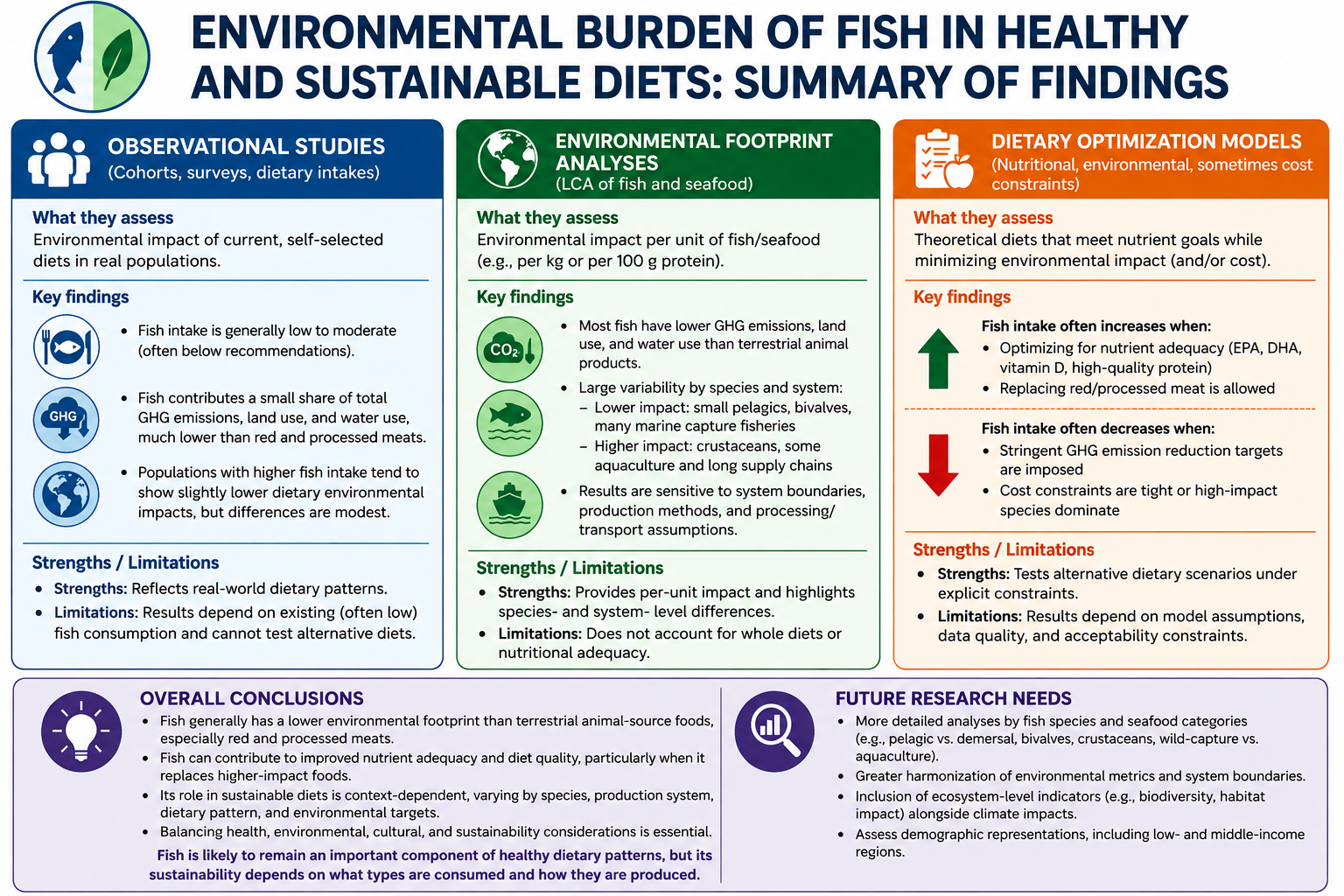
This infographic titled 'Environmental Burden of Fish in Healthy and Sustainable Diets' includes three main panels: Observational Studies assess the environmental impact of fish intake, noting generally low impacts; Environmental Footprint Analyses explain that most fish have lower emissions than terrestrial meats, while variability exists by species; Dietary Optimization Models focus on how fish intake can vary based on dietary goals and constraints. The bottom section summarizes overall conclusions and future research needs, emphasizing the balance of health, environmental, and sustainability factors in fish consumption.
Fish and sustainability: A complex relationship
Fish occupy a unique position in discussions about sustainable diets. Unlike many animal-based foods, particularly red and processed meats, fish often provides substantial nutritional benefits while generating a comparatively smaller environmental footprint. However, the level of environmental impact depends on the type of fish, fishing methods, aquaculture practices, transportation requirements, and supply chains.
Environmental impact of fish in current diets
Evidence from multiple countries indicates that fish generally contributes a relatively small proportion of total dietary environmental impacts compared with meat.
Studies found that, in typical diets of people from the United Kingdom, Netherlands, France, Spain, Italy, Canada, Japan, Portugal, Lebanon, and the United States, fish generally contributes a relatively small share of dietary greenhouse gas emissions compared with meat, although this varies by country, seafood type, and dietary pattern.
Research involving more than 65,000 adults in the United Kingdom showed that adults who ate fish instead of meat had much lower greenhouse gas emissions than those who ate meat. Individuals following healthier and more sustainable eating patterns generally consume more fish while maintaining lower overall environmental impacts.
Studies have also shown that increased fish consumption can lead to greater greenhouse gas emissions, particularly when certain species are consumed in large quantities.
Fish and seafood can have different environmental impacts, with small pelagic fish and mollusks generally having lower environmental burdens. In contrast, crustaceans and some aquaculture systems can be more carbon-intensive.
Fish in optimized, healthy and sustainable diets
Many researchers have used dietary modeling techniques to identify eating patterns that satisfy nutritional requirements while minimizing environmental impacts.
Various research shows that increased fish consumption occurs when optimizing diets for sufficient nutrition.
The reason for the increase in fish compared to other commonly eaten foods is that it can be challenging to get specific nutrients, particularly long-chain omega-3 fatty acids such as EPA and DHA, from those other foods.
In many European countries, replacing some meat with fish has led to measurable decreases in greenhouse gas emissions and land use, with potential health benefits.
Researchers found that fish often replaced environmentally intensive meats (such as beef and processed meats) rather than being added to the growing number of animal-based foods. Therefore, fish are allowed to maintain the same level of nutritional quality while meeting environmental goals.
As part of some optimally designed diets, consumers were encouraged to eat more oily fish for its higher nutrient density and potential health benefits.
When more fish is not always better
While fish is commonly included in many sustainable diet options, simply increasing fish consumption does not automatically guarantee environmental benefits. Some dietary models with stringent greenhouse gas reduction targets required lower fish intake or shifts toward lower-impact seafood species, alongside reductions in meat and other high-impact foods.
When working to meet more aggressive targets (33% to 50%) for reducing emissions in dietary models, fish consumption sometimes declined because some types of seafood still produced high carbon emissions.
Fish consumption levels often need to increase more for women than for men to meet their nutritional requirements; however, some models found that men could achieve their environmental goals without significantly changing their seafood intake. These disparities are due to differences in baseline dietary habits and the amounts of nutrients required.
The results indicate that no one-size-fits-all approach to creating a sustainable diet is appropriate. To develop successful strategies for a sustainable diet planning program, it is necessary to take into account local food culture, nutritional needs, environmental objectives, and the availability of seafood in the area.
Implications for public health and food policy
The review highlights important implications for policymakers, healthcare professionals, and consumers. For consumers, the findings reinforce the value of replacing portions of red and processed meat with carefully selected fish species. Such substitutions can improve diet quality while reducing environmental impacts. However, informed choices remain essential, as environmental performance varies considerably across seafood products.
Food systems can also expand access to sustainably caught seafood and improve aquaculture practices that support healthy diet transitions. Investments made in responsible fisheries management and practices that reduce environmental impacts will help strengthen the position of fish in sustainable food systems.
Conclusion
The evidence indicates that fish can contribute meaningfully to healthy and sustainable diets when consumed as part of broader dietary shifts away from environmentally intensive animal products.
Compared with meat, fish generally produce lower greenhouse gas emissions and require fewer natural resources, although environmental impacts vary considerably among species and production systems.
Modeling studies frequently show increased fish consumption in nutritionally optimized diets, particularly when fish replaces red and processed meat.
Overall, fish apappearompatible with achieving both nutritional adequacy and sustainability goals when sourced and consumed responsibly, but ittheirustainability depends on which species are chosen, how they are produced, and what foods they replace.
Disclosure
The authors reported that the study was supported by Bolton Food S.P.A.; one author was an employee of the company, while the authors stated that the funder had no role in the study design, analysis, interpretation, or writing.
Download your PDF copy by clicking here.
Journal reference:
- Dolci, A., Scuderi, A., Frias-Toral, E., Hernández, L., Di Mauro, A., Furnari, F., Rosi, A., Scazzina, F., & Grosso, G. (2026). Environmental burden of fish in healthy and sustainable diets. International Journal of Food Sciences and Nutrition. (1–25). DOI: 10.1080/09637486.2026.2658821 https://www.tandfonline.com/doi/full/10.1080/09637486.2026.2658821#abstract
 Can maternal diet prevent infant food allergy? A large trial puts eggs and peanuts to the test