From stocking supplies to assisting with instrument handling, humanoid robots may eventually support surgical teams, but safety evidence and staged clinical testing must come first.
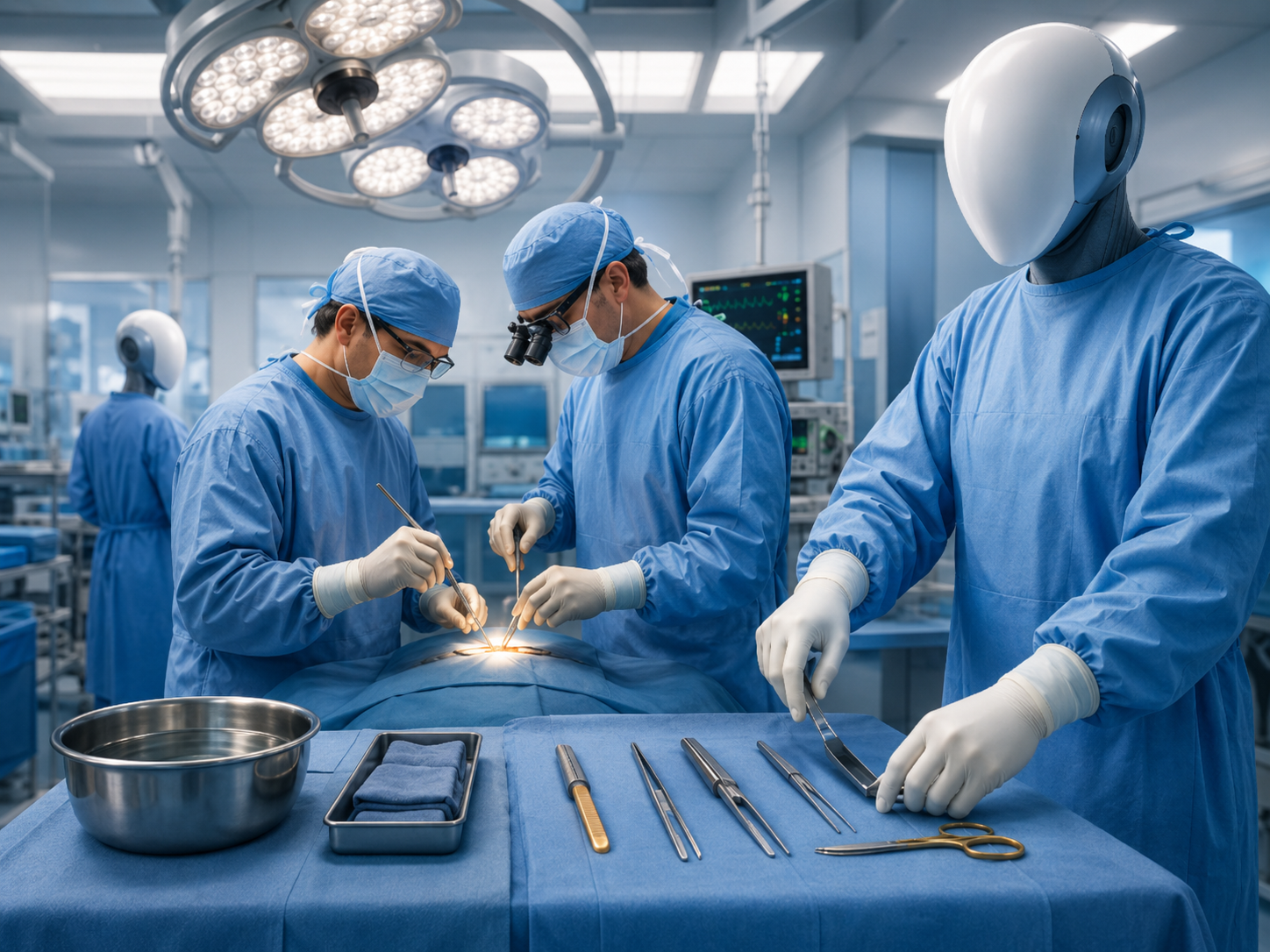
Perspective: Humanoid robots in the operating room: a framework for staged integration of embodied AI in surgery. Image credit: AI-generated image created using ChatGPT/OpenAI
A recent perspective published in the journal npj Digital Medicine discusses the potential integration and staged deployment of humanoid robots and embodied artificial intelligence (AI) to support and enhance surgical workflows in operating rooms (ORs).
The proposed framework could provide a pathway toward greater embodied AI autonomy within surgical environments, although evidence of safety, clinical benefit, or improved surgical outcomes remains lacking.
These humanoid systems could assist surgical teams by handling supplies, managing equipment, supporting sterile conditions, and helping prepare and reset operating rooms based on visual or verbal instructions. Humanoids may extend human expertise rather than replace it. However, their adoption requires phased deployment, validation, and regulatory and ethical oversight before routine use in real-world surgical practice becomes feasible.
Rather than simply improving surgeons' precision, future advances in surgery may involve embodied AI actively supporting operating room workflows. Unlike conventional precision-oriented surgical robots, intelligent humanoids with features such as bipedal mobility and bimanual dexterity could eventually enter ORs as general-purpose support systems, initially performing teleoperated or closely supervised, low-risk functions.
Although the true costs of reliable clinical deployment remain uncertain, humanoid development has attracted major industry investment, accelerating progress toward increasingly capable general-purpose systems.
A phased deployment pathway could begin with laboratory testing before progressing to low-risk perioperative tasks. These robots may progressively take on elevated-risk assistive roles while interacting with surgical instruments and machine interfaces in real-world ORs to improve workflow efficiency, reduce interruptions, and help alleviate staffing pressures.
In this perspective, researchers highlight the potential roles of humanoids in optimizing perioperative environments. They also discuss technical challenges, safety, and regulatory and ethical considerations for embodied AI as surgical teammates.
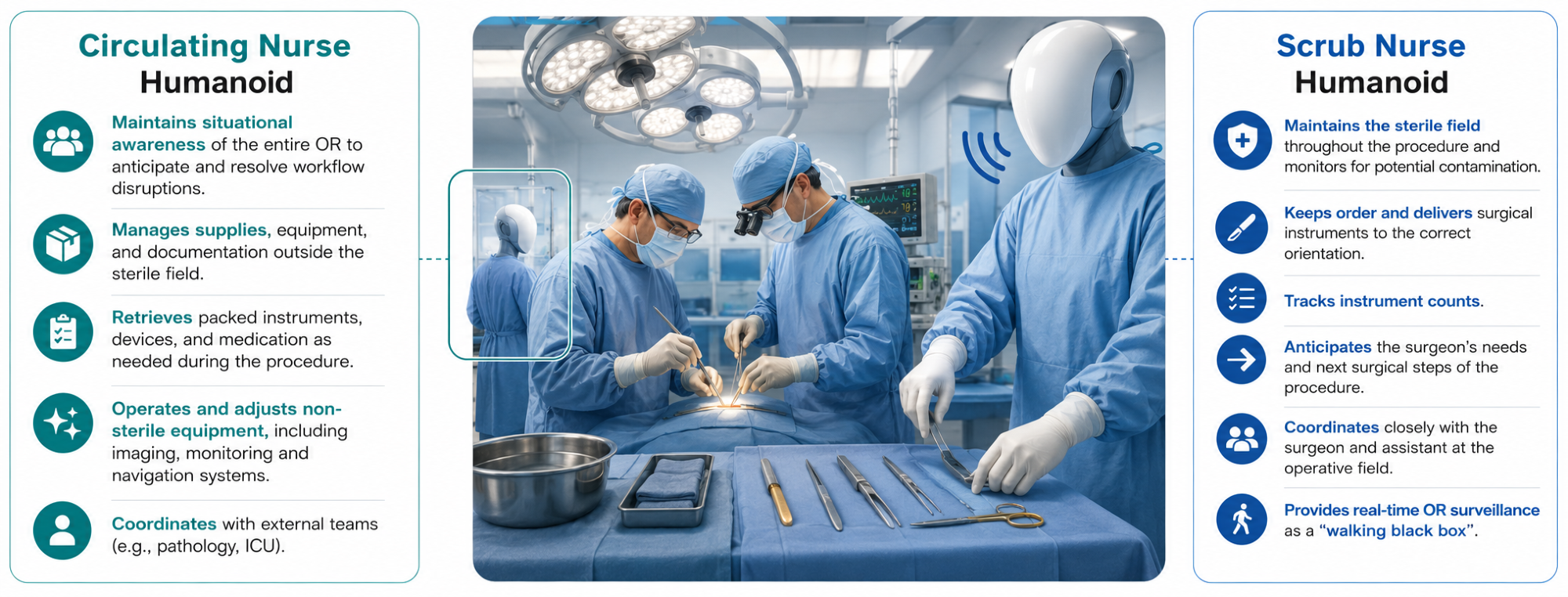
Humanoids as Embodied AI Teammates in the OR. This conceptual illustration depicts two humanoid agents supporting the surgical team, serving as circulating nurses (left) and scrub nurses (right). The humanoid circulating nurse maintains situational awareness of the entire OR, manages supplies and equipment, operates non-sterile devices, and coordinates with external teams. The humanoid scrub nurse maintains the sterile field, prepares and delivers instruments in the correct orientation, monitors for contamination, and anticipates procedural steps in real time. Both agents are envisioned as generalist embodied systems capable of navigating human-designed environments, interacting with existing surgical infrastructure, responding to verbal or nonverbal cues, and providing speech-based confirmation. With embodied AI, humanoid agents can combine bimanual dexterity, vision-language reasoning, and real-time perception to execute physically demanding and repetitive tasks. Image redrawn from Figure 1 in Kernbach, J.M., Brat, G., Topol, E.J. et al. (2026). Humanoid robots in the operating room: a framework for staged integration of embodied AI in surgery. npj Digital Medicine, article in press. DOI: 10.1038/s41746-026-02853-6 using ChatGPT / Open AI
Potential Roles and Staged Integration of Humanoids in Operating Rooms
Humanoids might eventually be integrated into existing surgical environments, such as ORs, without requiring major infrastructural changes. Their integration into surgical workflows may improve operative efficiency while allowing healthcare teams to devote more attention to direct patient care. These robotic agents could manage inventory and perform environmental tasks, helping reduce workflow delays. Assisting with instrument delivery, environmental monitoring, and logistics could reduce staff workload.
However, humanoid deployment in the OR should follow the stages of clinical development. Robots should first undergo preclinical validation and simulated testing before progressing to low-risk and later elevated-risk assistive clinical roles. For instance, these robotic agents may initially be deployed for cleaning and environmental services, followed by selected tasks traditionally undertaken by scrub and circulating nurses, including instrument handling. Direct high-risk surgical maneuvers would remain outside the proposed early deployment framework.
A staged deployment would evaluate core competencies, such as perception, grasping, and handoffs, through virtual simulations before clinical integration. Studies should separately assess instruction accuracy and successful task execution under human oversight. Humanoids would also need to meet regulatory requirements at each stage before progressing to more consequential roles.
Addressing Technical Challenges and Safety Concerns
Humanoids face issues like balance loss, hardware malfunctions, and environmental stressors in the OR. Fail-safe protocols, robust hardware, and rigorous validation are essential for reliable fault-tolerant operation.
Fine-tuning with cross-task robotic data could, in theory, enable these robots to perform complex, domain-specific tasks, although such capabilities have not been clinically evaluated. Designed to move and interact like humans, these robots could use existing operating room interfaces, including touchscreens and drawers, without requiring changes to current hardware. However, stable wheeled or task-specific platforms may initially be safer and more cost-effective for clearly defined roles.
Current surgical robotics primarily focuses on precision, while systems capable of performing complete operations with minimal human oversight remain at an early stage. Autonomous levels must be carefully controlled with oversight, traceability, and clear accountability.
Achieving rapid, context-aware decision-making in high-stakes environments exceeds current technological capabilities, particularly during unexpected surgical events that require swift judgment and coordinated team responses.
Advances in perception, manipulation, force feedback, and multimodal learning could enable humanoids to adapt to complex surgical environments. These robotic assistants could handle routine inventory tasks, from checking stock to retrieving and replenishing supplies, allowing procedures to continue with fewer interruptions and less unnecessary traffic in the operating room.
Continuous intraoperative data capture raises privacy, governance, and safety concerns. Informed consent should ensure that patients understand how humanoid robots will assist during surgery, the extent of their autonomous functions, and any potential implications for patient safety.
The effectiveness of humanoid-based operating room surveillance has yet to be established through clinical studies. Humanoids must be safeguarded against stressors such as electromagnetic interference, fluid exposure, and communication instability. Progression toward intraoperative roles requires rigorous testing and safety validation under controlled governance, followed by regulatory approval for use in real-world surgical contexts.
Conclusions
The authors suggest that humanoids could become valuable surgical teammates for perioperative tasks, including selected responsibilities traditionally performed by scrub and circulating nurses. Direct surgical-assistant functions remain a substantially more speculative and higher-risk possibility.
These robotic agents may allow clinicians to focus on decision-making and oversight, which remain primarily human responsibilities. Clinical staff could oversee humanoid agents remotely or on-site, enhancing safety and efficiency.
The emergence of humanoid robots could reshape the role of AI in operating rooms by combining physical assistance with adaptive intelligence. Whether the most suitable robotic form will ultimately be humanoid remains uncertain, and further studies should aim to overcome integration challenges such as non-verbal communication, team dynamics, and accountability to enable safe integration into surgical environments.
Surgical teams will require training to work with and supervise humanoids as their responsibilities become more complex.
Journal reference:
- Kernbach, J.M., Brat, G., Topol, E.J. et al. (2026). Humanoid robots in the operating room: a framework for staged integration of embodied AI in surgery. npj Digital Medicine, article in press. DOI: 10.1038/s41746-026-02853-6, https://www.nature.com/articles/s41746-026-02853-6
 New artificial intelligence model detects tissue damage in the heart