A global genomic analysis and field sampling in China suggest that the riskiest points for drug-resistant Salmonella may emerge after pigs leave the farm.
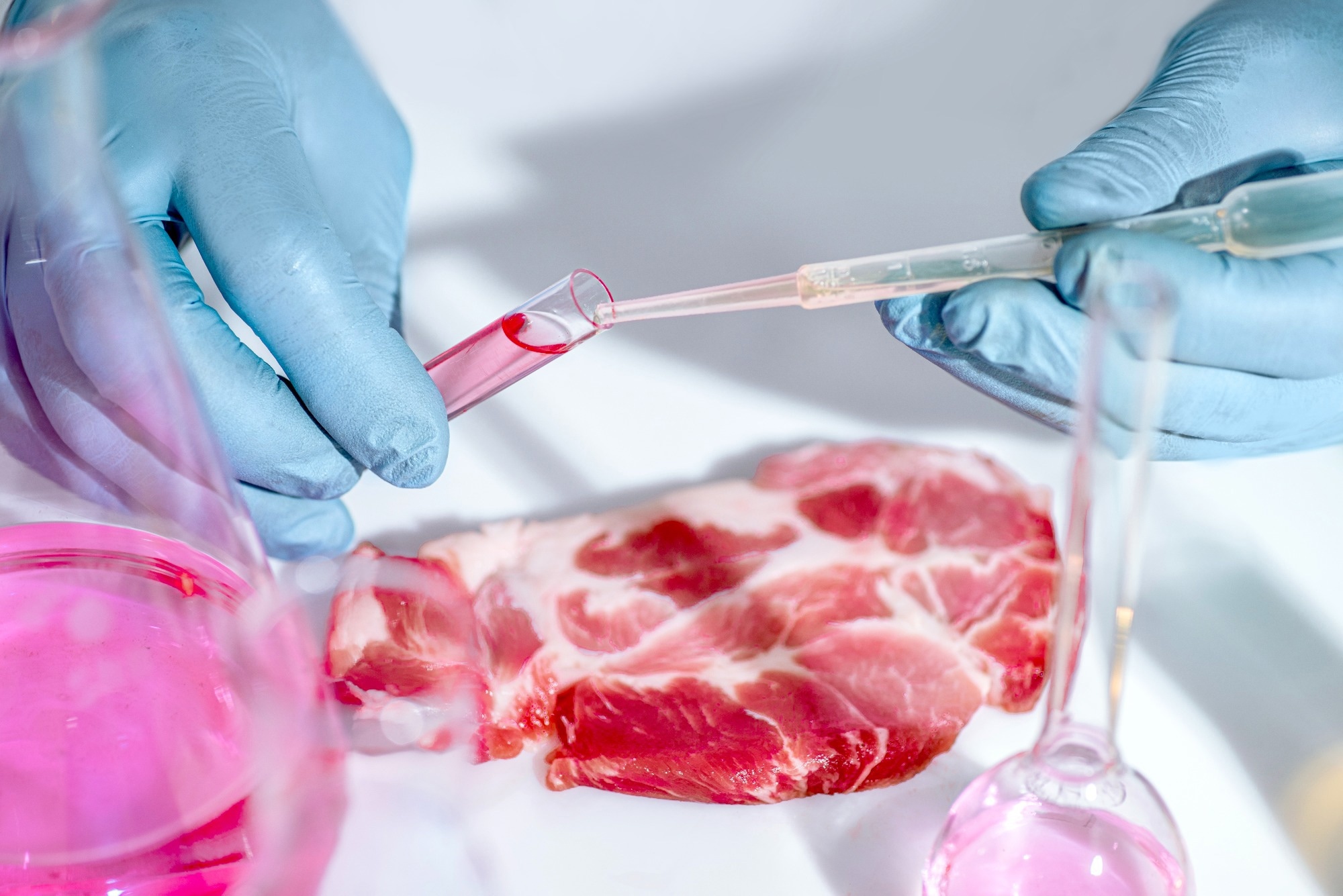
Study: Developing countries’ downstream pork supply chains shape the evolution of resistance and the spread of Salmonella 4,[5],12:i:- ST34. Image Credit: TSViPhoto / Shutterstock
In a recent study published online as an unedited 'Article in Press' in the journal npj Science of Food, researchers investigated the association between pork supply chains and the evolution of antimicrobial resistance in Salmonella enterica. The study integrated global genomic datasets (both human and swine; n = 129,136) with prospective field sampling collected along an integrated pork supply chain in Guangdong, China (n = 1,114), to assess whether specific supply-chain stages were associated with Salmonella contamination and enrichment of resistance genes.
Study findings identified S. enterica serovar 4,[5],12:i:- ST34 as a prominent human- and swine-associated lineage with a high resistance-gene burden, rather than the most prevalent serovar overall. Furthermore, the study suggested that downstream slaughterhouse and retail stages, particularly in developing-country pork systems, as illustrated by the Guangdong supply chain, are potential hotspots for higher Salmonella recovery and enrichment of resistant lineages.
These findings underscore the need to expand One Health interventions beyond farm-level management and emphasize the importance of increased pathogen monitoring and context-specific mitigation measures across pork supply chains.
Background
Salmonella enterica is one of the most prevalent foodborne pathogens affecting humans worldwide. Public health records estimate that the pathogen causes 108.1 million human illnesses and 291,000 deaths annually, and indicate that pork supply chains provide important potential transmission interfaces between swine reservoirs and consumers.
A decade of research on the epidemiology of S. enterica has identified the monophasic variant S. 4,[5],12:i:-, sequence type 34 (ST34), as a major multidrug-resistant threat globally, but has not fully resolved the factors shaping the pathogen’s prevalence, dissemination, and resistance ecology across pork supply chains.
Given the close association between pork supply chains and human disease outbreaks, researchers hypothesized that the processing and distribution of swine meat, especially in developing countries, may address this knowledge gap and influence the persistence and spread of multidrug-resistant S. 4,[5],12:i:- ST34.
Unfortunately, complete-chain genomic data from developing-country settings remained limited, preventing researchers from resolving whether downstream supply-chain interfaces may be associated with resistance-gene accumulation and the global spread of S. 4,[5],12:i:- ST34.
About the Study
The present study aimed to address these gaps by linking global genomic Salmonella dissemination patterns with data on local supply-chain contamination dynamics.
The study’s methodological framework combined an initial collection of 591,687 publicly available genomes, from which 114,042 human- and 15,094 swine-derived Salmonella sequences were retained across 83 countries, and a prospective field collection of 1,114 swine, pork, and environmental samples gathered across farms, slaughterhouses, and retail markets in Guangdong, China, n = 368 isolates.
The study’s analyses primarily used whole-genome sequencing (WGS) to characterize isolates and core-genome multilocus sequence typing (cgMLST) to compare genomic relatedness, supplemented with phylodynamic dating and Bayesian stochastic search variable selection (BSSVS).
Statistical analyses used generalized linear models (GLMs) to evaluate genomic and country-level predictors associated with inferred ST34 movement, and pangenome-based machine learning (ML) classifiers, specifically Random Forest, coupled with SHapley Additive exPlanations (SHAP), a game-theoretic interpretation approach, to identify host-associated genomic features.
Study Findings
The study’s evaluation of both human and swine genomic datasets identified S. 4,[5],12:i:- as one of the most common Salmonella serovars, ranking third in both global datasets. The serovar was also found to demonstrate the heaviest combined resistance-gene burden among leading serovars, averaging 7.0 antimicrobial resistance genes (ARGs) and 23.2–24.2 metal resistance genes (MRGs) per genome.
Notably, comparisons between data derived from developed countries and their developing counterparts revealed that the latter consistently exhibited elevated ARG loads compared with the former across all included serovars in both human (6.0 versus 2.1) and swine (7.8 versus 2.6) sources, P < 0.001.
Field sampling in Guangdong supported this pattern and showed a marked downstream contamination gradient. Evaluations of prospective sampling data revealed that Salmonella isolation rates rose from farms (4.52%) to slaughterhouses (48.22%) and were highest in retail markets (63.16%).
The field data also showed that multidrug resistance (MDR) was most prevalent among slaughterhouse isolates (84.73%), whereas extensive drug resistance (XDR) was highest among retail market isolates (30.55%). Genomic analyses identified S. 4,[5],12:i:- ST34 as the dominant serovar and lineage in the Guangdong collection, associated with IncHI2 plasmids and structured ARG and MRG modules.
Phylodynamic reconstruction estimated the most recent common ancestor of ST34 to around 1990, with a 95% highest posterior density interval of 1986–1996, inferring an initial intercontinental expansion from European-associated routes followed by secondary dissemination from East Asia to Southeast Asia and Oceania.
Finally, the Random Forest machine-learning model accurately discriminated swine-derived from human-derived ST34 genomes, with a test-set area under the receiver operating characteristic curve of 0.9402, and further identified genes such as qorB as model-informative, swine-associated features rather than deterministic host markers. These interpretations should be tempered by differences in sample types and sampling intensity across stages, and the public-genome findings are also subject to geographic, temporal, source, and submission biases and should not be interpreted as population-level prevalence estimates.
Conclusions
The present study indicates that downstream slaughterhouse and retail interfaces in developing countries may be critical yet often overlooked nodes. These nodes may serve as interfaces where Salmonella contamination, mobile resistance elements, and human exposure converge. However, the single Guangdong supply chain should be considered illustrative rather than representative of all developing-country settings.
The authors concluded that farm-level biosecurity alone may be insufficient to mitigate foodborne risks. Instead, mitigation requires integrated One Health strategies that prioritize slaughterhouse sanitation, improvements to cold-chain infrastructure, retail market surveillance, and risk-based genomic surveillance.
Journal reference:
- Peng, J., Peng, Z., Hong, Q., Xu, Z., Wu, C., Chen, J., Wu, Y., Xiao, R., Lin, Q., Chen, K., Li, J., Xu, C., Liao, M., & Zhang, J. (2026). Developing countries’ downstream pork supply chains shape the evolution of resistance and the spread of Salmonella 4,[5],12:I:- ST34. Npj Science of Food. DOI: 10.1038/s41538-026-01030-z, https://www.nature.com/articles/s41538-026-01030-z
 Stanford scientists develop an ultracompact gene activation tool