A new framework traces the complex biological pathways linking food to brain health and asks why the same dietary pattern may not work equally for everyone.
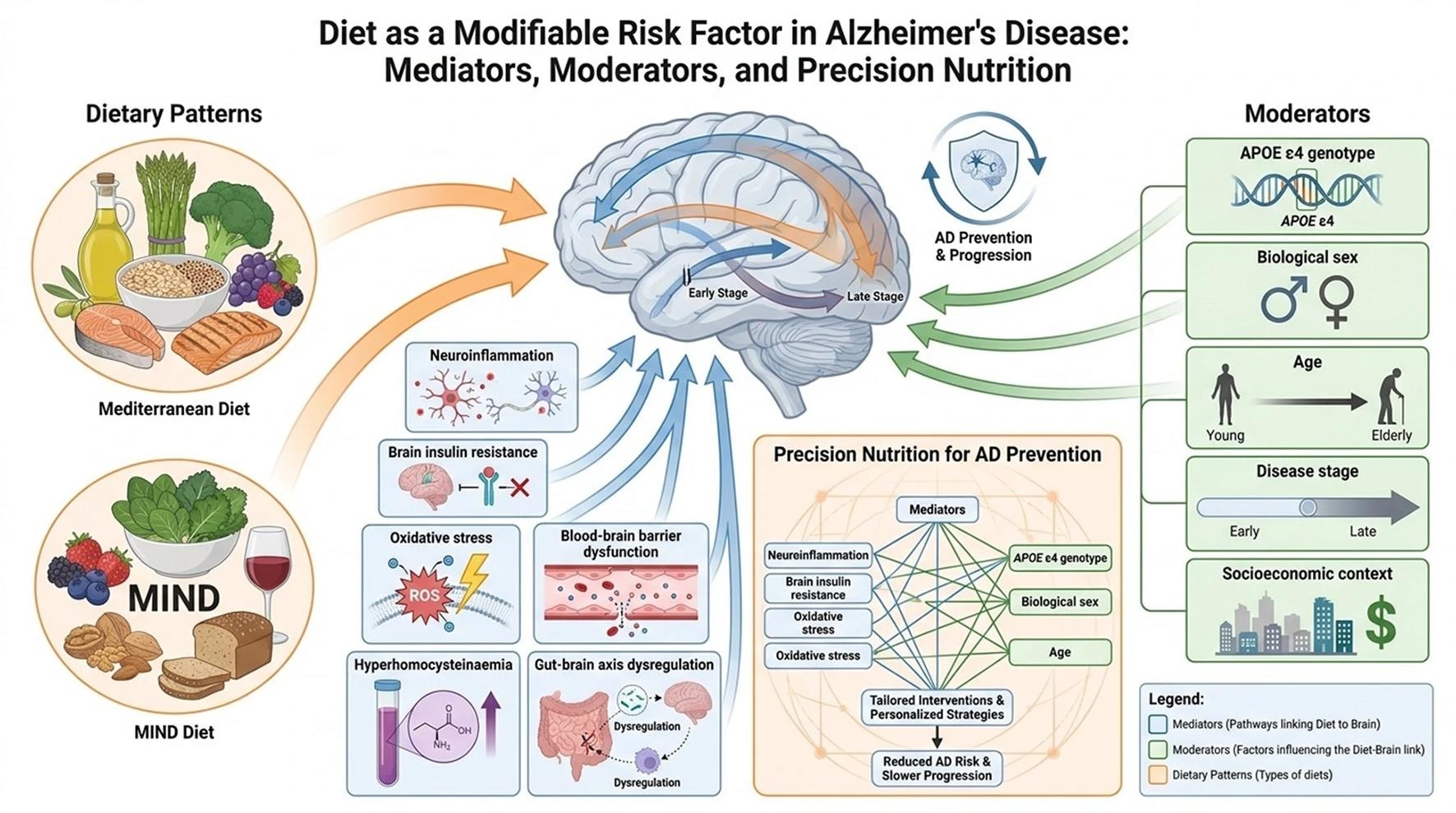
Diet as a modifiable risk factor for Alzheimer's disease. The effects of dietary patterns on AD risk and progression may operate through biological mediators, including neuroinflammation, insulin resistance, oxidative stress, blood-brain barrier dysfunction, hyperhomocysteinemia, gut-brain axis dysregulation, and amyloid-β pathology, while being modified by factors such as APOE ε4 genotype, sex, age, disease stage, and socioeconomic context. Understanding these mediators and moderators may inform precision nutrition strategies for AD prevention and management.
In a recent mini-review published in the journal Frontiers in Nutrition, researchers at Bond University, Australia, synthesized empirical evidence investigating how dietary patterns influence the risk and progression of Alzheimer’s disease (AD). The review focused primarily on biological mediators and individual and contextual moderators and subsequently formalized a novel conceptual framework to serve as the foundation for a planned meta-analysis and precision nutrition strategies aimed at reducing the global AD burden.
The findings suggest that by integrating data on mediators (the biological mechanisms connecting diet to neurodegeneration) and moderators (individual and contextual factors that alter the strength or direction of these associations), researchers may be better able to move beyond crude diet-disease correlations and elucidate why some dietary interventions may benefit specific subpopulations more than others.
Background
Dementia is a major global cause of disability and dependency, particularly among older adults, with 2021 reports estimating that approximately 50 million individuals (65 and older) live with the condition. Alzheimer’s disease (AD) is the most prevalent form of dementia, accounting for roughly two-thirds of dementia diagnoses among adults aged 65 and older. Genetic factors are estimated to account for 60% to 80% of AD risk.
However, concurrent neurobiological research suggests that an estimated 40% of dementia could be prevented by addressing potentially modifiable risk factors, including hypertension, obesity, diabetes, smoking, depression, social isolation, and physical inactivity. Observational meta-analyses have already consistently linked high Mediterranean (MedDiet) adherence to lower risks of cognitive impairment, dementia, and AD, including an estimated 11% lower dementia risk and 30% lower AD risk in one analysis, highlighting the potential role of dietary patterns in supporting cognitive health and reducing dementia risk.
Unfortunately, data from randomized controlled trials remain discordant, as demonstrated by the 3-year MIND trial, which found no significant cognitive advantage of the MIND diet compared with a calorie-matched control diet. Furthermore, previous reviews in the field underscore that nutritional research has historically treated the diet-AD relationship as a direct association, yet has often failed to formally account for the spectrum of biological mediators and personal factors that concurrently shape clinical responses.
About the review
The present review aimed to address these persistent empirical ambiguities and inform future precision dementia interventions by developing and formalizing a novel integrated mediator-moderator framework.
The study reviewed evidence across six key biological mediating pathways: 1. Neuroinflammation, 2. Brain insulin resistance, 3. Oxidative stress and advanced glycation end-products (AGEs), 4. Blood-brain barrier (BBB) integrity and cerebrovascular health, 5. Hyperhomocysteinemia, and 6. Gut-brain axis communication.
The authors also examined major moderating variables that may influence individual susceptibility, including: 1. Apolipoprotein E (APOE) ε4 genotype, 2. Biological sex and menopausal endocrine shifts, 3. Age and disease stage, 4. Physical activity levels, 5. Socioeconomic context and food security, and 6. Race and ethnicity.
Review findings
Evidence summarized in the paper indicates that components characteristic of Western dietary patterns, particularly saturated fats, can activate toll-like receptor 4 (TLR4) signaling, which in turn drives the release of pro-inflammatory cytokines (TNF-α, IL-1β, IL-6) that can compromise BBB tight junctions and activate microglia.
The authors also described how chronic hyperinsulinemia may divert insulin-degrading enzyme toward insulin metabolism, reducing its availability for amyloid-β clearance, while insulin resistance can activate pathways that promote tau hyperphosphorylation and contribute to AD-related pathology.
Conversely, the paper describes evidence that dietary polyphenols can activate Nrf2 antioxidant cascades, while plant-based, high-fiber diets may enrich beneficial SCFA-producing gut taxa. SCFAs such as butyrate may exert neuroprotective effects, including through histone deacetylase inhibition.
Central to the authors’ framework is the proposal that these biological pathways may themselves be shaped by moderating factors. For example, preclinical evidence suggests that APOE ε4 may heighten neuroinflammatory vulnerability to Western diets, while human studies indicate that dietary responses can differ between APOE ε4 carriers and non-carriers. Lipidomic studies have also identified cholesteryl esters and sphingomyelins as metabolites strongly associated with an increased risk of dementia among APOE ε4 homozygotes, although the broader evidence on APOE-diet interactions remains mixed.
Biological sex represents another vital modifier: The authors highlighted evidence of greater neurobiological vulnerability among women during the menopausal bioenergetic transition. Observational cohorts like REGARDS, in contrast, demonstrated stronger associations between MIND diet adherence and favorable cognitive outcomes in women than in men.
Furthermore, physical activity may complement dietary interventions, while exercise independently upregulates hippocampal BDNF via muscle-derived myokines (cathepsin B, irisin). Socioeconomic context may also modify diet-cognition associations: in Italian cohorts, greater adherence to the Mediterranean diet was associated with reduced cognitive decline among higher-SES participants, whereas no corresponding association was observed in lower-SES groups.
Conclusions
The present mini-review highlights that diet may influence AD pathogenesis through biological mediators that are strongly modified by genetic, sex-related, temporal, and socioeconomic moderators. It concludes that treating diet as a uniform exposure limits the availability of actionable clinical guidance.
The authors note several methodological limitations in the extant literature, including reliance on self-reported food frequency questionnaires, short trial durations (12–24 months) relative to the decades-long course of AD pathogenesis, and underrepresentation of low- and middle-income regions. They also highlight substantial heterogeneity and risk of bias across existing meta-analyses, complicating efforts to estimate the true magnitude of diet-related effects.
Overall, the authors state that current evidence supports Mediterranean, MIND, and DASH dietary patterns for neuroprotection, while ketogenic and microbiome-based approaches remain promising but undertested.
Moving forward, the authors recommend that future research employ individual participant data meta-analyses with prespecified moderator analyses and two-step Mendelian randomization to advance individualized precision nutrition recommendations.
 Overall dietary patterns matter more for heart health than nutrients