A study of hundreds of thousands of UK adults traces connections between inherited susceptibility, smoking, body fat, mental health, socioeconomic conditions, inflammatory proteins, and subtle changes in heart structure and function.
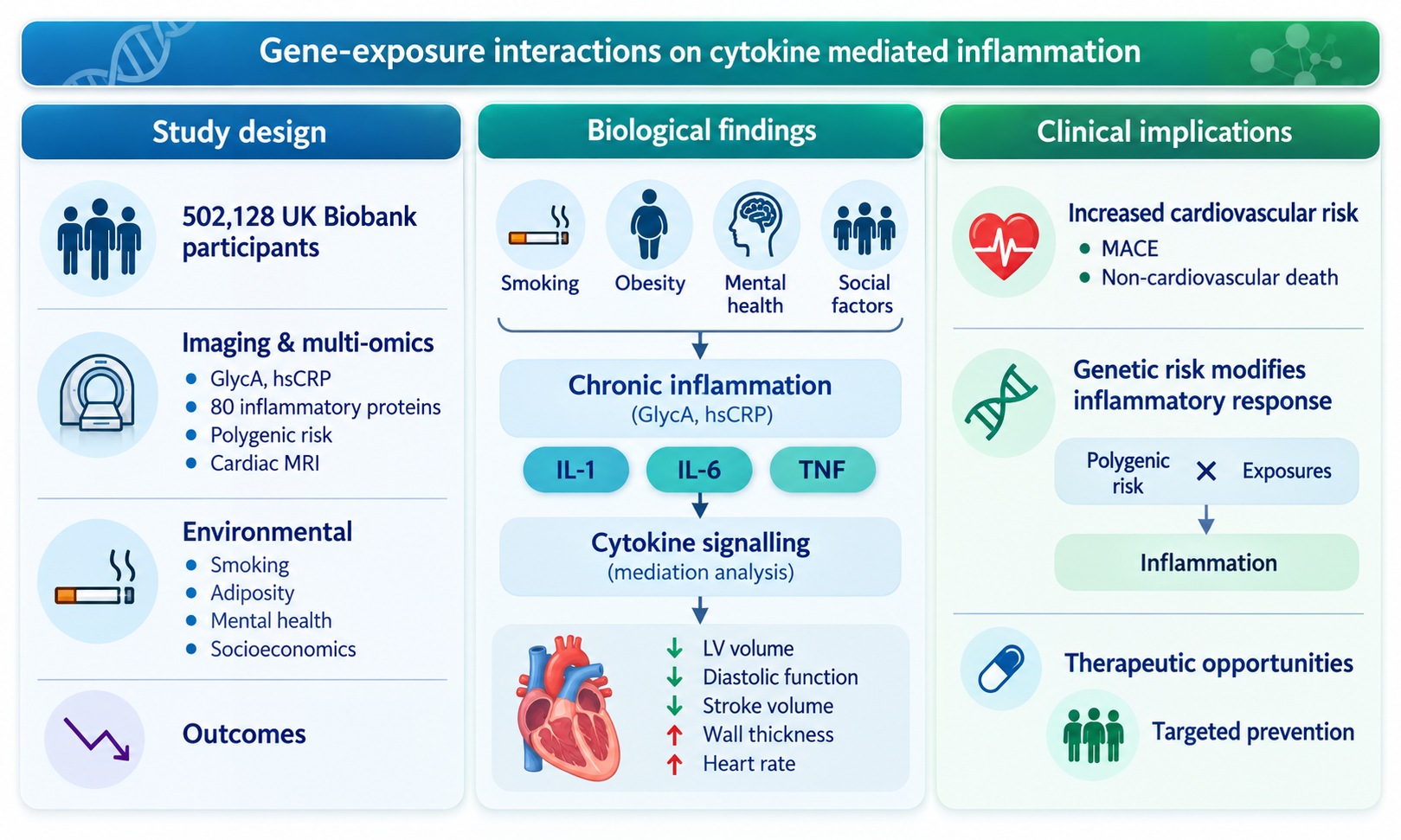
Study: Gene–environment interactions shape cytokine-mediated inflammation and cardiovascular risk
Genetic susceptibility may modify the association between environmental exposures and systemic inflammation and cardiovascular risk, according to a new study published in the European Journal of Preventive Cardiology.
Background
Chronic low-grade inflammation is a major hallmark of cardiovascular disease. Chronic inflammation has been associated with harmful changes in the heart structure and function, which are linked to an increased risk of heart attack and stroke even in individuals without clinically diagnosed cardiovascular disease.
Genetic and environmental risk factors are strongly associated with chronic systemic inflammation. Yet, it remains largely unknown how specific environmental risk factors interact with genetic risk factors to shape the association between chronic inflammation and cardiovascular outcomes.
Researchers at Imperial College London, UK, analyzed blood biomarkers, genetic profiles, cardiac imaging data, environmental exposure variables, and cardiovascular outcomes across subsets of up to 488,079 UK Biobank participants to identify specific inflammatory mediators that are associated with adverse cardiovascular events and to explore how environmental and genetic risk factors shape this association.
Key findings
Analyses controlling for potential confounders revealed that chronic inflammation, as indicated by higher levels of glycoprotein acetyls (GlycA), is associated with reduced cardiac chamber volume, increased cardiac wall thickness, reduced diastolic function, reduced stroke volume, and increased heart rate.
The study identified signaling pathways involving tumor necrosis factor (TNF), transforming growth factor (TGF), interleukin-1 (IL-1), IL-6, and hepatocyte growth factor (HGF) as predominant inflammatory mediators significantly associated with the observed changes in cardiac structure and function. In particular, IL-1 receptor antagonist statistically mediated the largest proportion of the GlycA association with left ventricular end-diastolic volume, while HGF mediated the largest proportion for left ventricular end-systolic volume and also mediated wall thickening.
Participants with the highest level of chronic inflammation showed a 43% higher risk of experiencing major adverse cardiovascular events than those with the lowest level of chronic inflammation. The most frequent adverse events were myocardial infarction, stroke, and heart failure. A total of 63 inflammatory proteins statistically mediated the association between chronic inflammation and major adverse cardiovascular events, with the most significant ones belonging mainly to the TNF and IL-6 signaling pathways. GlycA remained associated with major adverse cardiovascular events after adjustment for cardiac imaging measures and produced a modest improvement in 10-year risk reclassification when added to a model containing high-sensitivity C-reactive protein and conventional cardiovascular risk factors.
Among 177 environmental and body-composition factors analyzed, trunk fat mass, current smoking status, psychological distress, and low socioeconomic status showed the strongest positive association with chronic inflammation. Higher socioeconomic status, physical activity, and healthier diet showed the strongest inverse association with chronic inflammation.
Regarding gene-environment interactions, the analysis revealed that body fat composition, socioeconomic status, pollution, and mental health factors significantly interacted with polygenic cardiovascular risk scores in determining the level of chronic inflammation.
A total of 49 exposure-polygenic risk interactions were identified that significantly modified the association between GlycA levels and major adverse cardiovascular events. Socioeconomic status, mental health, and physical activity emerged as the strongest exposure categories.
Study significance
The study suggests that the risk of adverse cardiovascular outcomes associated with chronic systemic inflammation may reflect the convergence of inherited and acquired risk factors.
The study finds that chronic inflammation is associated with cardiac chamber (ventricular) volume reduction, cardiac wall thickening, and mild diastolic impairment (inefficient refilling of the heart).
The absence of atrial dilation (enlargement of upper chambers of the heart) suggests that the filling pressure may not be chronically elevated. A modest increase in heart rate may be a compensatory physiological response to reduced stroke volume (reduced volume of blood pumped out of the heart chamber per beat). The authors cautioned that differences in preload, physical fitness, body composition, or subclinical disease could also contribute to this cardiac pattern.
The observed inflammation-associated changes in cardiac structure and function may involve increased extracellular matrix deposition and collagen expression, impaired calcium homeostasis, and reduced cardiac cell contractility.
The study identifies several inflammatory biomarkers that showed strong associations with cardiac remodeling and major adverse cardiovascular events. These biomarkers, particularly those in the IL-1 and TNF superfamilies, may serve as therapeutic targets.
The study also provides a large-scale systematic assessment of the relative contributions of environmental exposures and genetic susceptibility to chronic systemic inflammation. The evaluation of the interactions between environmental exposures and polygenic risk for a range of cardiovascular diseases shows that genetic susceptibility significantly modifies the associations between environmental risk factors and chronic inflammation.
Future studies are needed to explore whether a combination of polygenic risk assessment and inflammatory biomarker measurements could help identify genetic susceptibility or resilience to inflammatory stressors and identify individuals at higher risk of adverse cardiovascular outcomes.
The study included UK Biobank participants who were predominantly White Europeans with more favorable socioeconomic status and health characteristics than the general UK population. These factors may restrict the generalizability of the study findings to other ethnic groups and higher-risk populations. The authors also noted that environmental exposures were measured with varying precision, the protein panel covered only part of the circulating proteome, and independent replication remains necessary.
Cardiovascular outcomes were assessed longitudinally, but the mediation analyses were conducted cross-sectionally and could not fully rule out reverse causation or residual confounding, so they could not establish causal pathways. The mediation findings should be regarded as exploratory.
Journal reference:
- Mattia Corianò, Shamin Tahasildar, Ling Huang, Khaled Rjoob, Majid Vafaeezadeh, Soodeh Kalaie, Jin Zheng, Lara Curran, Parisa Gifani, Marc-Emmanuel Dumas, Declan P O’Regan, Gene–environment interactions shape cytokine-mediated inflammation and cardiovascular risk, European Journal of Preventive Cardiology, 2026; zwag435, DOI: 10.1093/eurjpc/zwag435. https://academic.oup.com/eurjpc/advance-article/doi/10.1093/eurjpc/zwag435/8802224
 Exercise-based cardiac rehabilitation offers lasting heart health benefits