From Mediterranean food traditions to rising temperatures, a new European study investigates how climate, dietary patterns, and diabetes intersect, raising questions about what shapes population health.

Study: Climate Change and Human Health: An Exploratory Study on Rising Temperatures and Changing Dietary Habits in Europe with a Particular Focus on Italian Cuisine. Image Credit: S_Photo / Shutterstock
In a recent study published in the journal Sustainability, researchers compared regional food supplies, diabetes prevalence, and temperature trends across Europe and in Italy. Scientists from the University of Chieti-Pescara, Italy’s National Research Council, Vrije Universiteit Amsterdam in the Netherlands, and San Giovanni Addolorata Hospital in Rome, Italy conducted the research.
Climate change has been recognized as a key determinant of health. The food system is one of the contributing sectors, accounting for 21% to 37% of global greenhouse gas emissions. A transition to a more sustainable diet could reduce non-carbon dioxide emissions by up to 40% in Europe. Dietary patterns play a major role in this context, influencing chronic disease outcomes and the environmental footprint of food systems. The study also considered Italian cuisine following its recognition by UNESCO as intangible cultural heritage in December 2025.
About the study
In the present study, the researchers conducted an ecological comparison of regional climate, food supply, and diabetes data. They used the ECMWF Reanalysis 5th Generation (ERA5) dataset to analyze temperatures across the four European regions (Northern, Southern, Eastern, and Western). Data on air temperature at a height of two meters above the surface were used to compute an area-weighted annual average for each region from 2014 to 2024.
Temperature data for Italy were obtained from the Italian National Institute of Statistics (ISTAT) for the country's climate analysis. Data from the Food and Agriculture Organization of the United Nations Statistical Database were used to analyze changes in food availability across 62 countries in the four regions between 2010 and 2023. Food items were classified into various categories to compare the share of available dietary energy in each region with the Planetary Health Diet (PHD) recommendations. These estimates reflect national food supplies, not actual individual consumption.
These categories were starchy roots and tubers, whole grains, fruits, vegetables, tree nuts, milk and butter, legumes, fish and seafood, meat, poultry meat, eggs, sugar and sweeteners, palm and coconut oil, and unsaturated plant oil. The researchers calculated how far each region's dietary energy composition differed from PHD targets, based on the proportions of available calories rather than total energy supply. Finally, data on diabetes prevalence were obtained from the International Diabetes Federation for Europe (2011 and 2024) and from ISTAT for Italy (1980 onwards).
Findings
The researchers observed generally rising annual average temperatures across Europe, especially in Southern Europe, while Northern Europe recorded a marginally negative trend. Temperatures in Eastern and Northern Europe were lower on average, though this does not exclude harmful heatwaves. Southern Europe's stronger warming may increase heat-related risks for people with diabetes; evidence concerning hypoglycemia mainly relates to short-term outcomes in type 1 diabetes.
Across the four European regions, the unweighted average shares of available dietary energy from tree nuts and legumes were 1.3% and 0.8%, respectively, compared with the recommended 11.5% for both. By comparison, the shares from milk and butter (14.3%) and meat (10.8%) were higher than the recommended levels of 6.1% and 1.9%, respectively. Sugar and sweeteners also exceeded PHD targets, accounting for 12% of available dietary energy compared with the recommended 4.8%. The share attributed to cereals aligned with PHD recommendations, but the data did not distinguish whole grains from refined grains. In Eastern Europe, whole grains (34.5%) and sugar and sweeteners (12.8%) accounted for the largest share of dietary energy.
By contrast, legumes and tree nuts accounted for a small share of available dietary energy. In Northern Europe, whole grains (29.9%) and milk and butter (15.6%) were the main constituents of energy supply. Southern Europe had the highest share of dietary energy from unsaturated plant oil (17.4%), exceeding the recommended 14.8%. Animal-based foods were prevalent in Western and Northern Europe, particularly milk, butter, and meat.
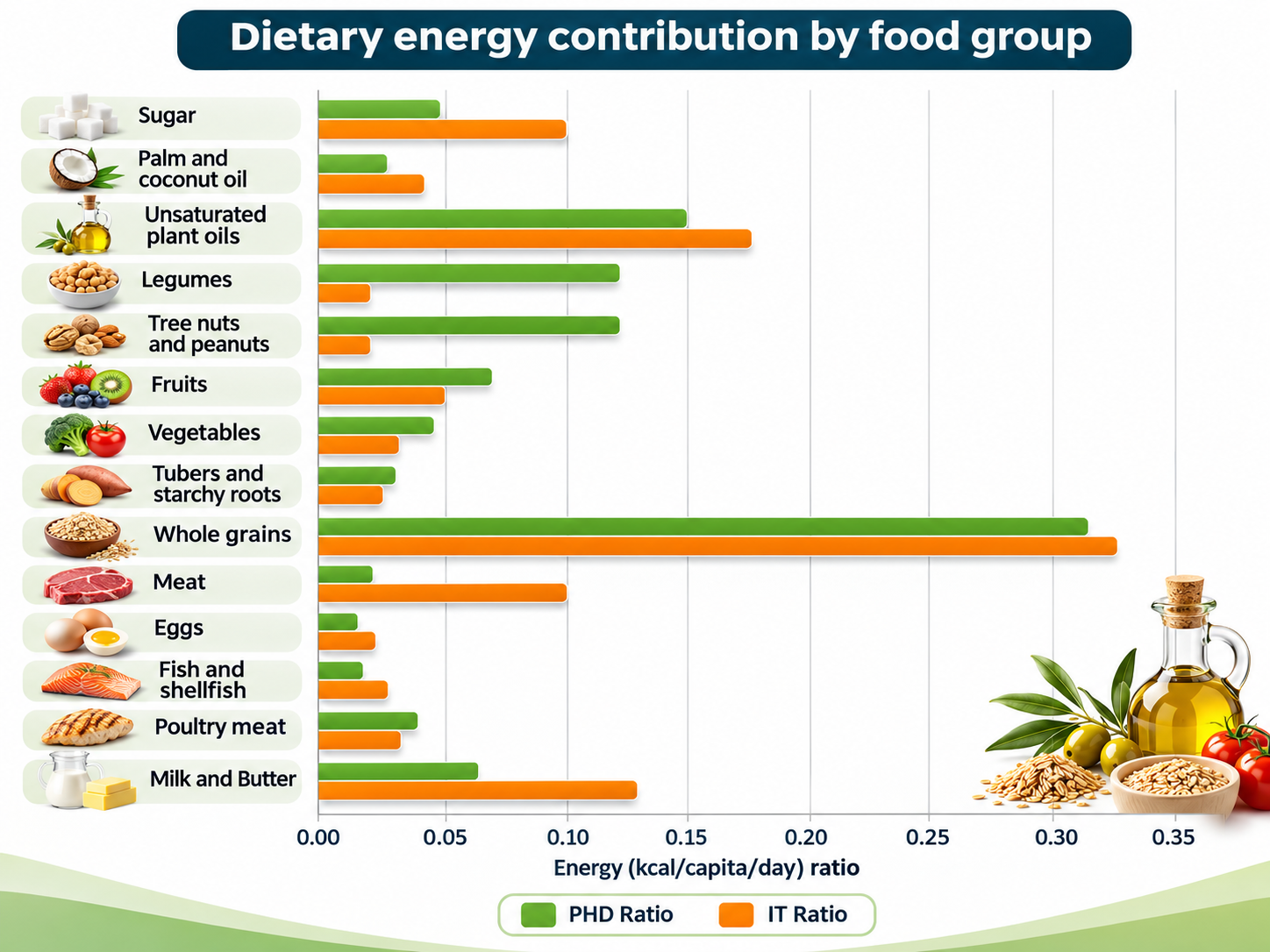
Graphic adapted from Figure 6 in the paper. Comparison between the Planetary Health Diet (PHD) and Italy. The bars show the ratio of each food category’s daily kcal/capita supply to Italy’s total daily kcal/capita supply. The green bars show the same ratio computed for the PHD.
Of the four regions, Southern Europe’s dietary energy composition was closest to PHD recommendations, while Western Europe’s was farthest from them. Diabetes prevalence among adults aged 20 to 79 rose in three of the four regions. Between 2011 and 2024, prevalence increased from 6.4% to 9.3% in Southern Europe, from 5.3% to 6.5% in Western Europe, and from 4.7% to 6.2% in Northern Europe.
Eastern Europe's estimated prevalence, which was the highest in 2011 at 7.3%, decreased to approximately 6% in 2024, though reporting limitations may have affected these figures. In Italy, the mean temperatures and diabetes prevalence increased over time. The correlation across 11 annual observations was moderate (r = 0.6) and does not establish a causal link. The share of available dietary energy from animal-based foods exceeded PHD recommendations. Italy's food-supply composition was closer to PHD recommendations than the European average.
Conclusions
Western and Southern Europe recorded the highest average temperatures and the strongest warming trends, whereas Eastern and Northern Europe remained cooler. Diabetes prevalence and temperature trends did not consistently move together: Eastern Europe had decreasing estimated prevalence but a warming trend. By comparison, Northern Europe showed increasing prevalence but a marginally negative temperature slope.
While Southern Europe's food-supply composition was closest to the PHD recommendations, the region recorded the fastest-growing and highest diabetes prevalence. Italy had lower temperatures, lower diabetes prevalence, and a slightly smaller deviation from the PHD than Southern Europe. The regional analysis did not adjust for factors such as aging, obesity, physical activity, or access to healthcare, and cannot establish whether warming or diet contributed to diabetes trends.
The findings support further research combining social and environmental sustainability dimensions with strategies for disease prevention and climate change adaptation. UNESCO recognition of Italian cuisine provides cultural context, not proof of health benefits.
Source:
Journal reference:
- Mascitelli A, Buso M, Prestileo F, et al. (2026). Climate Change and Human Health: An Exploratory Study on Rising Temperatures and Changing Dietary Habits in Europe with a Particular Focus on Italian Cuisine. Sustainability, 18(21), 11264. DOI: 10.3390/su182111264, https://www.mdpi.com/2071-1050/18/21/11264
 Scientists found a link between Mediterranean diet blood markers and longer survival