The process of translating a biotherapeutic from the laboratory to the market is highly regulated and inherently complex.
Approval requires comprehensive analytical characterization, including verification of structural complexity and heterogeneity, evaluation of repeatability, assessment of stability and aggregation, detection of impurities and contaminants, measurement of bioactivity and potency, and immunogenicity testing.
Because no single analytical method can provide all the necessary data, a broad panel of complementary techniques is essential for complete characterization.
One particularly valuable combination is multi-angle light scattering (MALS) paired with liquid chromatography. MALS enables the determination of absolute molar mass without the need for molecular calibration standards, making it independent of elution time and less susceptible to bias caused by column variability.
MALS measures molar mass directly in solution and can be performed in native formulation buffers. Its ability to accurately quantify oligomerization states, aggregates, and fragments makes it an ideal tool for gaining critical insight into biotherapeutic quality and stability.
This article highlights several published studies that utilized the DAWN™ MALS instrument as part of an analytical toolkit for biotherapeutic approval and biosimilar comparability assessments.
The first case study involves a company seeking re-approval following a switch to a higher-yielding cell line. The second explores biosimilarity between a developed biosimilar and reference products released in both the EU and U.S. markets. The final study compares two approved biosimilars with a reference product, evaluating their stability profiles under forced degradation conditions.
Image Credit: Waters | Wyatt Technology
Publication highlights
Comparability strategy and demonstration for post-approval production cell line change of a bevacizumab biosimilar IBI305
IBI305, developed by Innovent Biologics, is predominantly used to treat various cancers by inhibiting the formation of new blood vessels, thereby halting tumor growth.1
As part of a process improvement, Innovent transitioned from the CHO-K1S host cell line to CHOK1SV GS-KO, resulting in a threefold increase in expression titer.
In collaboration with the China National Medical Products Administration (NMPA), Innovent published their approach to selecting analytical methods to determine whether this change introduced any molecular deviations requiring further investigation.
MALS was used to verify molar mass, assess size variants for aggregation and stability, and evaluate charge variants to better understand degradation pathways. Samples collected before and after the cell line change were compared with the reference product.
For size variant analysis, size-exclusion chromatography coupled with MALS (SEC-MALS) was employed to determine the molar mass of the main peak and quantify high-molecular-weight species (HMWS) and aggregate mass.
Table 1. SEC-MALS size variant analysis for purity assessment. Comparison between pre- and post- cell line change and reference product. Source: Adapted from Wu, Z. et al. Antibody Therapeutics 6(3), 194–210 (2023)
| SEC-MALS Attributes |
Pre-Change |
Post-Change |
Reference |
| Monomer MW (kDa) |
155.3–155.8 |
155.7–156.2 |
154.7–155.2 |
| Monomer Content (%) |
99.0–99.0 |
98.9–99.3 |
98.1–98.2 |
| HMWS MW (kDa) |
309.3–317.0 |
308.3–319.5 |
319.3–327.4 |
| HMWS Content (%) |
1.0–1.0 |
0.7–1.1 |
1.8–1.9 |
Category:
Attributes:
Risk: |
Size Variants
Purity/Impurity
Medium |
For charge variant analysis, seven isoforms were fractionated via cation exchange chromatography (CEX) and evaluated using biophysical and functional assays. CEX-MALS was also performed to measure the molar mass of these charge variants, providing additional insights into potential degradation mechanisms.
MALS was used to evaluate the impact of the process change on biosimilar quality by enabling absolute molar mass determination, aggregation analysis, and charge variant characterization.
The data obtained from SEC-MALS and CEX-MALS demonstrated that the cell line change did not result in significant deviations in molecular properties, supporting regulatory approval.
Characterization for the similarity assessment between the proposed biosimilar SB17 and ustekinumab reference product using state-of-the-art analytical methods
SB17, developed by Samsung Bioepis, is a biosimilar to ustekinumab (Stelara™), a monoclonal antibody used to treat plaque psoriasis and psoriatic arthritis.2
To obtain regulatory approval, SB17 needed to demonstrate structural and functional similarity to ustekinumab reference products sourced from both the U.S. and EU.
This study described the comprehensive analytical work undertaken to compare the physicochemical and biological properties of SB17 and the reference products, ensuring comparability.
SEC-MALS, combined with a differential refractive index (dRI) detector, was used to quantify the percentage of the main peak, high-molecular-weight species (HMWS), and low-molecular-weight species (LMWS) in both SB17 and the reference products.
The study also included a comparison of experimentally derived extinction coefficients as an additional biosimilarity parameter. The SEC-MALS-dRI method enabled empirical extinction coefficient determination by integrating dRI and UV280 signals.
This work demonstrated that incorporating MALS into conventional SEC with optical detection significantly enhanced the depth of characterization, enabling a more rigorous biosimilar evaluation. By providing precise data on molar mass distribution, size variants, and extinction coefficients, MALS played a central role in supporting the regulatory case for SB17’s biosimilarity.
SB17 was approved by the U.S. Food and Drug Administration in 2024.6
Comparative stability study and aggregate analysis of Bevacizumab marketed formulations using advanced analytical techniques
Bana et al. conducted a study to assess the stability of two approved bevacizumab biosimilars compared to a reference product. Real-time stability testing and comprehensive analytical assessments were performed to evaluate critical product attributes, including native protein content, intact molecular weight, higher-order structure, and charge and size variants.
In addition, forced degradation studies were conducted under chemical, thermal, and mechanical stress conditions.
The importance of stability testing is emphasized in several International Council for Harmonisation (ICH) guidelines (including Q5C, Q6B, and Q1B), which provide a framework for evaluating the stability of biotechnological and biological products during processing, shipping, and storage.
Table 2. List of forced degradation studies performed by Bana et al. Source: Waters | Wyatt Technology
| Stress Type |
Conditions |
Time Points |
| Thermal Stress |
50 ± 2 °C |
1, 7, and 14 days |
| Chemical Stress |
Acidic – pH 3.0 ± 0.2
Neutral – pH 3.0 ± 0.2
Basic – pH 10.0 ± 0.2 |
1, 3, and 6 hours |
| Mechanical Stress |
Agitation at 200 rpm |
1, 12, and 24 hours |
SEC-MALS was employed to monitor product-related impurities, aggregate formation, and changes in higher-order structure due to chemical and thermal stress, as well as mechanical agitation.
The SEC-MALS analysis showed that both biosimilars and the reference product remained stable at elevated temperature for up to one day. However, prolonged exposure resulted in increased aggregate formation, with dimers and trimers accumulating over a 14-day period.
All formulations were similarly prone to aggregation under mechanical stress, with significant conformational changes observed within 24 hours.
Bana et al. proposed that this sensitivity to agitation-induced aggregation may be linked to the use of polysorbate 20 as a surfactant in the buffer formulations.
Comprehensive size variant analysis
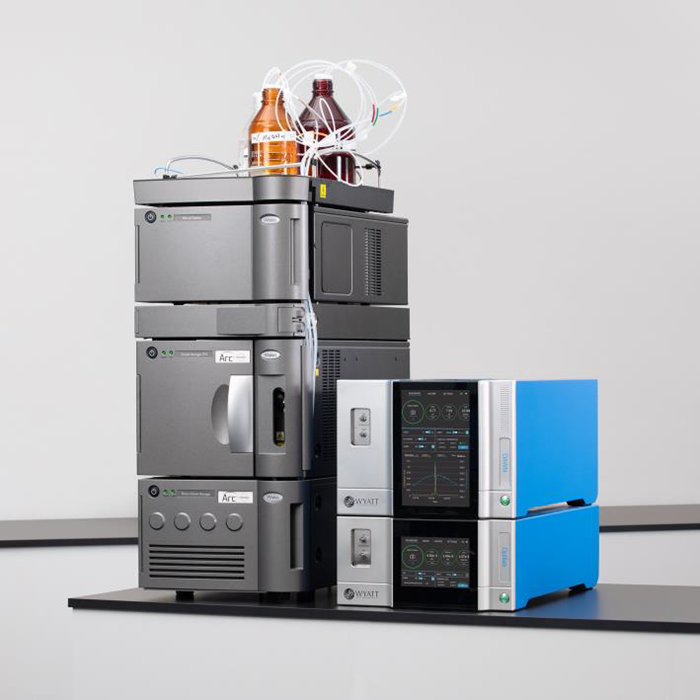
Image Credit: Waters | Wyatt Technology
The DAWN™ MALS instrument from Waters™ is the most advanced light scattering system available, enabling the absolute characterization of proteins, macromolecules, conjugates, and nanoparticles.
It delivers exceptional sensitivity across the broadest range of molar mass, size, and concentration.
Waters™ offers a fully integrated solution for SEC-MALS and HPLC-SEC analysis. The DAWN™ MALS photometer seamlessly integrates with the robust Arc™ Premier HPLC system and high-performance MaxPeak™ Premier SEC columns, ensuring consistent measurements across both runs and locations.
Both ASTRA™ and Empower™ software platforms are compliance-ready. Empower™ offers a comprehensive suite of HPLC-SEC analysis tools alongside enterprise-level data management capabilities.
References and further reading
- Wu, Z., et al. (2023). Comparability strategy and demonstration for post-approval production cell line change of a bevacizumab biosimilar IBI305. Antibody therapeutics, (online) 6(3), pp.194–210. https://doi.org/10.1093/abt/tbad017.
- Yang, S.-Y., et al. (2025). Characterization for the Similarity Assessment Between the Proposed Biosimilar SB17 and Ustekinumab Reference Product Using State-of-the-Art Analytical Methods. Drugs in R&D. https://doi.org/10.1007/s40268-024-00501-6.
- Bana, A.A., et al. (2023). Comparative stability study and aggregate analysis of Bevacizumab marketed formulations using advanced analytical techniques. Heliyon, (online) 9(9), pp.e19478–e19478. https://doi.org/10.1016/j.heliyon.2023.e19478.
- Avastin. (2023). How Avastin® (bevacizumab) works for 1L metastatic non-squamous non-small cell lung cancer (NSCLC). (online) Available at: https://www.avastin.com/patient/nsclc/about/how-avastin-works.html.
- STELARA®. (2022). How Does STELARA® Work. (online) Available at: https://www.stelarainfo.com/plaque-psoriasis/treatment-information/how-does-stelara-work/.
- Samsung Bioepis Co., Ltd., 2024. News releases. [online] Available at: https://www.samsungbioepis.com/en/news-room/newsroomView.do?idx=402¤tPage=1
Acknowledgments
Produced from materials originally authored by Udayabagya Halim, Ph.D from Wyatt Technology, LLC.
About Waters | Wyatt Technology
Wyatt Technology Corporation develops instrumentation, software and techniques for the characterization of macromolecules and nanoparticles, in solution, based on light scattering and related technologies. The physical properties determined by Wyatt’s products include absolute molar mass of proteins, polymers and other macromolecules; size and charge (zeta potential); protein-protein and other biomolecular interactions; composition of conjugated proteins and co-polymers; and macromolecular conformation.
Products and services
Wyatt’s product line includes instruments and software for:
- on-line multi-angle light scattering (MALS), used in conjunction with size-exclusion chromatography to quantify absolute molar mass, size, conformation, conjugation and aggregation
- traditional (cuvette-based) and high-throughput (microwell plate-based) dynamic light scattering (DLS) to determine size (radius) and size distributions, protein melting temperature and stability-indicating parameters
- electrophoretic mobility (PALS) to determine molecular charge/zeta potential
- composition-gradient light scattering for label-free analysis of biomolecular interactions
- field-flow fractionation for separation of macromolecules and nanoparticles from 1-1000 nm, used in conjunction with on-line light scattering and other detection technologies to quantify molar mass and size
Wyatt also offers, on a limited basis, sample analysis services utilizing its unique technologies.
Sponsored Content Policy: News-Medical.net publishes articles and related content that may be derived from sources where we have existing commercial relationships, provided such content adds value to the core editorial ethos of News-Medical.Net which is to educate and inform site visitors interested in medical research, science, medical devices and treatments.