ACRO's Human FcRn binding Kit (TR-FRET) uses TR-FRET technology.
Product details
FAB
- Comprehensive validation - Confirmed with different antibody subtypes and antibody medications.
- Simple and fast operation - No intricate washing procedures, greatly minimizing time.
- High batch consistency - Rigorous oversight of the quality of raw materials and finished products, guaranteeing a consistent supply.
- Accurate and reliable results - Exceptional sensitivity with negligible matrix influences.
- High throughput capability - Facilitates various product specifications, perfect for high-throughput screening.
- Fast completion - Outcomes achieved in merely one hour.
Product specifications
Source: ACROBiosystems
| |
|
| Assay Type |
Competition-TR-FRET |
| Format |
100T/500T |
| Reactivity |
Human |
| Regulatory Status |
RUO |
| Assay Time |
1 hr |
| Sample volume |
10 μL |
Product overview
The Human FcRn Binding Kit (TR-FRET) uses a homogeneous (no-wash) competition TR-FRET technology, which stands for Time-Resolved Fluorescence Resonance Energy Transfer, to assess the interaction between human FcRn and antibody drug candidates or FcRn inhibitors.
This kit is designed to aid in the evaluation of the half-life of antibody drug candidates and to conduct high-throughput screening of FcRn inhibitors within a timeframe of 30 minutes to 1 hour. It serves as a universal detection tool for determining the capacity of antibody drugs to bind to FcRn.
Note that the TR-FRET Sample Dilution Buffer and Detection Buffer are created for different functions and should not be mixed or substituted, as improper usage may result in unexpected or inconsistent experimental outcomes. The Sample Dilution Buffer is exclusively for sample dilution, while the Detection Buffer is specifically formulated for diluting Donor and Acceptor reagents.
When conducting experiments under varying pH conditions, it is critical to select the appropriate TR-FRET Detection Buffer. For instance, the TR-FRET Detection Buffer for a pH 6.0 Reaction System (Cat. No. DB-06) must be utilized for pH 6.0 reactions, whereas the TR-FRET Detection Buffer for pH 7.4 (Cat. No. DB-05) should be employed for pH 7.4 reactions.
Storage
- Upon receipt, store the unopened kit at a temperature of 2 to 8 °C.
- Find the expiration date on the outer packaging and refrain from using reagents that have expired.
- The opened kit must be stored in accordance with the storage conditions specified in the Components Table. The shelf life of the opened kit is 30 days from the date of opening.
Materials provided
Source: ACROBiosystems
| ID |
Components |
Size |
| FRT01-C01 |
Human FCRN&B2M Heterodimer
Protein Europium-chelate |
100 tests/500 tests |
| FRT01-C02 |
FA Labeled human IgG antibody |
100 tests/500 tests |
| FRT01-C03 |
Human IgG standard |
200 μg/100 tests 1 mg/500 tests |
| DB-04 |
TR-FRET Sample Dilution Buffer, pH 7.4 |
50 mL/100 tests & 500 tests |
| DB-05 |
TR-FRET Detection Buffer, pH 7.4 |
50 mL/100 tests & 500 tests |
| DB-06 |
TR-FRET Detection Buffer, for pH 6.0
reaction system |
50 mL/100 tests & 500 tests |
Assay principles
This Human FcRn binding Kit (TR-FRET) uses TR-FRET technology (Time-Resolved Fluorescence Resonance Energy Transfer). It combines the donor biotinylated FcRn and europium-chelate-labeled streptavidin, with an FA-labeled human IgG1 antibody acceptor.
- In the absence of FcRn-binding components, the donor and acceptor remain in close proximity due to the binding of FcRn and the FA-labeled Human IgG1 antibody. Upon excitation, the donor emits a signal at 620 nm, which is then absorbed by the acceptor, resulting in an emission at 665 nm.
- Conversely, when FcRn-binding components are present, they disrupt the interaction between the donor and acceptor, thereby inhibiting the occurrence of FRET.
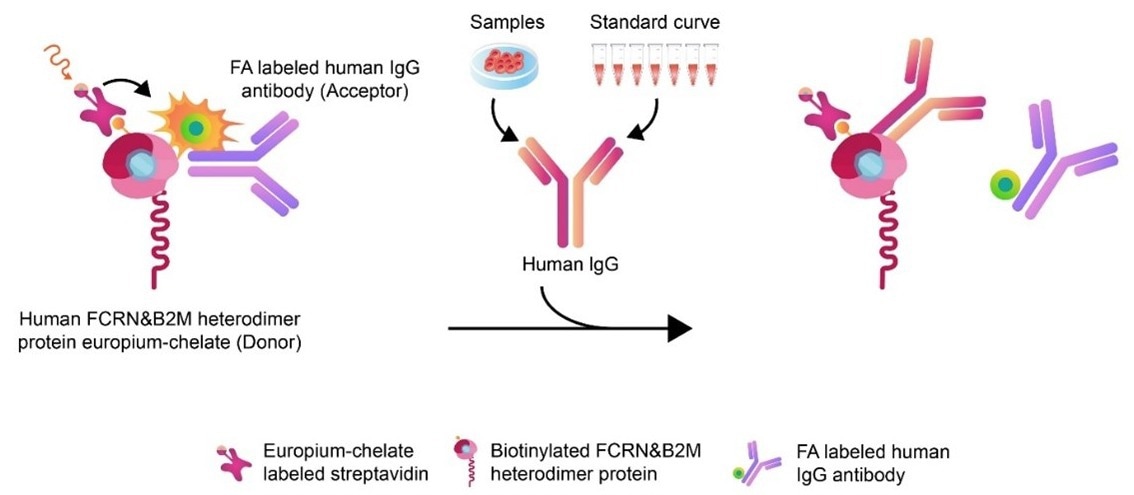
Image Credit: ACROBiosystems
ACRO Quality Management System
- QMS (ISO, GMP)
- Quality Control Process
- Quality Advantages
Performance data
Bioactivity-TR-FRET
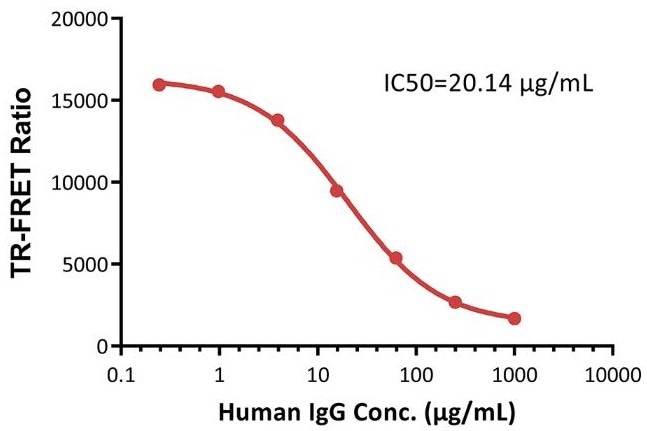
Inhibition Assay of interaction of Human FcRn and Human IgG1 antibody by Human IgG standard in a homogeneous (no wash) TR-FRET (Time-Resolved Fluorescence Resonance Energy Transfer) competition assay, with a typical IC50 of 20.14 μg/mL (QC tested). Image Credit: ACROBiosystems
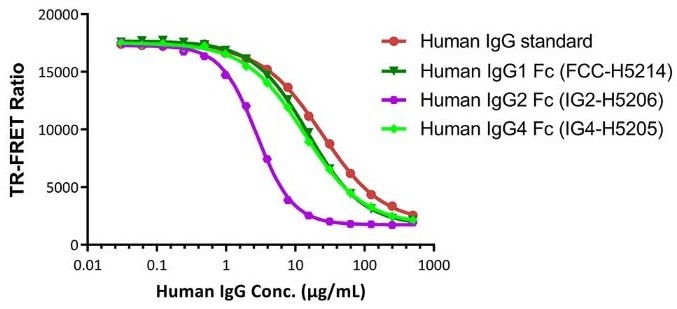
The kit has been used to detect different subclasses of Human IgG Fc proteins, which exhibit different IC50 results as expected. Image Credit: ACROBiosystems
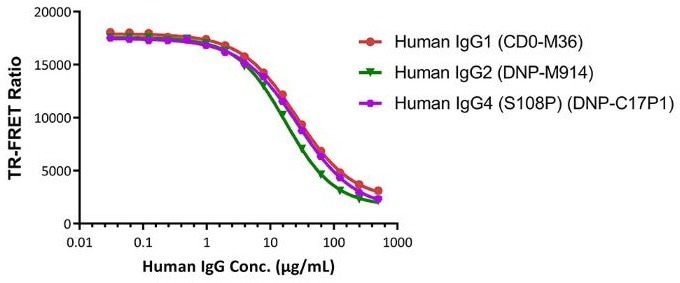
The kit has been used to detect different subclasses of Human IgG, which exhibit different IC50 results as expected. Image Credit: ACROBiosystems
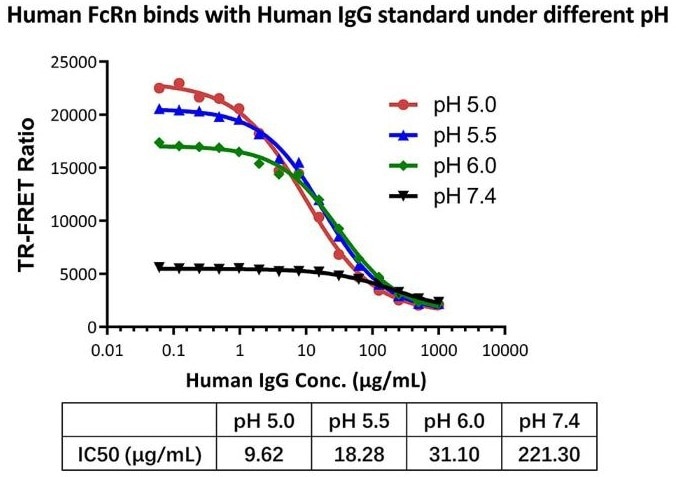
The kit has been used to detect the binding activity between Human FcRn and Human IgG standard under different pH. The IC50 shows a significant increase with increasing pH, which correlates with a decreased binding between Human FcRn and Human IgG standard. Image Credit: ACROBiosystems
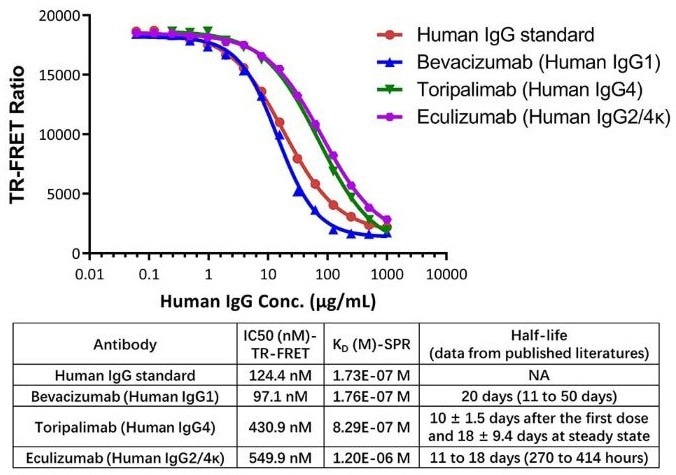
The half-lives of these 3 monoclonal antibodies currently in clinical use generally correlate with the binding affinity to FcRn. The kit has been used to detect 3 FDA-approved antibody drugs of different binding affinities to FcRn, and the IC50 trends are consistent with the affinity constant from SPR, as well as the actual in vivo half-life published. Image Credit: ACROBiosystems
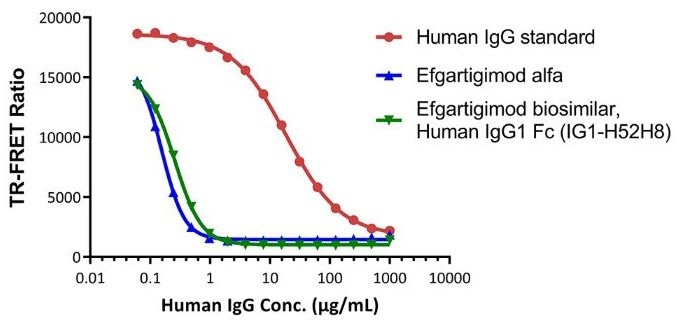
The kit is suitable for the detection of FcRn inhibitors. It shows that both Efgartigimod and its biosimilar, Human IgG1 Fc (C103S, M135Y, S137T, T139E, H316K, N317F) His Tag (Cat. No. IG1-H52H8) exhibit good inhibitory activity in this TR-FRET competition assay. Image Credit: ACROBiosystems