The human TSLP R (Luc) HEK293 reporter cell line from ACROBiosystem expresses a STAT5 response element, as well as full-length human TSLP R and IL-7R.
Product details
- Genetically modified cell lines accurately reflect MOA (Mechanism of Action)
- Increased activity and a wider assay window for a reliable, reproducible cell-based bioassay
- Extensive application data to support assay development and validation
- Complete traceable record, stringent quality control, and validated cell passage stability
- Parent cell line is legally sourced from an internationally recognized cell resource bank and commercially licensed
- Worldwide commercial license support when regulatory filing is needed
Description
The Human TSLP R (Luc) HEK293 Reporter Cell was engineered to express both a STAT5 signaling response element and the full-length human TSLP R (Uniprot: Q9HC73-1) and IL-7 R alpha (Uniprot: P16871-1) receptors.
Upon stimulation with human TSLP protein, the TSLP/TSLP R interaction triggers STAT5-mediated luminescence. Inhibition of TSLP binding to TSLP R by either anti-TSLP or anti-TSLP R antibodies leads to a reduction in luminescence.
Application
Screen for neutralizing anti-human TSLP or anti-human TSLP R.
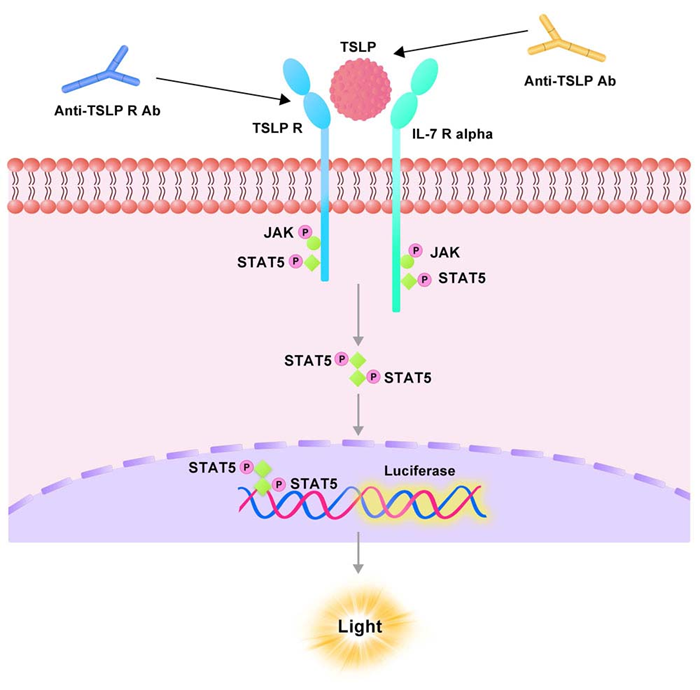
Image Credit: ACROBiosystems
Growth properties
Adherent
Selection marker
Zeocin (100 μg/mL) + Puromycin (2 μg/mL)
Complete growth medium
DMEM medium + 10 % FBS.
Freeze medium
Serum-free cell cryopreservation medium.
Quantity
One vial has at least 5 × 10⁶ cells in 1 mL serum-free cryopreservation medium.
Storage
Frozen in liquid nitrogen.
Mycoplasma testing
Negative.
Sterility testing
Negative.
Instructions for use
Detailed culturing and assay protocols are provided in the data sheet.
ACRO Quality Management System
- QMS (ISO, GMP)
- Quality Advantages
- Quality Control Process
Performance data
Receptor assay
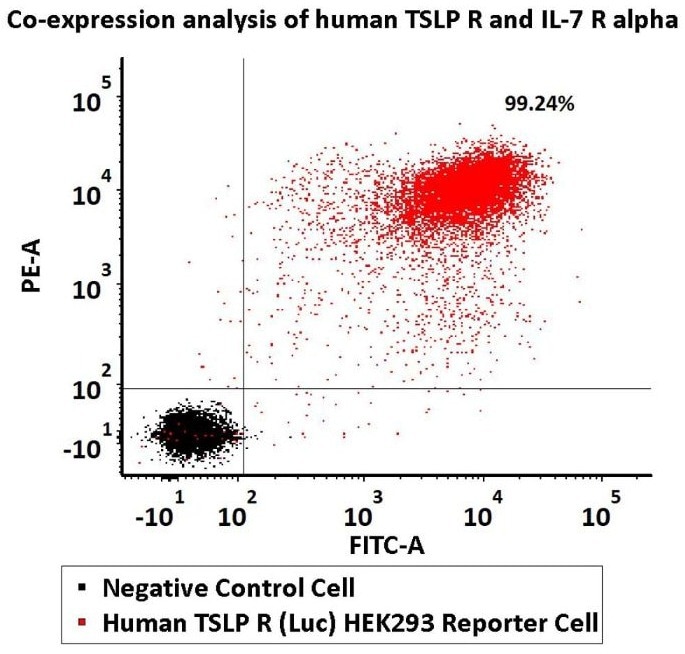
Co-expression analysis of human TSLP R and IL-7 R alpha on Human TSLP R (Luc) HEK293 Reporter Cell by FACS. Cell surface staining was performed on Human TSLP R (Luc) HEK293 Reporter Cell or negative control cell using PE-labeled anti-TSLP R antibody and FITC-labeled anti-IL-7 R alpha antibody. Image Credit: ACROBiosystems
Application
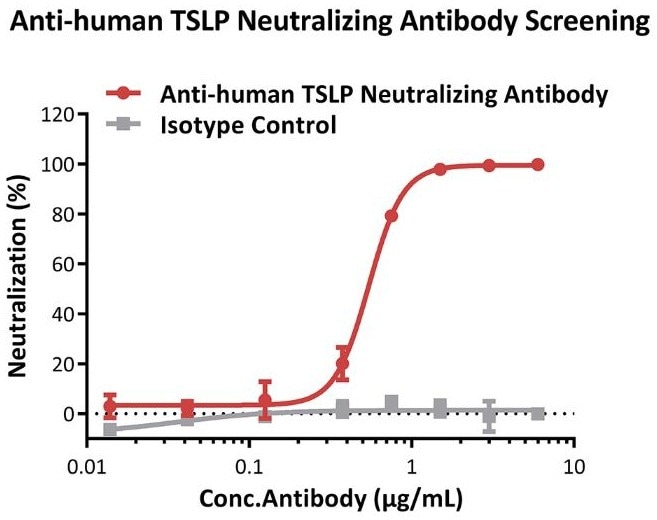
Inhibition of human TSLP protein-induced reporter activity by anti-human TSLP neutralizing antibody. This reporter cell was incubated with serial dilutions of antibodies in the presence of human TSLP protein (Cat. No. TSP-H52Hb) with a final concentration of 0.3 μg/mL. The EC50 of anti-human TSLP neutralizing antibody is approximately 0.55 μg/mL. Image Credit: ACROBiosystems
Signaling bioassay
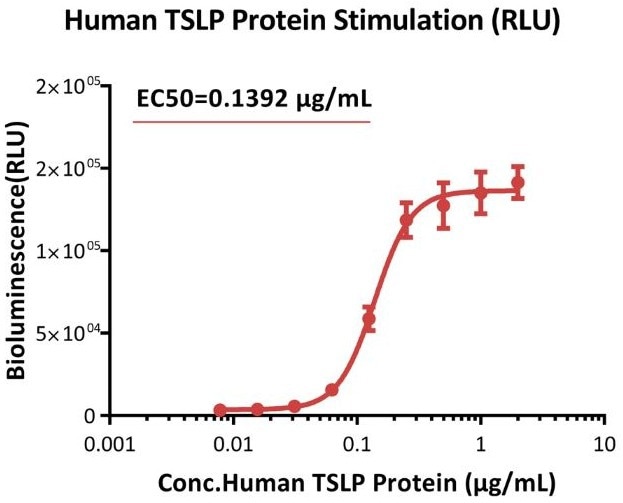
Response to human TSLP protein (RLU). The Human TSLP R (Luc) HEK293 Reporter Cell was stimulated with serial dilutions of human TSLP protein (Cat. No. TSP-H52Hb). The EC50 was approximately 0.1392 μg/mL. Image Credit: ACROBiosystems
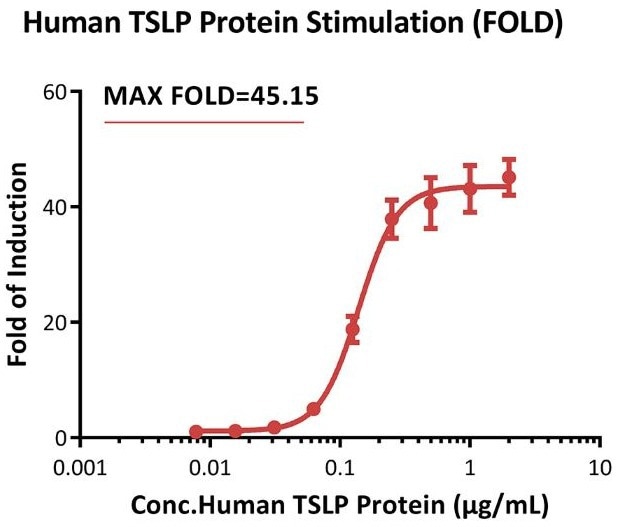
Response to human TSLP protein (FOLD). The Human TSLP R (Luc) HEK293 Reporter Cell was stimulated with serial dilutions of human TSLP protein (Cat. No. TSP-H52Hb). The max induction fold was approximately 45.15. Image Credit: ACROBiosystems
Passage stability
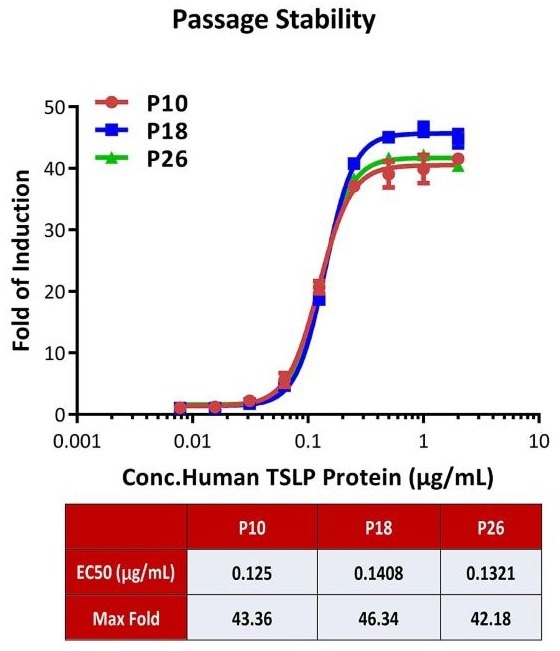
Passage stability analysis by Signaling Bioassay. The continuously growing Human TSLP R (Luc) HEK293 Reporter Cell was stimulated with serial dilutions of human TSLP protein (Cat. No. TSP-H52Hb). Human TSLP protein-stimulated response demonstrates passage stabilization (fold induction and EC50) across passage 10-26. Image Credit: ACROBiosystems