ACROBiosystem's PE-Labeled Human CD19 (20-291) Protein, His Tag is a PE-labeled human CD19 (aa 20–291, His-tag) produced in HEK293 cells using next-generation site-specific conjugation.
Synonym
CD19, B4, CVID3, MGC12802
Source
PE-Labeled Human CD19 (20-291), His Tag (CD9-HP2H5) is generated through the conjugation of PE to Human CD19 (20-291), His Tag utilizing an advanced site-specific technology within the Star Staining labeling platform. Human CD19 (20-291), His Tag is expressed in human 293 cells (HEK293). It comprises AA Pro 20 - Lys 291 (Accession # P15391-1).
Molecular characterization

Image Credit: ACROBiosystems
This protein carries a polyhistidine tag at the C-terminus.
Conjugate
- PE
- Excitation Wavelength: 488 nm / 561 nm
- Emission Wavelength: 575 nm
Formulation
Lyophilized from a solution filtered through a 0.22 μm membrane in PBS, containing 0.2 % BSA, at pH 7.4, with trehalose serving as a protectant.
Reconstitution
ACROBiosystems Inc., highly advises adhering to the reconstitution protocol outlined in the CoA to achieve optimal performance.
Storage
For extended storage, the product must be kept in a lyophilized state at -20 °C or below.
It should be shielded from light and should not undergo multiple freeze-thaw cycles.
This product remains stable after being stored at:
- -70 °C for 3 months under sterile conditions after reconstitution.
- -20 °C to -70 °C for 12 months in the lyophilized state.
ACRO Quality Management System
- QMS (ISO, GMP)
- Quality Advantages
- Quality Control Process
Performance data
Evaluation of CAR expression
FACS analysis of anti-CD19 CAR expression
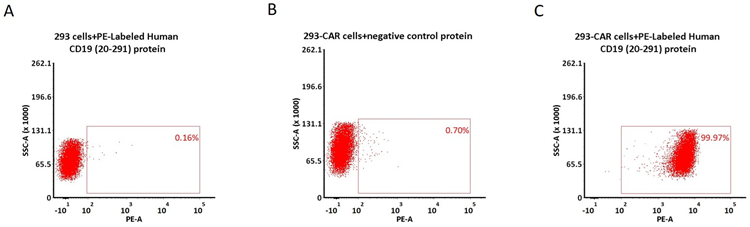
5e5 of anti-CD19 CAR-293 cells were stained with 100 μL of 1:50 dilution (2 μL stock solution in 100 μL FACS buffer) of PE-Labeled Human CD19 (20-291), His Tag (Cat. No. CD9-HP2H5) and negative control protein respectively (Fig. C and B), and non-transfected 293 cells were used as a control (Fig. A). PE signal was used to evaluate the binding activity (QC tested). Image Credit: ACROBiosystems
FACS analysis of non-specific binding to PBMCs
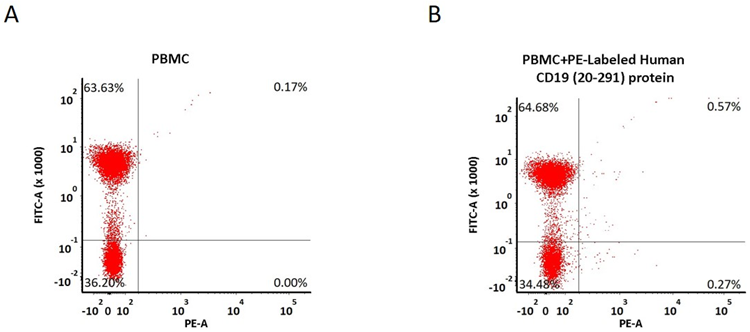
5e5 of PBMCs were stained with PE-Labeled Human CD19 (20-291), His Tag (Cat. No. CD9-HP2H5), and anti-CD3 antibody, washed, and then analyzed with FACS. FITC signal was used to evaluate the expression of CD3+ T cells in PBMCs, and PE signal was used to evaluate the non-specific binding activity to PBMCs (QC tested). Image Credit: ACROBiosystems