The Human TL1A-DR3 Inhibition Kit (TR-FRET) uses a homogeneous (no-wash) competition TR-FRET technology, which stands for Time-Resolved Fluorescence Resonance Energy Transfer, to screen for inhibitors that affect the binding of human TL1A to human DR3 within a timeframe of 30 minutes to an hour. Additionally, it serves as a universal detection tool to assess the capability of TL1A to bind to human DR3.
Product details
FAB
- Comprehensive validation - Verified using diverse antibody drugs.
- Simple and fast operation - No complex washing procedures, which greatly saves time.
- High batch consistency - Strict quality control of raw materials and finished products, guaranteeing a steady supply.
- Accurate and reliable results - High sensitivity with limited matrix effects.
- High-throughput capability - Supports multiple product specifications, making it ideal for high-throughput screening.
- Fast completion - Results available in just 1 hour.
Product specifications
Source: ACROBiosystems
| |
|
| Assay Type |
Competition-TR-FRET |
| Format |
100T/500T |
| Reactivity |
Human |
| Regulatory Status |
RUO |
| Assay Time |
1 hr |
| Sample volume |
10 μL |
Storage
- Upon receipt, store the unopened kit at a temperature of 2 to 8 °C.
- Find the expiration date on the outer packaging and refrain from using reagents that have expired.
- The opened kit must be stored in accordance with the storage conditions specified in the Components Table. The shelf life of the opened kit is 30 days from the date of opening.
Materials provided
Source: ACROBiosystems
| ID |
Components |
Size |
| FRT02-C01 |
Human TL1A Protein Europium-chelate |
100 tests/500 tests |
| FRT02-C02 |
FA Labeled Human DR3 Protein |
100 tests/500 tests |
| FRT02-C03 |
Monoclonal Anti-TL1A Antibody, Human IgG1 |
20 μg/100 tests 100 μg/500 tests |
| DB-04 |
TR-FRET Sample Dilution Buffer, pH 7.4 |
50 mL/100 tests & 500 tests |
| DB-05 |
TR-FRET Detection Buffer, pH 7.4 |
50 mL/100 tests & 500 tests |
Assay principles
This Human TL1A-DR3 inhibition kit (TR-FRET) integrates TR-FRET technology (Time-Resolved Fluorescence Resonance Energy Transfer). It uses a combination of biotinylated human TL1A and europium-chelate-labeled streptavidin as the donor, while the FA-labeled human DR3 protein serves as the acceptor.
In the absence of inhibitors that prevent human TL1A from binding to human DR3, the donor and acceptor remain in close proximity due to the interaction between human TL1A and FA-labeled human DR3. When excited by a specific light source, the donor emits a signal at 620 nm, which is then absorbed by the acceptor, leading to a 665 nm emission.
When inhibitors are present that obstruct the binding of human TL1A to human DR3, the interaction between the donor and acceptor is disrupted, inhibiting the occurrence of FRET.
ACRO Quality Management System
- Quality Control Process
- QMS (ISO, GMP)
- Quality Advantages
Performance data
Bioactivity-TR-FRET
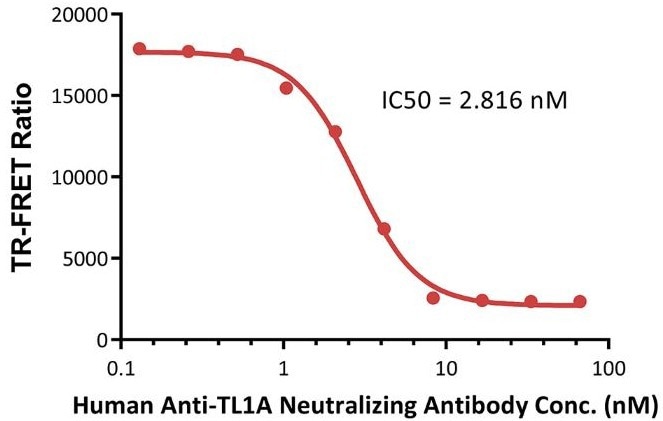
Inhibition of Europium-chelate labeled human TL1A: FA labeled human DR3 binding by Human Anti-TL1A Neutralizing Antibody. Premix serial dilutions of Human Anti-TL1A Neutralizing Antibody (1:2 serial dilution, from 10 μg/mL to 0.01953125 μg/mL (66.6667-0.1302 nM)) and Human TL1A Protein Europium-chelate and incubate at room temperature (20 ℃-25 ℃) for 0.5 hours. Then add FA Labeled Human DR3 Protein and incubate at room temperature (20 ℃-25 ℃) for 0.5 hours. Detection was performed with IC50 of 2.816 nM. The assay was performed according to the above-described Datasheet (QC tested). Image Credit: ACROBiosystems
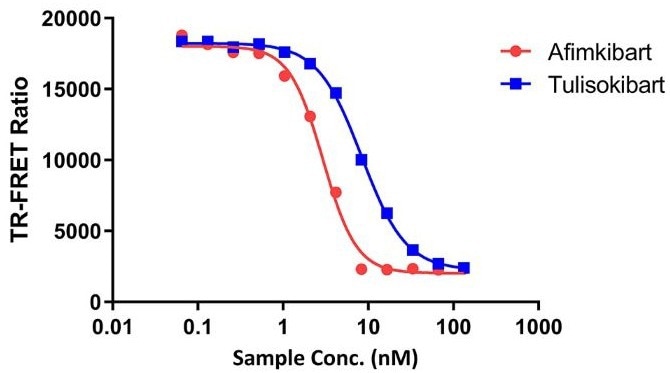
The inhibitory effects of two anti-TL1A antibodies known to inhibit the Human TL1A-DR3 interaction were tested. The two antibodies (Afimkibart & Tulisokibart) were shown to inhibit the interaction with IC50 values of 2.954 & 8.404 nM respectively. Image Credit: ACROBiosystems