A major UK study shows that commonly used home pulse oximeters can overestimate oxygen levels in people with darker skin, increasing the risk of undetected hypoxemia and raising urgent questions about device standards, regulation, and clinical interpretation.
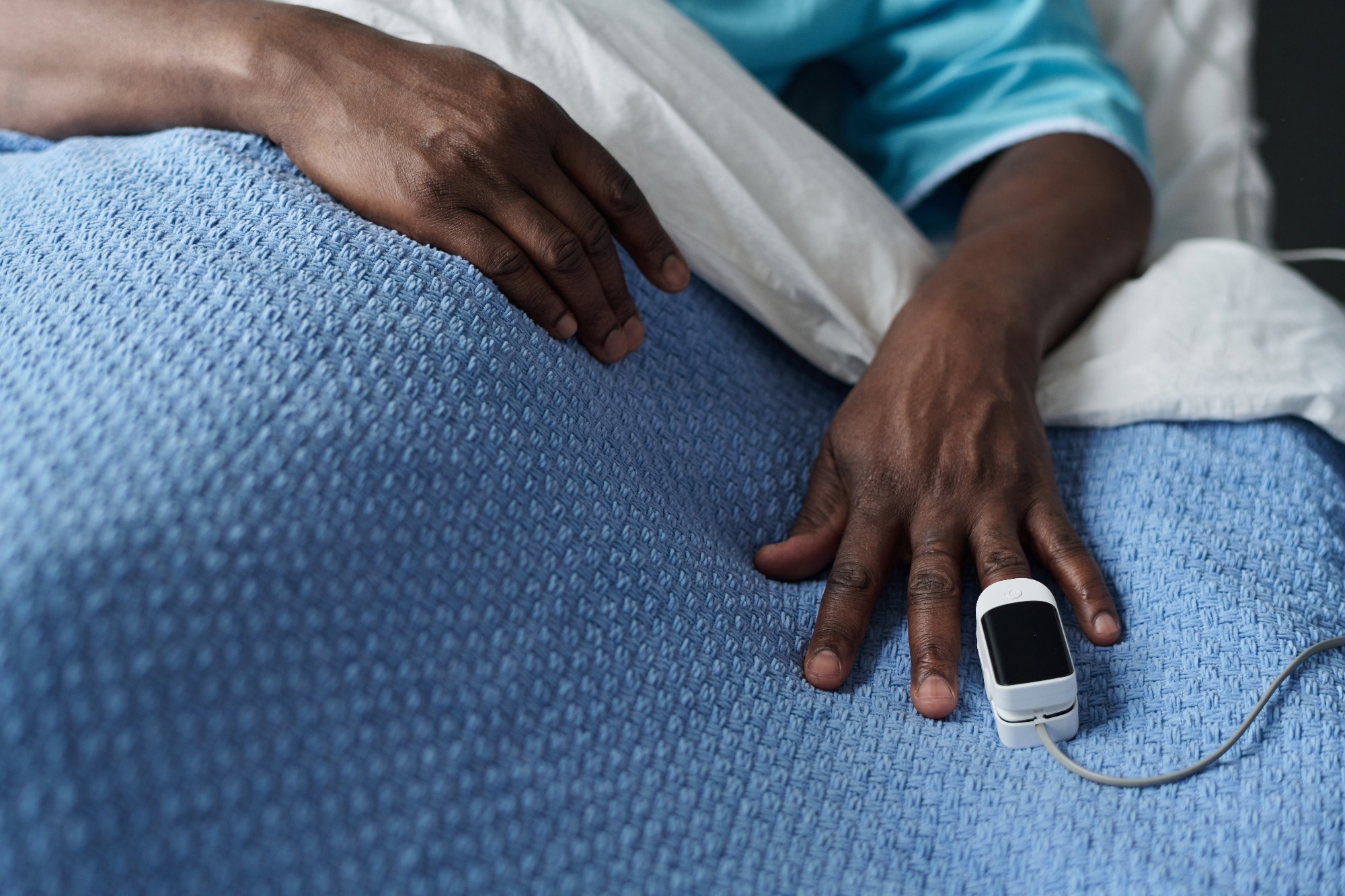
Study: The impact of skin tone on performance of pulse oximeters used by NHS England COVID Oximetry @home scheme: measurement and diagnostic accuracy study. Image Credit: AnnaStills / Shutterstock
Oxygen in blood is primarily transported by the red cell pigment hemoglobin. The fraction of total hemoglobin that is oxygenated hemoglobin in arterial blood is the arterial hemoglobin oxygen saturation (SaO2), which is measured directly from an arterial blood gas sample and used to detect and assess hypoxemia, or low blood oxygen concentration. Pulse oximetry is often used to noninvasively estimate saturation by measuring light absorbance in the tissue vascular bed. However, its accuracy is far from uniform, especially in darker skin tones.
A recent study in The British Medical Journal examined how skin color affects the accuracy of hypoxemia diagnosis by pulse oximetry.
Development and Widespread Use of Pulse Oximeters
Pulse oximeters began to be commercially sold in the 1980s, with subsequent striking advances in design, convenience, and portability. The coronavirus disease 2019 (COVID-19) pandemic led to a significant increase in the use of fingertip pulse oximeters at home. These are inexpensive, battery-powered, and suitable for home use.
Pulse oximeters can enable remote monitoring of peripheral oxygen saturation (SpO2) and detection of early hypoxemia. The NHS England exploited this with the rollout of the COVID Oximetry @home scheme. However, some cheap pulse oximeters produce inaccurate readings, emphasizing the need for regulation.
Skin Tone and Accuracy of Hypoxemia Detection
Darker skin is also associated with an increased risk of a false negative, leading to delayed or missed diagnosis of hypoxemia. Earlier studies used race or ethnicity to stand in for skin tone. Others used the Fitzpatrick skin tone or other color comparison charts to determine skin tone.
Both methods lack the objectivity of spectrophotometry, leading to major flaws in these studies. Spectrophotometry measures light reflection over different wavelengths and calculates the skin color accordingly. The results are used to calculate the individual typology angle (ITA), derived from objective lightness and colour measurements.
Regulatory Standards and Performance Metrics
The ISO, which certifies pulse oximeters and other devices for safety and basic performance, does not require accounting for skin tone variations. The performance metric for measurement accuracy is the accuracy root-mean-square (ARMS), which combines bias (systematic error) with precision (random error or noise).
The FDA has published a draft to improve oximeter accuracy evaluation by increasing both the number of participants and the range of skin tones. It considers not only ARMS but variation in bias over a 100° range of ITA.
Rationale for the EXAKT Study
In response to NHS concerns, the NIHR launched the EXAKT study to assess how skin tone affects measurements and diagnostic accuracy of five fingertip pulse oximeters used in the home oximetry scheme.
Study Design and Data Collection
The study used data from patients recruited or screened for the UK-ROX trial, designed to assess various approaches to oxygen therapy. This included 903 critically ill patients in 24 intensive care units in England between June 2022 and August 2024, a setting chosen to enable paired arterial blood gas sampling and to capture a wider range of oxygen saturations, including lower SaO2 values.
The five oximeters were used to measure SpO2, and the readings were compared with the SaO2 measured simultaneously by co-oximetry, the gold standard. Skin tone was objectively measured using a handheld spectrophotometer.
Analytical Approach and Diagnostic Thresholds
The researchers aimed to evaluate pulse oximeter performance in terms of its overall accuracy, precision, and bias. Both false positive and false negative rates for SpO2 ≤92% and ≤94% were evaluated against a reference SaO2 threshold of ≤92% to examine how often SpO2 fails to identify hypoxemia. They used the receiver operating characteristic (ROC) curve to measure overall testing performance across different cutoffs.
In particular, they looked for occult hypoxemia (SaO2 below 88% but SpO2 >92%).
Measurement Accuracy and Skin Tone Effects
The study included 11,018 pairs of SpO2–SaO2 measurements. All five pulse oximeter types in the study showed reduced precision across all SaO2 levels. Overall accuracy was also reduced, largely due to substantial imprecision rather than systematic bias alone. At lower saturations, SpO2 measurements were too high, and at higher saturations, too low.
All five pulse oximeters overestimated the saturation with darker skin tones. Median dark skin was associated with an average increase of 0.6–1.5 percentage points in mean SpO2 values compared to lighter tones.
At lower saturations, darker skin tones exacerbated the bias towards falsely high SpO2 readings, thereby increasing the risk of missing hypoxemia. At higher saturations, the underestimation error tended to partially offset the higher SpO2 associated with darker skin tone, reducing the bias.
Diagnostic Consequences and Occult Hypoxemia
As a result, the accuracy of pulse oximeters varied with skin tone, though the direction and magnitude of the bias depended on saturation levels and the oximeter model. The devices showed a reduced ability to distinguish true hypoxemia in darker-skinned individuals.
The ARMS predominantly varied with measurement precision rather than skin tone-associated error. However, despite their small size, their effect on diagnostic accuracy was significant.
At both SpO2 thresholds, false negatives increased in darker-skinned individuals, while false positives decreased. False negatives increased by 5–35 percentage points at higher SpO2 thresholds in darker-skinned individuals.
While cases of occult hypoxemia were rare and estimates imprecise, they occurred more often in individuals with darker skin tones. Overall, hypoxemia was more frequently missed in this group.
Context, Strengths, and Limitations
These findings align with prior research but are limited to low-cost pulse oximeters supplied under the COVID Oximetry @home scheme. Results may not apply to critical care oximeters used in hospital settings.
A smaller American study of critical care oximeters using the same spectrophotometry approach also found significant overestimation of saturation in darker-skinned patients.
This large prospective study used objective skin-tone measurements and advanced statistical modeling, thereby strengthening its conclusions. However, unmeasured confounders such as reduced peripheral perfusion in critical illness may limit generalisability to home use.
Clinical Implications and Future Directions
SpO2 values tended to be higher in people with darker skin, potentially resulting in clinically significant differences in diagnostic accuracy.
Clinicians should interpret pulse oximetry cautiously, especially in darker-skinned individuals. Manufacturers should ensure robust pre- and post-market testing across skin tones.
Current standards do not adequately address these issues. SpO2 trends are more clinically informative than isolated values and must be interpreted in context. Updated guidelines are needed to support optimal hypoxemia care where confirmatory testing is unavailable.
Further research should incorporate objective skin tone measurement and explore alternatives to spectrophotometry to improve accessibility.
Journal reference:
- Martin, D. S., Doidge, J. C., Gould, D., et al. (2026). The impact of skin tone on performance of pulse oximeters used by NHS England COVID Oximetry @home scheme: measurement and diagnostic accuracy study. The BMJ. DOI: 10.1136/bmj-2025-085535, https://www.bmj.com/content/392/bmj-2025-085535
 Researchers followed glucose monitor users for three years and found a possible kidney benefit