In more than 6,500 US adults free of cardiovascular disease at baseline, researchers found that higher ultraprocessed food intake tracked with a higher long-term risk of ASCVD, with a stronger association in Black participants.
Key takeaways
Higher ultraprocessed food intake was associated with a higher risk of atherosclerotic cardiovascular disease.
Each additional daily serving of ultraprocessed food was associated with a roughly 5% increase in ASCVD risk.
The association was stronger among Black participants, and no significant interaction was observed by sex or income.
Among ultraprocessed food categories, sugary foods showed the clearest association with higher cardiovascular disease risk.

Study: Association Between Ultraprocessed Food Consumption and Cardiovascular Disease Risk: MESA (Multiethnic Study of Atherosclerosis). Image Credit: Rimma Bondarenko / Shutterstock
A new study published in the journal JACC Advances highlights the growing cardiovascular risks associated with higher daily consumption of ultraprocessed foods (UPF) across diverse populations. Analyzing data from over 6,000 multiethnic United States (US) adults without pre-existing cardiovascular disease (CVD), researchers identified a clear, approximately linear association between higher UPF intake and increased incident atherosclerotic cardiovascular disease (ASCVD) risk.
The association was particularly pronounced among Black American participants, and the authors discuss potential socioenvironmental and structural contributors. These findings add to growing evidence linking UPFs to poor cardiometabolic outcomes and emphasize the need for targeted dietary strategies and public health interventions.
Dietary Patterns and Cardiovascular Health Risks
Healthy dietary patterns, such as the Dietary Approaches to Stop Hypertension (DASH) and Mediterranean diets, are well established for improving cardiometabolic health and lowering CVD risk. These diets emphasize fruits, vegetables, whole grains, legumes, nuts, and low-fat dairy.
In contrast, diets high in red and processed meats, refined grains, added sugars, and saturated fats are associated with adverse outcomes, including ASCVD. UPFs, characterized by industrial formulations with additives and minimal whole foods, have emerged as key contributors. However, much of the existing evidence comes from racially homogeneous populations, limiting generalizability.
Study Design and Multiethnic Cohort Analysis
In this longitudinal study, researchers evaluated associations between UPF intake and incident ASCVD risk, including variation by race/ethnicity, sex, and socioeconomic status.
The study included participants from the Multiethnic Study of Atherosclerosis (MESA), comprising adults aged 45–84 years without baseline CVD. Data were collected between 2000 and 2002, with follow-up through 2012.
Researchers collected demographic, socioeconomic, clinical, and lifestyle data using standardized questionnaires. Clinical measures included blood pressure, lipid profiles, anthropometry, and waist circumference.
Dietary intake was assessed using food-frequency questionnaires (FFQs), and foods were classified using the NOVA system. The Alternative Healthy Eating Index (AHEI) was used to evaluate overall diet quality.
Multivariate Cox regression models estimated hazard ratios (HR) for incident CVD events, including myocardial infarction, cardiac arrest, stroke, and cardiovascular mortality.
Restricted cubic spline models evaluated dose-response relationships, and survival analyses were conducted across UPF intake quintiles. Additional analyses explored subgroup differences and socioenvironmental influences. As an observational study, results indicate association rather than causation.
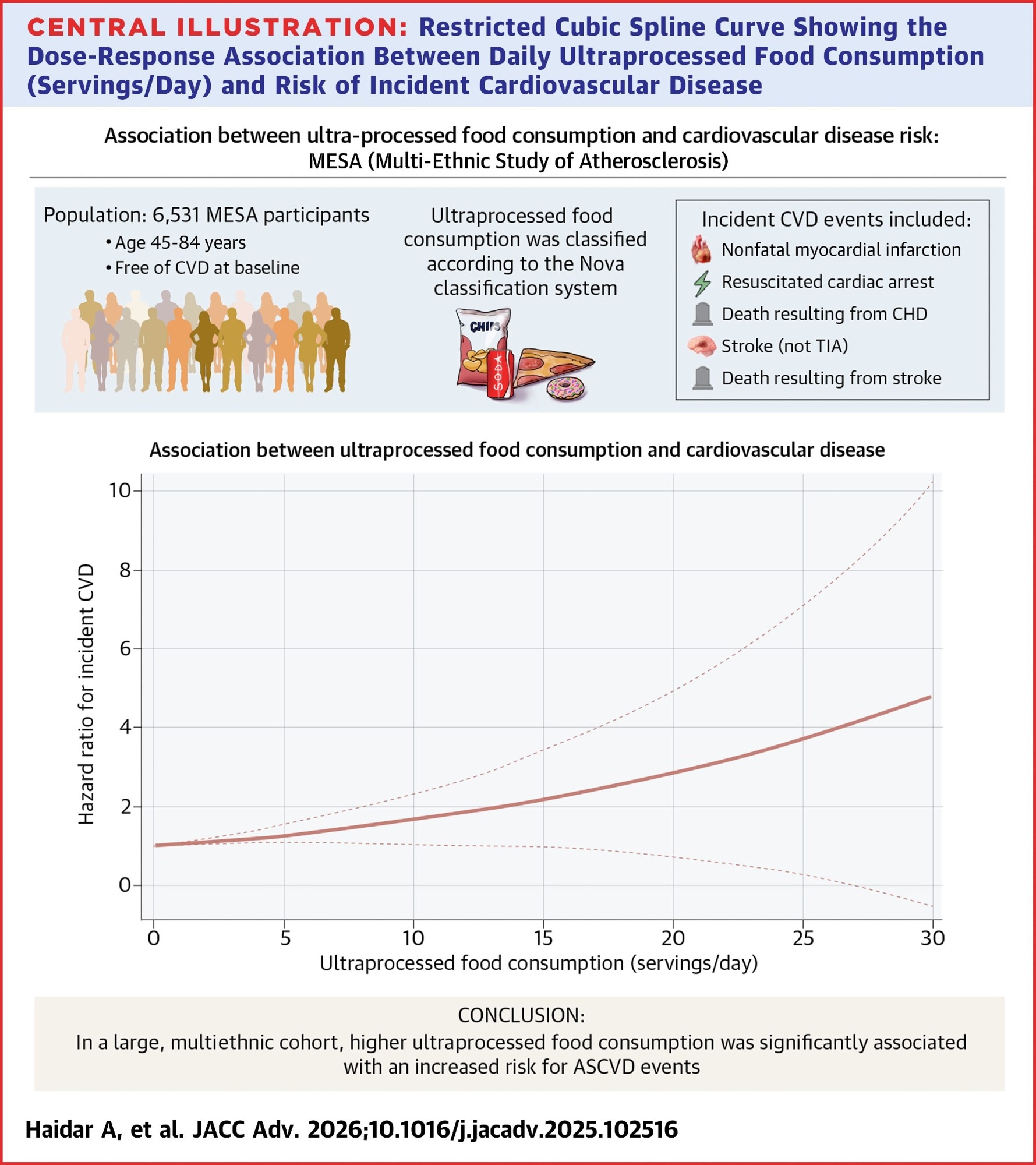
Dose Response Relationship Between UPF and ASCVD
The analysis included 6,531 participants (3,093 men and 3,438 women) across diverse racial and ethnic groups. Participants consumed an average of 4.38 servings of UPFs per day. Over 83,870 person-years of follow-up, 710 incident CVD events were recorded.
Higher UPF intake was associated with increased ASCVD risk. Each additional daily serving corresponded to an approximate 5% increase in risk (HR, 1.05), with risk rising more steeply at higher intake levels.
Survival analyses showed that individuals in the lowest UPF intake quintile had the highest CVD-free survival, while those in the highest quintile had the lowest. The highest quintile had a 67% greater risk of ASCVD than the lowest quintile (HR, 1.67). These findings demonstrate a consistent dose-response relationship over two decades, although dietary intake was assessed only at baseline.
Stratified analyses showed stronger associations among Black participants (HR, 1.06) than among non-Black participants (HR, 1.03). Sugary UPFs showed the most consistent association with increased risk, while processed meats showed borderline associations, and mixed dishes were not significant. No significant interactions were observed by sex or income.
Although biological mechanisms were not directly tested, the authors suggest potential pathways including excess energy intake, metabolic dysfunction, hypertension, and inflammation.
Public Health Implications and Study Limitations
The findings identify UPF intake as a significant, modifiable risk factor for cardiovascular disease, with disproportionate effects in Black populations. Clinical and public health strategies should address UPF consumption alongside broader structural factors such as food access, marketing, and socioeconomic inequalities.
Limitations include reliance on self-reported dietary data and potential misclassification within FFQs. Future research should refine UPF definitions, investigate biological mechanisms, and evaluate targeted interventions. Dietary intake was measured at baseline, although follow-up analyses suggested relative stability over time.
Journal reference:
- Haidar A, Rikhi R, Watson K, et al. (2026). Association Between Ultraprocessed Food Consumption and Cardiovascular Disease Risk: MESA (Multiethnic Study of Atherosclerosis). JACC Advances. DOI: 10.1016/j.jacadv.2025.102516, https://www.jacc.org/doi/10.1016/j.jacadv.2025.102516
 What links smoking, body fat, mental health, genes, and heart risk? Inflammation may be part of the answer