A small trial suggests IL-6 receptor blockade may help some patients with inflammation-linked depression, but the signal now needs confirmation in larger, longer studies.
Brief Report: Interleukin 6 as a Treatment Target for Depression - A Proof-of-Concept Randomized Clinical Trial
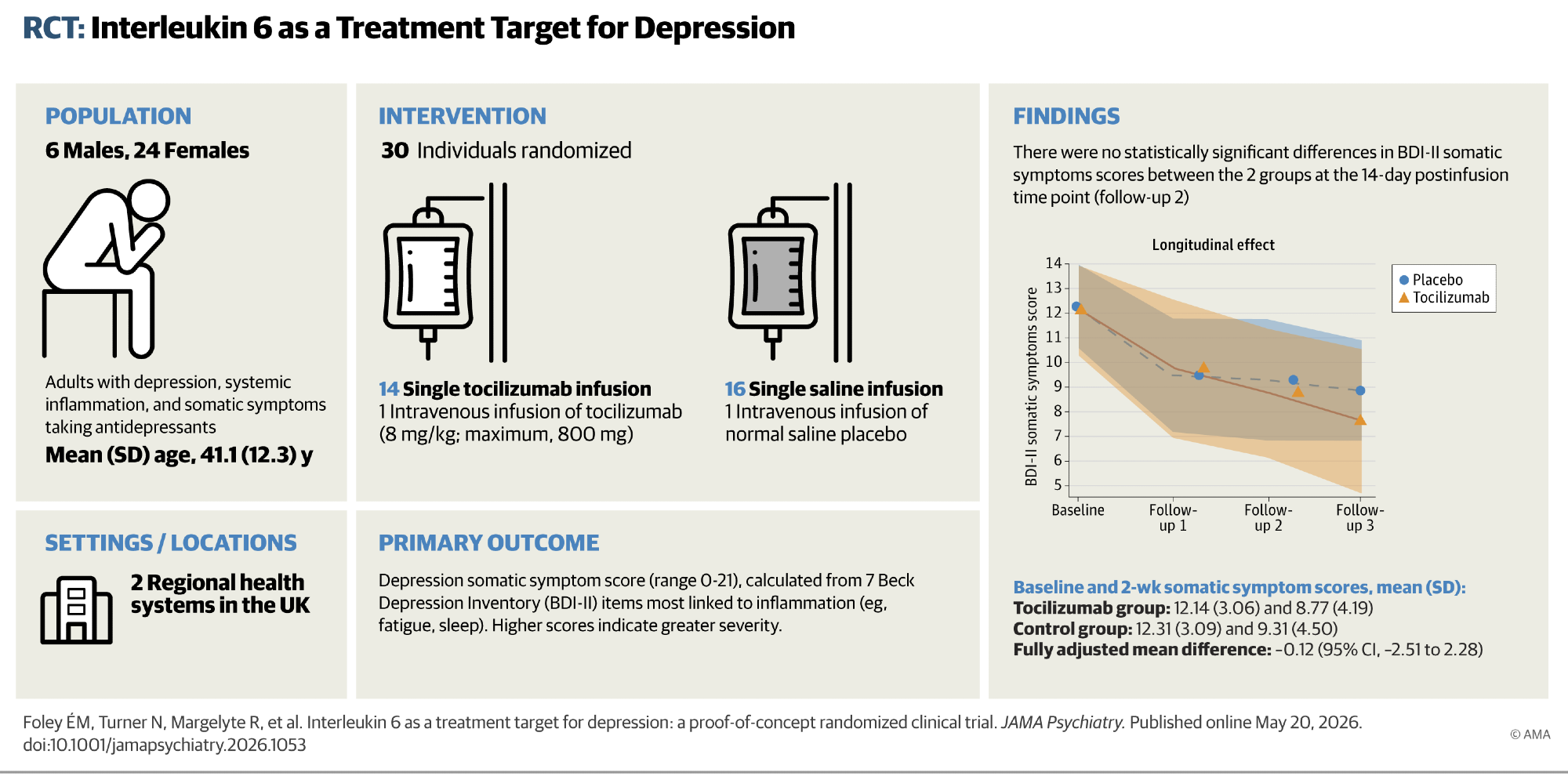
In a recent proof-of-concept randomized controlled trial (RCT) published in JAMA Psychiatry, researchers investigated whether systemic interleukin 6 receptor (IL-6R) inhibition with tocilizumab, an IL-6 receptor antagonist, could improve depressive symptoms among individuals with difficult-to-treat depression linked to low-level inflammation.
Tocilizumab therapy was associated with a pattern of greater stepwise improvement in depression severity, somatic distress, anxiety, and fatigue over time. The treatment also numerically favored remission and response rates. These changes correlated with initial high-sensitivity C-reactive protein (hs-CRP) better than IL-6 levels.
The findings highlight the potential of IL-6/IL-6R pathway inhibition as a treatment target for inflammation-associated depression. Such strategies may eventually be paired with repeat hs-CRP testing for patient selection, a simple, low-cost blood test, to predict treatment response and support broader access to precision-based care.
IL-6 is a well-known cytokine that can increase the levels of inflammation in the body. Scientists have found this molecule in high amounts in blood samples of people with difficult-to-treat depression. Blood-based markers such as hs-CRP are also higher in conditions linked to inflammation.
An increasing body of evidence also suggests inflammation may contribute to depression. Drawing on these findings, researchers have tested several anti-inflammatory drugs to treat depression. Most of these therapies, however, exert broad effects. This makes it difficult to identify specific pathways involved. High-quality clinical trials investigating whether targeting the IL-6/IL-6R pathway in patients can improve their depressive symptoms remain limited.
About the study
In this double-blinded RCT, researchers explored IL-6 as a potential target to develop treatments for difficult-to-treat depression with low-grade inflammation.
The trial comprised 30 individuals diagnosed with moderate-severe depression using the International Classification of Diseases, Tenth Revision (ICD-10) codes. These participants also had low-grade inflammation with hs-CRP levels of 0.30 mg/dL or above on two tests.
The study population had a high burden of somatic depressive symptoms, assessed using the Beck Depression Inventory II (BDI-II) scale, score ≥7. Researchers recruited participants from primary and secondary care centers, as well as those who self-referred, between October 2018 and June 2022 in the United Kingdom (UK).
The team randomly divided the participants into two groups balanced for gender and depression severity. One group received a single intravenous 8.0 mg/kg tocilizumab infusion (maximum dose: 800 mg per patient), n=14. The other group received a saline infusion (placebo), n=16. Researchers assessed outcomes at study initiation and at 1, 2, and 4 weeks after the infusion. They used the BDI-II scale to assess somatic symptoms two weeks post-infusion, the primary outcome, and depression severity, the secondary outcome.
The researchers used established scales to assess exploratory outcomes. These included anxiety, fatigue, cognition, anhedonia, and health-related quality of life (HRQoL). They used the following scales: the State-Trait Anxiety Inventory (STAI) for anxiety; the Multidimensional Fatigue Inventory (MFI) for fatigue; the Cambridge Neuropsychological Test Automated Battery (CANTAB) for cognition; the Snaith-Hamilton Pleasure Scale (SHAPS) for anhedonia; and the EuroQol 5-dimension 3-level (EQ-5D-3L) for HRQoL.
The team analyzed data between 2023 and 2025. They used multivariable regression models for statistical analysis. They also calculated risk difference (RD) and number needed to treat (NNT) values to estimate remission rates and assess treatment response.
Results
The mean age of the participants was 41 years; 80% were female. They were taking antidepressant medications. Over half of them (57%) used selective serotonin reuptake inhibitors (SSRIs). Tocilizumab therapy showed a pattern of greater stepwise improvement in depression severity, somatic symptoms, anxiety, and fatigue. The remission rate and symptom-level effects also numerically improved. However, the prespecified primary outcome, somatic symptoms at day 14, showed little difference between groups. After four weeks of infusion, researchers observed remission rates of 54% vs. 31%, RD=0.2, NNT = 5, with response rates of 46% vs. 19%, RD=0.2, NNT = 4, in the treatment vs. placebo groups. These findings favored tocilizumab numerically, although confidence intervals included no effect. The drug, however, could not improve cognition.
Since the study included only a few participants, the researchers could not determine whether the findings were statistically significant. They, nevertheless, considered the treatment to confer possible clinically meaningful benefits in reducing anxiety, fatigue, depression severity, and improving overall well-being. The improvements corresponded to initial hs-CRP levels rather than IL-6 levels. These findings suggest that hs-CRP could more reliably predict response to immune therapy. Tocilizumab was also well tolerated over four weeks for these patients. None of them withdrew from the study or reported serious adverse events.
Conclusions
The findings suggest that blocking IL-6-associated inflammation could offer a novel approach for people with depression linked to chronic inflammation. Such treatments could especially benefit patients who respond poorly to standard antidepressants. The findings also suggest that repeat hs-CRP testing may help identify patients most likely to benefit from IL-6-targeted treatments in future trials. Such efforts could eventually help improve resource allocation and treatment outcomes, thereby lowering the disease burden on individuals and healthcare systems.
By helping doctors choose treatments based on individual biological profiles, these treatments could also move depression care a step closer to precision medicine. In the future, trials should include larger populations and longer follow-up periods to validate these findings and make them more applicable to broader populations.
Download your PDF copy by clicking here.
 Add-on drug lumateperone boosts sexual function in patients with depression