A sweeping analysis of more than 800 studies challenges the idea of a universal “safe” drinking limit, finding stronger evidence for alcohol-related harms than for any uncertain health benefits.

Study: Health effects associated with alcohol consumption: a Burden of Proof study. Image Credit: Shchus / Shutterstock
In a recent comprehensive review published in the journal Nature Health, researchers synthesized the complex, often contradictory evidence on alcohol consumption and human health. The review analyzed data from over 800 observational studies to map statistically supported risk levels for twenty distinct diseases, including various cancers and cardiovascular conditions.
Review findings revealed that while light drinking may be associated with modestly lower risks for certain metabolic and heart conditions, the habit was found to simultaneously increase risks for numerous cancers, suggesting that universal safe-drinking thresholds may be difficult to justify.
Alcohol Guidelines and Evidence Gaps
Despite decades of research and extensive amounts of public health funding, the overall health impacts of alcohol consumption across diseases remain a subject of intense scientific debate. National alcohol consumption (drinking) guidelines are found to vary drastically across the globe, thereby leaving consumers confused about what constitutes a "safe" level of intake.
While previous meta-analyses have aimed to elucidate the association between alcohol consumption and human health, they have largely focused on isolated diseases and have failed to account for underlying study biases. A commonly cited example of this is known as the "sick quitter" effect, where people abstain from alcohol only because they are already ill.
Consequently, the widely accepted and popularized narrative that low-to-moderate drinking (up to 20 grams of pure alcohol daily) protects against cardiovascular disease (CVD) and type 2 diabetes (T2D) has been increasingly called into question. Unfortunately, the association between varying dosages and the broad spectrum of alcohol-associated chronic diseases remains unresolved.
Burden of Proof Review Methods
The present review aimed to address this knowledge gap by employing the Burden of Proof meta-analytic framework, a highly conservative mathematical model designed to objectively quantify the strength of evidence. The study combined data from sixteen systematic reviews across four major databases (PubMed, Embase, CINAHL, and Web of Science) through 2023 and encompassed 843 cohort and case-control studies.
Studies were screened to include those that reported relative risks for alcohol intake and twenty specific health outcomes (“clinical endpoints”), including ten types of cancer, four cardiovascular diseases, and six other conditions, e.g., tuberculosis and cirrhosis.
Statistical analyses included a Meta-Regression Bayesian, Regularized, Trimmed (MR-BRT) model to generate relative risk (RR) functions while systematically trimming out potential data outliers and adjusting for known study-design biases, a common example of which is previous studies failing to adjust for patient age.
The review also included a Burden-of-Proof Risk Function (BPRF) to represent the most conservative estimate of risk. These findings were finally translated into an easily understandable zero-to-five-star rating system for each specific disease.
Alcohol-Related Cancer and Liver Risks
The review’s findings revealed that even low alcohol intake levels were associated with increased risks of several cancers. The strongest evidence, a five-star rating, linked alcohol to other pharyngeal cancer, with the study demonstrating that 76 grams of alcohol per day was associated with a mean RR of 4.24 (95% uncertainty interval [UI]: 3.33–5.40), while the conservative BPRF estimate represented at least a 105% increased risk across the typical exposure range.
Moderate, three-star, evidence showed that alcohol was associated with substantially higher risk of cirrhosis and chronic liver diseases by at least 40% (RR 4.25, 95% UI: 1.87–9.66 at 61 grams per day). The data further revealed that colorectal, laryngeal, lip, and oral cavity cancers were similarly associated with alcohol consumption levels.
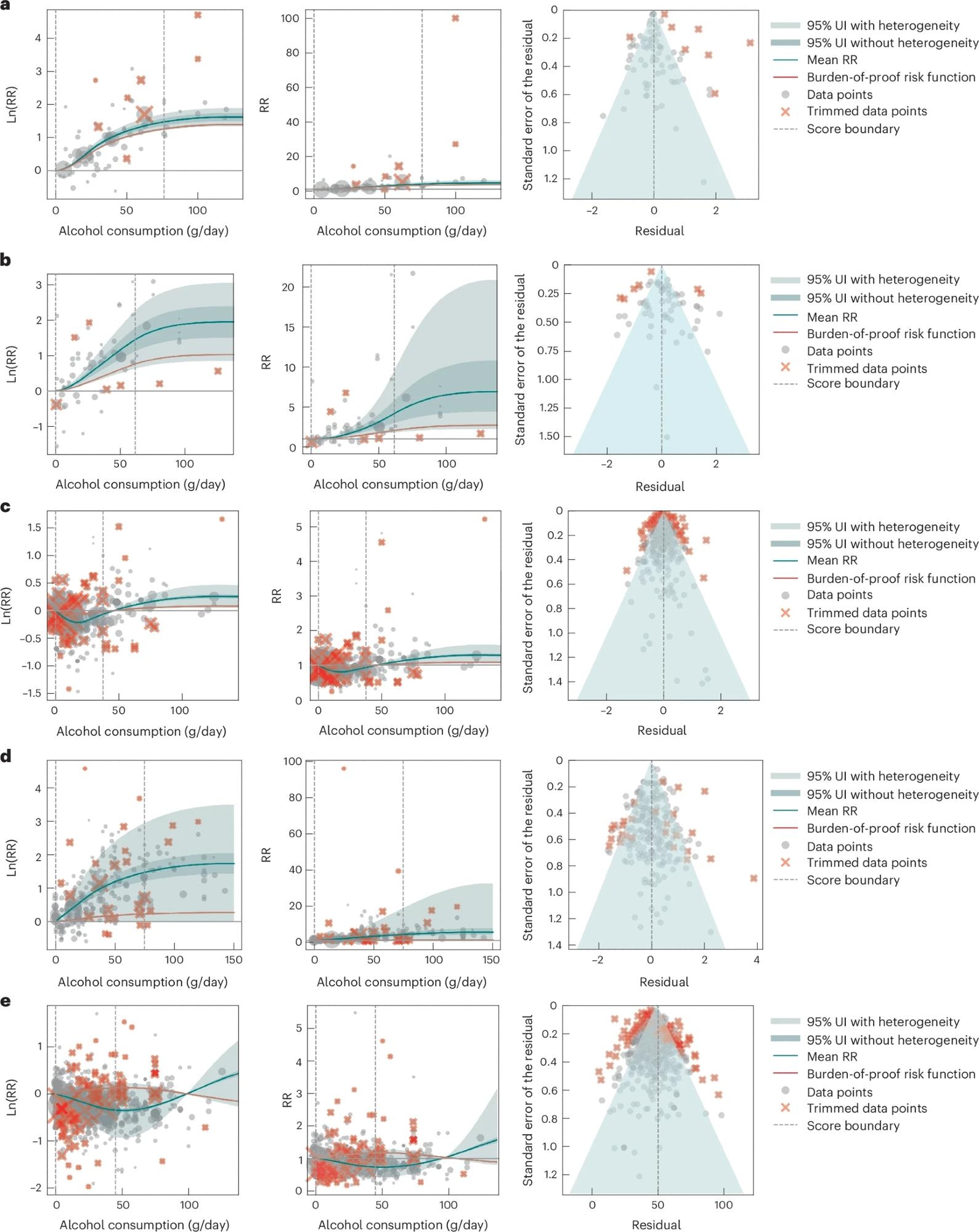
a, Alcohol consumption and other pharyngeal cancer. b, Alcohol consumption and cirrhosis and other chronic liver diseases. c, Alcohol consumption and type 2 diabetes. d, Alcohol consumption and oesophageal cancer. e, Alcohol consumption and ischaemic heart disease. The risk curves are computed relative to no alcohol consumption. In the left and middle plots, the dark line indicates the mean RR across alcohol consumption levels (in grams per day); the light and dark shading show 95% UIs with and without between-study heterogeneity, respectively, with the red line highlighting the burden-of-proof function; the size of the data points corresponds to the inverse of the standard error, with those trimmed during the model fitting process marked by a red x; and the dashed lines represent the 15th percentile of the reference exposure and the 85th percentile of the alternative exposure. To visualize log-RR points in the plots on the left, we plotted each data point with the x value at the midpoint of the alternative group and the y-value offset by the difference between the reported and predicted log risk. In the middle plots, we exponentiated the y values from the plots on the left to yield the RR curve. Shown on the right are customized funnel plots, with the x axis representing residuals between predicted and observed RRs, and the y axis representing uncertainty from both measurement error and between-study heterogeneity.
Light Drinking Benefits Remain Uncertain
Conversely, the review revealed a J-shaped or U-shaped relationship between alcohol consumption and several cardiometabolic conditions. Low-to-moderate drinking was found to be associated with weak, two-star evidence of reduced risk for T2D, a 5% reduction, and Alzheimer’s disease and other dementias (AD), a 6.4% reduction.
The review found that the theoretical minimum risk exposure level for T2D was 18 grams per day (RR 0.80, 95% UI: 0.67–0.97). However, the analyses found that at higher consumption levels, any protective metabolic associations rapidly disappeared, instead being replaced by severe and potentially chronic health detriments.
Safe Alcohol Thresholds Remain Difficult
The present review indicates that the well-documented cancer risks associated with alcohol use are supported by stronger and more consistent evidence than the modest and uncertain observational associations suggesting cardiometabolic benefits of light and moderate drinking. Because the data showed that even low levels of alcohol consumption were associated with higher risk for several, but not all, cancer outcomes, the researchers argue against universal, arbitrary safe-drinking thresholds such as the currently popularly prescribed 20 grams of pure alcohol daily limit.
Instead, public health strategies must pivot toward clear, evidence-based messaging that communicates these escalating risks. The authors also emphasized that the findings should not be interpreted as endorsing alcohol consumption for health benefits, because the lower-risk associations for cardiovascular disease, T2D, and dementia remain observational and uncertain. As the scientific community continues to refine its understanding of diet and disease, individuals should consider these findings carefully when making personal lifestyle choices.
Download your PDF copy by clicking here.
 Semaglutide trial targets people with liver disease, obesity and alcohol addiction