New lifetime-risk modeling challenges the idea that moderate drinking is physiologically safe, showing that alcohol-related death and disease risks begin rising at levels many Americans may consider routine.
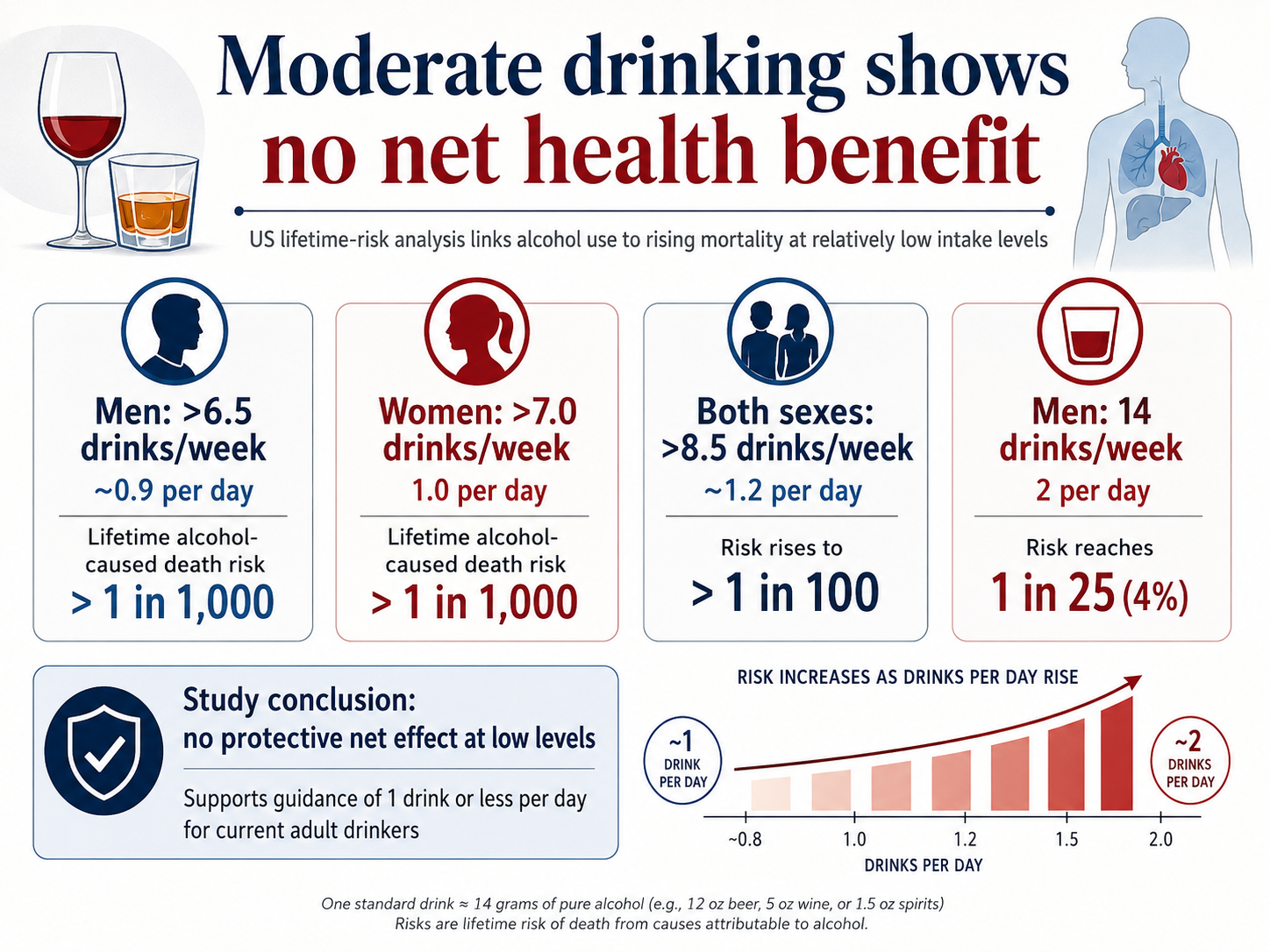
Image Credit: Created with OpenAI ChatGPT using data from George et al., Journal of Studies on Alcohol and Drugs, 2026.
In a recent study published in the Journal of Studies on Alcohol and Drugs, researchers reassessed the popular belief that drinking in moderation is physiologically safe by calculating absolute lifetime mortality risks associated with weekly alcohol consumption in the United States. The study used a cause-specific mathematical model on nationwide datasets to investigate how drinking volumes and per-occasion patterns impact population-level lifetime mortality and morbidity risk.
Study outcomes did not support claims of a net protective effect from moderate drinking by demonstrating no evidence for any net protective health benefits, even at low-to-moderate alcohol consumption thresholds. Instead, the findings revealed that drinking volume and per-occasion patterns were associated with rising absolute health risks, prompting the authors to recommend tightening national guidance to no more than one standard drink daily for current adult drinkers.
Alcohol Risk and Guideline Gaps
Despite being causally linked to more than 200 health conditions and estimated to be responsible for 178,000 deaths annually, alcohol is widely consumed in the United States. While decades of research have aimed to elucidate the long-term physiological outcomes of frequent drinking, this pursuit has historically faced major roadblocks.
Reviews indicate that traditional all-cause mortality studies often suffer from "sick-quitter bias," where former drinkers who quit due to poor health are misclassified as abstainers, leading to the false interpretation that light drinking may improve physiological health.
Alarmingly, the evidence from these studies was likely an important contributor to previous federal guidelines on safe drinking. US federal guidelines used to permit up to two daily drinks for males, a baseline that modern evidence suggests may mask meaningful long-term health hazards.
Cause-Specific Alcohol Modeling
The present study aimed to address this knowledge gap and inform future US public health alcohol consumption guidelines by mapping cause-specific lifetime risks across the spectrum of alcohol consumers within the American population.
The study calculated absolute risk curves by implementing a multi-method, cause-specific modeling approach that integrated long-term mortality and demographic data from several national sources, including the National Vital Statistics System, 2022 US mortality statistics, the US Census Bureau for demographic data, national alcohol-use surveys, injury surveillance systems, and morbidity estimates from the Institute for Health Metrics and Evaluation.
Because alcohol consumption in national surveys is self-reported, which is known to capture only 40-60% of alcohol consumption and sales, the study upshifted survey averages to match 80% of adult per capita sales data, specifically modeling population intake via a gamma distribution.
Meta-analytic relative risks for conditions causally linked to alcohol were selected by experts in the field. Unlike previous studies, these relative risks utilized lifetime abstainers as the reference group to minimize selection bias. The study’s primary endpoints included absolute lifetime mortality, years of potential life lost, and disability-adjusted life years.
Weekly Drinking Raises Mortality Risk
The study’s analyses demonstrated that low-level consumption offers no statistically significant net protective health effects, emphasizing that elevated lifetime alcohol-attributable mortality risks crossed the 1 in 1,000 threshold at just over 6.5 drinks per week for males and 7.0 drinks per week for females.
The analyses revealed a lifetime alcohol-attributable mortality risk exceeding 1 in 1,000 when males consume over 6.5 drinks per week, and females consume over 7.0 drinks per week. Strikingly, this risk was found to jump tenfold to 1 in 100 when the weekly consumption of either sex exceeded 8.5 standard drinks per week.
Crucially, the findings highlighted that at 14 drinks per week for males, the upper limit of former federal recommendations, the risk of an alcohol-caused death climbs to 1 in 25, 4% absolute mortality probability. The findings further identified that increased alcohol consumption disproportionately impacts female health. At 14 drinks per week, the relative risk of death from liver cirrhosis was found to be 2.10 for males, compared to 5.38 for females.
Finally, per-occasion drinking patterns were observed to substantially alter population-level health risks. Specifically, consuming over one drink per occasion was shown to exacerbate the risk of breast cancer, intoxication-associated injury, and cardiovascular disease (CVD).
Binge drinking was shown to offset or reverse some protective cardiovascular associations reported in moderate drinkers without binge episodes. Younger adults under 40 display acute vulnerability, with most alcohol-attributable deaths driven by road traffic crashes, other unintentional injuries, and intentional injuries.
Alcohol Guidance and Public Health
The present study adds to a growing body of empirical evidence highlighting the negative role of alcohol on human physiology, emphasizing that alcohol consumption, even in moderation, is associated with higher modeled lifetime alcohol-attributable mortality and morbidity risks compared to true abstinence.
To address this burden, the evidence supports changing federal guidelines to recommend that current adult drinkers consume no more than 1 standard drink per day. Consequently, the authors advocate for government-supported alcohol-control measures, clearer drinking guidance, container health warnings, and routine medical screening to counteract the growing burden of alcohol-associated annual mortality across the country.
Download your PDF copy by clicking here.
Journal reference:
- George, S., et al. (2026). Alcohol Intake and Health Study: No Protective Effect at Low Levels, With Mortality Increasing to 1 in 25 at 14 Drinks Per Week. Journal of Studies on Alcohol and Drugs, 87(4), 621–638. DOI: 10.15288/jsad.25-00435. https://www.jsad.com/doi/10.15288/jsad.25-00435
 Alcohol-free beer looks cheaper on the shelf, but the checkout tells a different story