A nationwide Finnish study shows that oral semaglutide was linked to meaningful metabolic improvements in everyday diabetes care, including among older adults who are often underrepresented in clinical trials.

Study: Nationwide Real-World Retrospective Study of Oral Semaglutide Use in Adults Living With Type 2 Diabetes in Finland. Image Credit: Piyaset / Shutterstock
In a recent study published in the journal Diabetes, Obesity and Metabolism, researchers conducted a nationwide Finnish study to evaluate the real-world effectiveness and clinical outcomes of oral semaglutide. The study included more than 7,000 adults with type 2 diabetes (T2D) who initiated oral semaglutide treatment between April 1, 2021, and December 31, 2023.
Study findings showed that oral semaglutide use was associated with significant improvements in blood sugar control, reduced body weight, improved several lipid markers, and reduced alanine aminotransferase (ALT), a liver enzyme marker, in study participants. Notably, the study found that once-daily oral semaglutide was associated with lower HbA1c levels and 12-month weight loss across diverse age groups, including adults aged 75 years and older.
These findings support the real-world therapeutic effectiveness of oral semaglutide outside highly controlled clinical trials.
Background
Despite decades of research, type 2 diabetes (T2D) remains a progressive global health challenge. Recent records highlight that T2D is more prevalent in older adults, with prevalence peaking after age 80.
While the development of glucagon-like peptide-1 receptor agonists (GLP-1RAs) has expanded diabetes care, the bulk of the literature on these medications derives from tightly controlled clinical trials (e.g., Phase III trials such as the global PIONEER program), with only a few studies investigating their real-world effectiveness.
Reviews on the topic highlight that while clinical trials are essential to ensure a drug's safety and performance prior to widespread (routine) administration, their inherent rigidity in participant selection leaves critical gaps regarding how these medications perform in routine clinical practice, especially among elderly or frail patients and similar high-risk populations.
Furthermore, previous clinical studies have often suffered from small sample sizes or limited medical databases, thereby restricting their broader generalizability and use as proxies for performance estimates in routine clinical practice.
About the Study
The present study aimed to address this knowledge gap by conducting a nationwide retrospective observational study using Finland's comprehensive national health registers.
The study population included 7,249 adult patients with registry-identified T2D who initiated prescribed oral semaglutide (a GLP-1 receptor agonist) treatment between April 1, 2021, and December 31, 2023. Patients were screened to include only those who were GLP-1RA-naïve, defined as having no recorded GLP-1RA purchases during the 365-day pre-index period, in the final analytical dataset.
Participants included in the study were followed through June 30, 2024, ensuring a minimum observation period of 180 days. The study’s primary endpoints were changes from baseline in glycated hemoglobin (HbA1c, a marker of long-term blood sugar levels) and total body weight at 182.5 days and 365 days post-initiation.
Secondary endpoints evaluated broader cardiometabolic and liver-enzyme health indicators, including low-density lipoprotein (LDL) cholesterol, high-density lipoprotein (HDL) cholesterol, total cholesterol, triglycerides, the HDL/triglycerides ratio, and ALT. Statistical analyses included linear mixed-effects modeling to track changes in the outcomes under investigation.
Study Findings
Study analyses of real-world oral semaglutide outcomes revealed that among the patients included in the longitudinal trajectory modeling, mean HbA1c levels sharply decreased from a baseline of 7.9% to 6.8% at 6 months (p < 0.001), maintaining a stable level of 6.9% at the 12-month mark (p < 0.001), thereby suggesting that the glycemic improvement was maintained through one year.
Weight loss outcomes were similarly positive, with participants demonstrating a mean body weight reduction from 106 kilograms at baseline to 100 kilograms at 6 months (p < 0.001), dropping further to 98 kilograms by the end of one year (p < 0.001).
Analysis of participants’ cardiovascular and metabolic risk markers also showed significant improvement. LDL cholesterol dropped from a baseline of 2.5 mmol/L down to 2.0 mmol/L at 6 months (p < 0.001), and liver enzyme marker ALT fell from 50 U/L at baseline to 42 U/L at 6 months, reaching 37 U/L at 12 months (p < 0.001).
Among participants aged 75 years or older (n = 920), significant glycemic and weight reductions were also observed, although analyses of HbA1c and weight trajectory included smaller subgroups of 349 and 104 patients, respectively.
Finally, the study revealed sex differences in observed outcomes, with women achieving greater relative weight loss than men over the year, with estimated 12-month reductions of 9 kilograms in women compared with 7 kilograms in men.
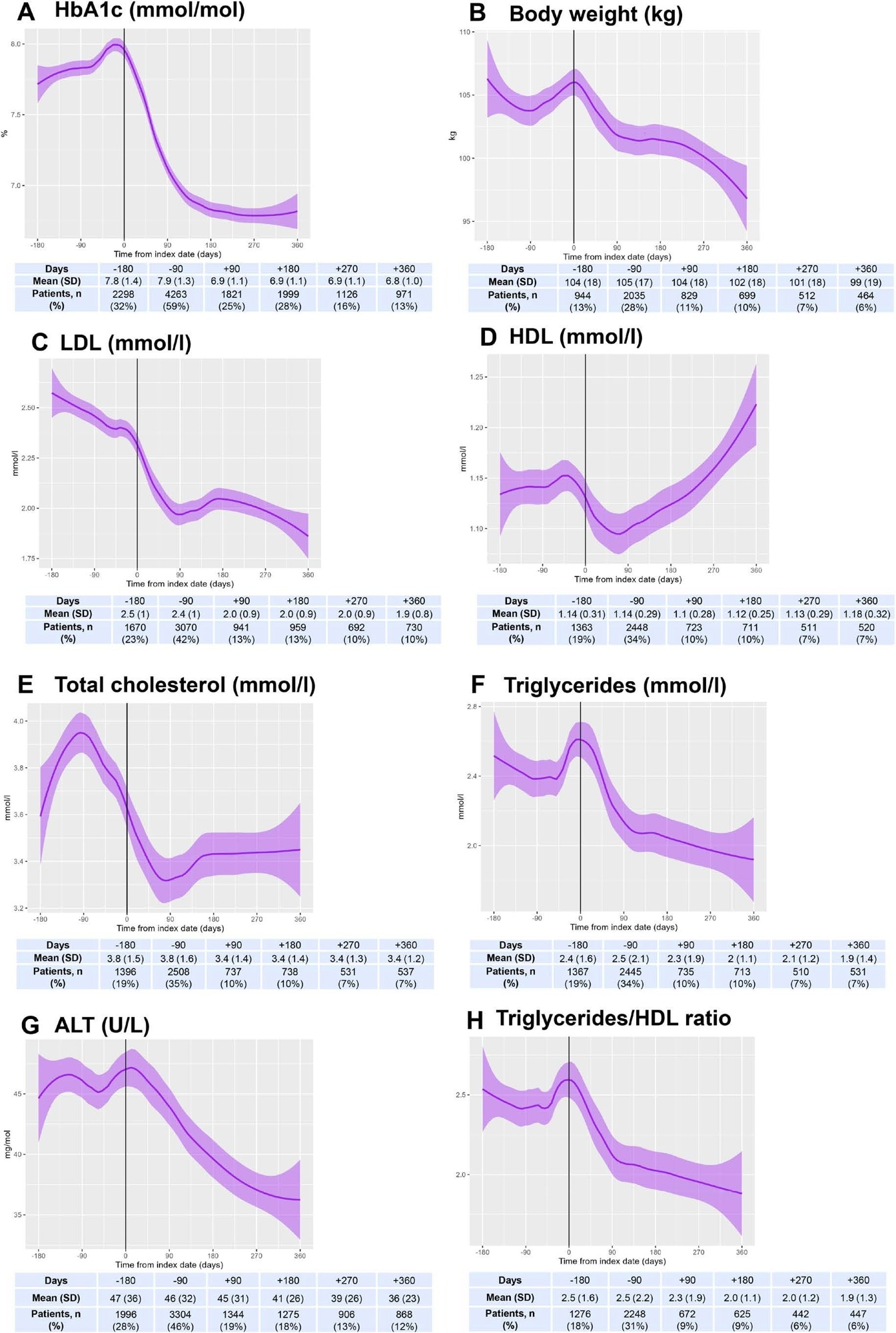
Progression of HbA1c (A), weight (B), LDL (C), HDL (D), total cholesterol (E), triglycerides (F), ALT (G), and triglycerides/HDL ratio (H) relative to the index date. Changes in measurements are presented as smoothed linear trends with 95% confidence intervals, using a 90-day time window.
Conclusions
The present nationwide Finnish registry study suggests that oral semaglutide delivers clinically relevant improvements across several metabolic markers in everyday clinical practice. It fills critical gaps in the medical literature by supporting the medication's real-world effectiveness in older adults aged 75 and older and demonstrating positive effects on ALT, a liver enzyme marker.
While the authors noted that 45% of participants discontinued oral semaglutide treatment at one year and acknowledged the inherent reliance of their methodology on sometimes partially incomplete routine clinical records, the study also lacked a control group and could not account for potential confounding from medication changes or lifestyle factors. Because of these limitations, the findings should be interpreted as real-world associations rather than definitive causal evidence.
Overall, the study supports the real-world effectiveness of oral semaglutide for glycemic control, body weight reduction, lipid markers, and ALT improvement in adults with T2D who met Finnish reimbursement criteria, while highlighting the need for further controlled research on longer-term persistence and liver-related outcomes.
The work was supported by Novo Nordisk Pharma, and several authors reported financial relationships with Novo Nordisk or employment/shareholdings with the company.
Download your PDF copy by clicking here.
 Study shows circadian rhythms vary across different cell types