A new study shows how a lowered WHO guideline transforms manganese from an overlooked nuisance into a global groundwater concern, with untreated wells across Asia and other hotspots driving the largest risks.
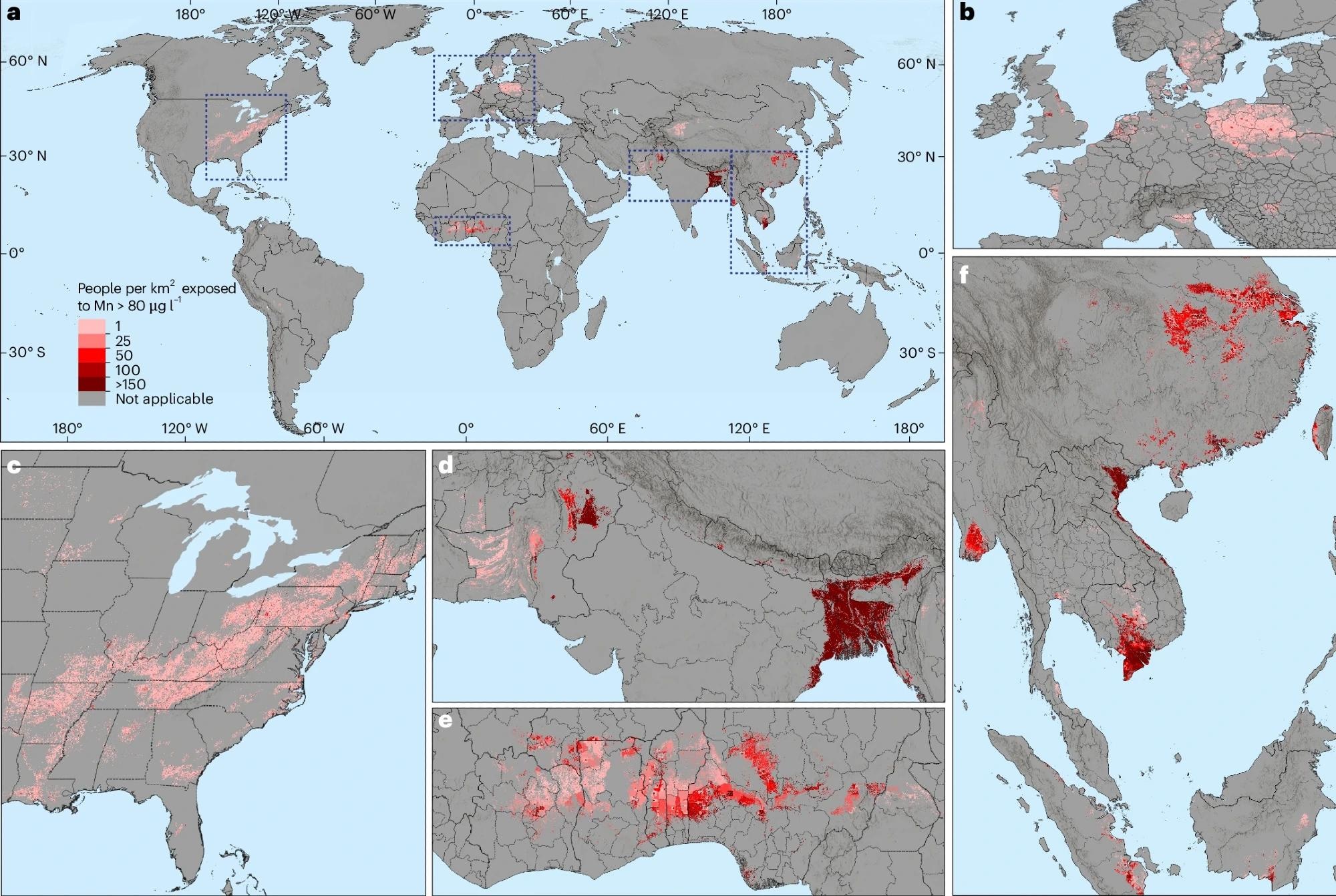
a, Global risk map showing the density of population consuming untreated groundwater containing at least 80 µg l−1 of Mn. This was produced by applying a cut-off of 0.5 to the groundwater Mn probability hazard map in Fig and overlaying the rural and urban population density in 2025 while accounting for national-level groundwater use rates in both of these settings. Dashed boxes in (a) indicate the locations of detailed views of high-risk areas of Europe (b), the eastern USA (c), South Asia (d), West Africa (e) and East and Southeast Asia (f). g, Comparison of the global affected population by continent for the concentration thresholds of 400 µg l−1 (old WHO guideline), 80 µg l−1 (current WHO guideline) and 50 µg l−1 (EU guideline). These estimates are also provided in Table 1. Supplementary Fig. 2 shows the population risk maps of all three concentration thresholds, including an estimated area of applicability. Basemap administrative boundaries data in a–f from Natural Earth (https://www.naturalearthdata.com). Study: Manganese, a hidden threat to global water quality and health
In a recent study published in the journal Nature Water, researchers employed a machine learning (ML)-based modeling approach to estimate the extent of elevated manganese levels in untreated groundwater.
Against the backdrop of the World Health Organization's (WHO) decision to lower its guideline from 400 to 80 micrograms per liter (µg/L) to protect infant neurological health, the study revealed that about 180 to 220 million people worldwide may be at risk of consuming manganese above the updated WHO guideline via untreated groundwater, a four- to fivefold increase from previous estimates.
This research highlights an urgent need to incorporate manganese into global water monitoring frameworks alongside better-known geogenic contaminants such as arsenic and fluoride.
Background
Groundwater sustains roughly half of the global population and has long served as a critical buffer against the ongoing impacts of climate change. While public health campaigns aggressively target high-profile contaminants like arsenic and fluoride, manganese has historically evaded serious scrutiny.
Reviews in the field attribute this lack of attention to water managers who view manganese primarily as an aesthetic nuisance that causes foul tastes or stains and clogs plumbing infrastructure, rather than a significant threat to human well-being.
Recent toxicological insights, however, challenge this worldview, establishing that while dietary manganese from food is essential, elevated concentrations dissolved in drinking water may contribute to neurological effects. Several epidemiological studies have linked chronic manganese exposure with cognitive deficits and behavioral disorders, particularly in children and infants, who are considered the most sensitive population.
Given this emerging evidence, the World Health Organization (WHO) in 2021 lowered its provisional drinking water guideline from 400 µg/L to a substantially more protective 80 µg/L. Consequently, many wells that were below the previous WHO guideline may now exceed the updated provisional guideline, necessitating a renewed global reassessment of water safety.
About the Study
The present study aimed to address this pressing need by designing a comprehensive global spatial mapping project that leverages machine learning (ML) algorithms to assess the status of groundwater worldwide, specifically its manganese content. The study’s dataset comprised an unprecedented 295,475 unique groundwater manganese measurements.
To focus on aquifers more likely to be used by domestic wells, the researchers excluded samples from reported depths greater than 100 meters, while retaining measurements without reported depth, leaving a final modeling dataset of 224,804 data points.
The ML algorithm used was a random forest model trained to correlate these measurements with continuous global environmental layers. Study parameters focused on climate, including aridity and precipitation patterns; topography, including elevation and terrain roughness; soil traits, including organic carbon density and silt percentage; and hydrogeology, including regional rock and sediment types accounted for in the analyses.
The model’s predictive accuracy was high, achieving a standard stratified random cross-validation Area Under the Receiver Operating Characteristic (AUC) of 0.84-0.85. Spatial cross-validation accuracy estimates provided a more conservative test of geographic transferability, with AUCs ranging from 0.72 to 0.75, thereby supporting the model’s global-scale utility while retaining uncertainty in data-sparse regions.
Study Findings
The study’s hazard maps reveal widespread manganese hotspots distributed across all inhabited continents. By overlaying these maps with global population density and rates of reliance on untreated groundwater, the study estimated that between 180 and 220 million people could consume untreated groundwater exceeding the new 80 µg/L threshold, a fivefold increase from the previous estimate of 45 million at the former 400 µg/L guideline.
Furthermore, the study emphasizes that adopting the stricter European Union guideline of 50 µg/L would expand this figure to about 358 million. Geographical risk estimates showed that more than 90% of exposed individuals live in Asia, particularly in the Ganges-Brahmaputra Delta across Bangladesh and India, Pakistan's Punjab region, the Mekong and Red River deltas in Vietnam, eastern Sumatra, and areas along the lower Yangtze River in China.
Other major global hotspots outside this region include the eastern United States, northern Europe, and West Africa. Finally, the study revealed an important geochemical pattern: modeled high-manganese and high-arsenic areas overlap only to a limited extent, at about 4.2%.
The authors attributed this to manganese’s tendency to dissolve under substantially milder reducing conditions than arsenic. Consequently, wells determined to be safe for arsenic may still contain elevated, and in some cases high, concentrations of manganese.
Conclusions
The study’s findings indicate that, despite global manganese exposure being comparable with estimates for arsenic and fluoride contamination, this groundwater contaminant receives far less critical attention from international groundwater monitoring programs and authorities.
Encouragingly, the authors emphasize that manganese is among the least expensive groundwater contaminants to treat, while arsenic treatment is estimated to cost two to five times more and often removes manganese at the same time. Basic treatment techniques like aeration and rapid sand filtration can be effective for both municipal plants and private wells.
The study concludes by recommending that international bodies incorporate manganese into routine groundwater monitoring campaigns and presents the outcomes of the ML algorithm as a spatial tool for identifying high-risk aquifers and safeguarding public health. However, the authors stress that the maps indicate where guideline-exceeding concentrations are more or less likely to occur, and that actual manganese levels can only be confirmed through groundwater testing.
 Prenatal cannabis exposure linked to subtle brain and behavioral differences in children