AMT Medical B.V., a clinical-stage Dutch medical technology company, today announced that the one-year results of the SAFE-CAB II clinical trial have been published in The Journal of Thoracic and Cardiovascular Surgery. The study is the first prospective clinical evaluation of the ELANA® Anastomotic System, a new technology designed to make coronary artery bypass grafting (CABG) more reproducible and accessible to a far broader group of patients.
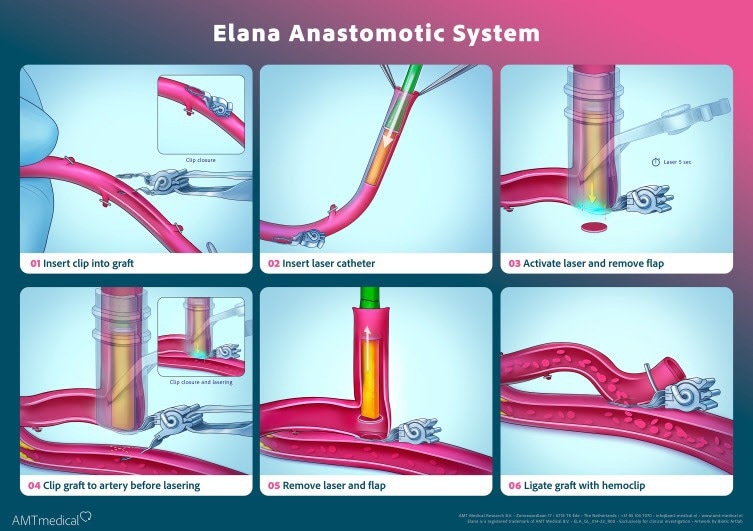 Image Credit: AMT Medical B.V.
Why this matters, for patients and for healthcare systems
Coronary artery bypass grafting is the most durable treatment for advanced coronary artery disease, with around one million procedures performed worldwide every year. Despite decades of innovation, the most critical step of the operation, sewing the bypass graft onto the diseased coronary artery by hand, has remained essentially unchanged since the 1960s. It is delicate, time-consuming, and the single technical step most often cited by surgeons as the obstacle to wider use of minimally invasive and robotic bypass techniques.
The ELANA® Anastomotic System replaces that hand-sewn connection with a small titanium clip and a precisely controlled laser pulse. The connection is made before the artery is opened, so the coronary artery never has to be clamped or temporarily blocked, blood keeps flowing throughout the procedure.
For patients. A sutureless, flow-preserving connection is a foundational enabler of minimally invasive and robotic CABG, approaches associated in the published literature with smaller incisions, less surgical trauma, shorter hospital stays, faster return to daily life and a reduced risk of complications compared with traditional open-chest surgery. SAFE-CAB II now provides the first prospective clinical evidence that this enabling technology is safe and effective in human use.
For surgeons and hospitals. A defined, six-step mechanical procedure replaces a hand-sewn step requiring 8–12 hand-sewn stitches per anastomosis, that today is highly skill-dependent. By removing the human-factor variability inherent to hand-sewing, the procedure is designed to reduce variation regardless of which surgeon performs it.
For healthcare systems. The shorter recovery, fewer complications and shorter ICU and hospital stays associated with minimally invasive bypass approaches create the potential for meaningful improvements in capacity utilization and cost efficiency, where freed-up capacity can be put to use. An internal health-economic assessment, based on benchmark data from major CABG literature, estimates that, at scale, direct CABG-related hospital costs could be reduced by 35-50% relative to conventional open-chest CABG, with additional productivity gains for working-age patients through faster return to work.
For the first time, a rigorous prospective trial shows that the most challenging step of a bypass operation can be performed without sutures on a beating heart, and without ever interrupting blood flow to the patient’s coronary artery. That is genuinely new. It is the technical breakthrough the field has been waiting for to make modern, less invasive bypass surgery available to many more patients than today.”
Bart P. van Putte, MD PhD, Principal Investigator; Department of Cardiothoracic Surgery, St Antonius Hospital, Nieuwegein, and Amsterdam UMC
The SAFE-CAB II trial in brief
SAFE-CAB II (registered as DRKS00020545 and NCT07005843) is a prospective, single-arm clinical trial conducted at St Antonius Hospital in Nieuwegein, The Netherlands, in close collaboration with Deutsches Herzzentrum der Charité in Berlin, Germany. Between June 2023 and September 2024, 71 patients undergoing elective CABG received the bypass connection between the left internal thoracic artery and the left anterior descending coronary artery, the most clinically important bypass in the operation, using the ELANA® system. Patients had an average age of 71 years; the average number of bypass connections per patient was 3.5.
All angiographic data were independently reviewed by Cardialysis (Rotterdam, The Netherlands), one of the leading academic core laboratories in cardiovascular research. The trial was monitored end-to-end by an independent contract research organization (HEMEX AG) under the continuous oversight of an independent Data Safety Monitoring Board, and conducted in compliance with the Declaration of Helsinki, the EU Medical Devices Regulation, and ISO 14155 and 14971 standards.
What the data show
- Primary endpoint met: device-related serious cardiac events at one year occurred in 2.9% of patients, statistically non-inferior to the historical surgical benchmark (p = 0.0033).
- Six-month patency: 92.5% across the full trial, and 97.5% in the subgroup treated with the latest-generation laser catheter. These rates match the upper range of what is reported for the best hand-sewn bypasses.
- In a subset of patients with an angiographically uncertain result, intravascular ultrasound confirmed the bypass connection was fully open and unobstructed.
- Total one-year serious cardiac events was 8.7%, as expected.
- No safety concerns related to the device were identified by the independent Data Safety Monitoring Board.
How the ELANA® Anastomotic System works
The ELANA® technology was originally developed at UMC Utrecht in the Netherlands for bypass surgery in the brain, received CE marking in 2008 and FDA clearance in 2012 for that indication, and has since been used in more than 1,000 patients worldwide. Over the past decade, AMT Medical’s team has re-engineered the platform specifically for the coronary anatomy, with extensive preclinical validation including ex-vivo human hearts and large-animal studies.
In the operating room, the surgeon uses the ELANA® system to attach a small titanium clip to the coronary artery and then fires a controlled laser pulse that creates a clean opening within the clip. The connection is made in a fully defined six-step sequence rather than relying on hand-sewn stitches one at a time. Because the connection is made before the artery is opened, blood continues to flow to the heart muscle throughout the procedure. The six-step procedure is described in detail in a separate peer-reviewed technical publication in the Journal of Visualized Surgery.
Market opportunity and next steps
Coronary artery disease is the leading cause of death globally, and CABG remains the most durable treatment for its most advanced forms. The global CABG device market represents a substantial and recurring annual opportunity, and is expected to expand further as the percentage of procedures performed using minimally invasive and robotic approaches grows. Today, the lack of a reliable sutureless connection technology is widely viewed as the single most important barrier holding that transition back.
With SAFE-CAB II peer-reviewed and published, AMT Medical now has the clinical foundation to move into the next phase of its commercial and regulatory pathway:
- Preparing CE marking for open and MIDCAB (minimally invasive direct coronary artery bypass) indications under the EU Medical Devices Regulation.
- Preparing an Investigational Device Exemption submission with the U.S. Food and Drug Administration for an Early Feasibility Study, in collaboration with leading U.S. cardiac surgery centers with discussions currently underway with several leading academic centers.
- Initiating the next generation of clinical trials in minimally invasive and robotic settings, including a planned multivessel investigation.
- Continuing the two-year follow-up of the SAFE-CAB II cohort.
Earlier this year, AMT Medical appointed Geert van Gansewinkel as Chief Executive Officer to lead the company through this next growth phase. Mr. van Gansewinkel joined AMT Medical from GATT Technologies, where as CEO he led the company through CE marking in 2023, FDA PMA approval in 2025, and a successful acquisition by Johnson & Johnson in 2025. Founder Rutger Tulleken transitioned to the role of Founder and Strategic Advisor, where he continues to support platform innovation, intellectual property development, grant funding and collaboration with surgeons and research institutions. AMT Medical has raised over EUR 40 million to date, including a USD 25 million Series B in 2025 led by Bender Analytical Holding B.V., with participation from Invest-NL, the European Innovation Council Fund and Oost NL.
“Peer-reviewed publication in JTCVS is a defining milestone for AMT Medical. It places the ELANA platform on a solid clinical foundation, independently adjudicated and reviewed by the international cardiothoracic surgery community. We now have everything we need to take the next steps: CE marking for open and MIDCAB indications, an IDE submission with the FDA in collaboration with leading U.S. centers, and the next generation of trials in minimally invasive and robotic surgery. Our goal is simple, to make high-quality bypass surgery, with faster recovery and fewer complications, available to far more patients than today,” says Geert van Gansewinkel, Chief Executive Officer, AMT Medical B.V.
How does AMT’S ELANA® system work?. Video Credit: AMT Medical B.V.
 Molecular mapping reveals hidden cellular programs in heart transplant rejection