Researchers put a standard 300 mg caffeine dose to the test across memory, executive function, mood, temperature, and sport-like agility under tightly controlled early-morning conditions.
Study: Effects of Acute Caffeine Ingestion on Morning Temperature, Mood, Reactive Agility and Cognitive Measures in Males: A Standardized Approach. Image Credit: Timothy OLeary / Shutterstock
In a recent study published in the journal Nutrients, researchers investigated whether 300 mg of caffeine (CAFF) affects morning cognitive performance, reactive agility, temperature, mood, withdrawal symptoms, appetite, and satiety in naïve-mild habitual CAFF consumers.
Background
Morning performance can vary with time of day: diurnal differences range from 9.0% to 34.2% for reaction time, 7.3% for alertness, and 7.8% to 40.3% for attention. Athletes must perform early because of tournament schedules, training needs, and environmental considerations. CAFF is used to increase arousal and reduce fatigue by antagonizing adenosine receptors, and research suggests morning effects may involve alertness, vigilance, sustained attention, reaction time, and energy. However, earlier studies have suffered from inconsistent dosing and timing, inadequate familiarization, and limited control over chronobiological factors. Further research is needed to clarify CAFF’s effects on morning cognition and agility.
About the study
The secondary analysis included 51 healthy, recreationally active males aged 18-30 years who habitually consumed less than 150 mg of CAFF daily. The researchers selected low habitual consumers partly to minimize withdrawal effects during the non-caffeine conditions. Participants completed six laboratory visits: three familiarization sessions at 12:00 h and three experimental sessions separated by at least 72 h. Experimental conditions were CAFF 300 mg, placebo (PLAC; maltodextrin), and an open-label no-pill control (NoPill) in a counterbalanced crossover design. CAFF and PLAC were ingested at approximately 06:30 h, and these trials were double-blind. Participants maintained a standardized sleep schedule, avoided CAFF and alcohol for 24 h and intense exercise for 48 h before testing, and replicated a prescribed diet during the preceding 24 h. They arrived at the laboratory in a fasted state.
The study formed part of a broader research program. Mood, sleep, and CAFF withdrawal findings had been reported previously, as had cognitive data from a subset of 17 participants, whereas reactive agility data had not been reported.
Cognitive performance was assessed with the trail-making test (TMT), Rey’s Auditory Verbal Learning Test (RAVLT), and Stroop word-color interference test. Rectal temperature and mean skin temperature were measured after 30 min of rest and following a warm-up. A reactive agility test (RAT) was completed twice by 27 participants. Mood, sleep, CAFF withdrawal, hunger, and satiety were assessed by questionnaires. General linear models with repeated measures were used for the analyses, with body mass included as a covariate for most outcomes. Reactive agility outcomes were analyzed using repeated-measures ANOVA without adjustment for body mass. The analyses also included standard checks of statistical assumptions, pairwise comparisons, and effect sizes.
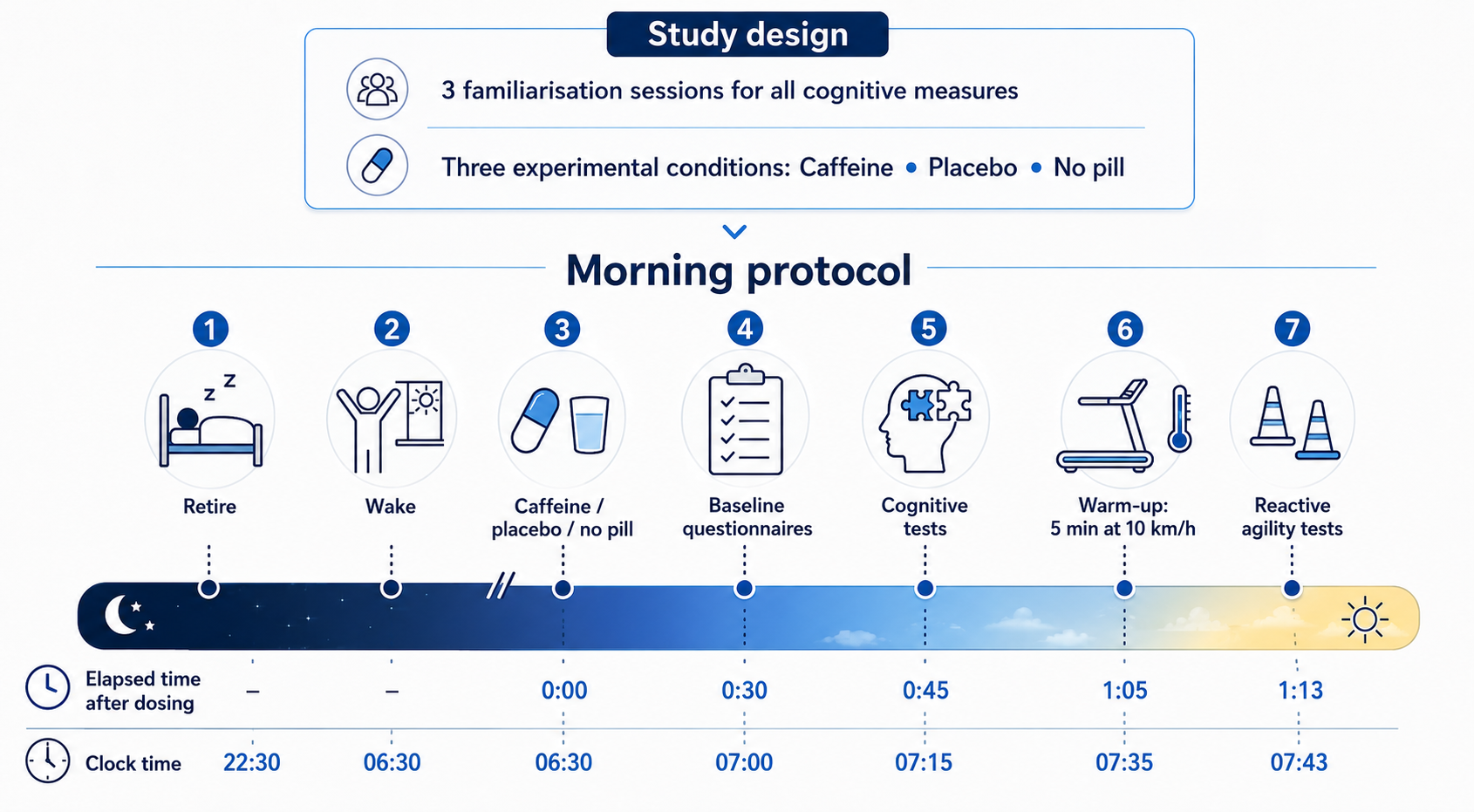
Schematic representation of the research design and experimental protocol undertaken by participants in the investigation. The first/top timeline starts from waking, when pills were taken; 30 min later, participants arrived at the laboratory, through to the completion of the reactive agility tests. The bottom timeline starts from retiring and ends with finishing the testing. In both timelines, the points are 15 min earlier or later, depending on individual scheduling. The thermometer represents rectal and mean skin (Tr and Tsk) temperature measurements. The clipboard indicates where subjective resting ratings through questionnaires (Q’s) and cognitive tests were undertaken. Participants were asked to identify their condition just before the warm-up and immediately after the reactive agility test.
Study results
Across the three experimental conditions, CAFF was not associated with differences in rectal temperature or mean skin temperature, with or without adjustment for body mass. Resting rectal temperature values were similar across NoPill, CAFF, and PLAC. Across conditions, mean skin temperature decreased by 0.88 °C from rest to post-warm-up, although this effect was no longer evident after accounting for body mass. Rectal temperature did not change significantly after warm-up. The authors attributed the decrease in skin temperature to peripheral heat dissipation associated with exercise rather than to a CAFF effect.
Hunger, fullness, desire for sweet or savory foods, physical tiredness, sleepiness, energy, and lethargy were similar among the three conditions, regardless of body mass. Sleep-related ratings, including ease of falling asleep, time to fall asleep, perceived sleep quality, wake time, and alertness upon waking, were also comparable across conditions. Tiredness and alertness ratings, as well as Stanford Sleep Questionnaire scores, also did not differ. Profile of Mood States (POMS) measures and CAFF withdrawal symptoms likewise remained similar between NoPill, CAFF, and PLAC.
For the RAT, completed by 27 participants, CAFF did not affect total contacts, mean movement time, cognitive-motor efficiency, or movement-time variability. Performance for total contacts and mean movement time was comparable across NoPill, CAFF, and PLAC. However, light position affected mean movement time and cognitive-motor efficiency. Lights 1 and 5, positioned farthest from the central starting point, required longer movement times and produced lower rates of successful responses than lights 2, 3, and 4. The influence of light position was similar across conditions, and treatment order did not affect performance. The RAT could not separate reaction time from movement execution time, so both were combined into a single movement time measure, and the authors cautioned that the test had limited validation and external validity.
The cognitive test battery showed no clear differences among conditions, regardless of whether body mass was taken into account. TMT completion times, RAVLT recall scores, and Stroop measures were comparable across NoPill, CAFF, and PLAC. Treatment order also did not affect performance across the cognitive measures.
Conclusions
In this study, ingesting 300 mg of CAFF 60 min before morning testing did not improve cognitive or reactive agility performance in naïve-mild habitual CAFF-consuming males. CAFF also did not reduce negative mood states, improve subjective tiredness, alter hunger or satiety, or meaningfully change rectal or mean skin temperature. Adjusting for body mass did not materially change the findings for outcomes included in those analyses. The reactive agility results were limited to 27 participants, and the study involved young males with relatively low habitual CAFF intake. Participants were also tested while fasted, which may limit the applicability of the findings to athletes who eat breakfast before morning competition. Further research is needed in females, people with different habitual CAFF intakes and chronotypes, and elite athletes.
Journal reference:
- Edwards, B. J., Giacomoni, M., Agulhari, J. P. S., Mauvieux, B., Pullinger, S. A., Vickery, S. J., Cook, G. M., Roberts, J. W., & Chester, N. (2026). Effects of Acute Caffeine Ingestion on Morning Temperature, Mood, Reactive Agility and Cognitive Measures in Males: A Standardized Approach. Nutrients. 18(17). DOI: 10.3390/nu18172771, https://www.mdpi.com/2072-6643/18/17/2771
 More coffee, higher testosterone? This study found a more complicated picture