Emerging research suggests certain dietary compounds may strengthen the body’s defences against microplastic exposure, but translating these findings into clinical practice will require much stronger human evidence.

Review: Micro- and Nanoplastics and Human Health: Role of Food Nutrients Targeting Nfe2l2 Gene in Diabetes. Image Credit: HaHanna / Shutterstock
In a recent narrative review article published in the journal Nutrients, researchers explored the role of food nutrients in countering the adverse effects of micro- and nanoplastics (MNPs).
MNPs are increasingly investigated for potential environmental health concerns, with much of the evidence derived from experimental, toxicological, and exposure studies rather than from long-term human clinical research. MNPs impact human health by activating multiple mechanisms, including inflammation, pyroptosis, oxidative stress, and disruption of cellular barriers. Recent studies, primarily in vitro, animal, and limited observational human studies, suggest that microplastics (MPs) can disrupt lipid and glucose metabolism, but direct causal links to human diabetes remain unconfirmed.
Moreover, polystyrene MPs have been reported to aggravate kidney damage in mice by elevating oxidative stress. Oxidative stress is regulated by the nuclear factor erythroid-derived 2-like 2 (Nrf2). Nrf2 is usually complexed with Kelch-like ECH-associated protein 1 (Keap1) in the cytoplasm. Under stress, the Nrf2-Keap1 interaction is disrupted, allowing Nrf2 to enter the nucleus and bind to the antioxidant response elements.
This redox mechanism induces the transcription of stress-resilience genes, thereby maintaining homeostasis and restoring stress adaptation in response to MNP-induced damage. Specific dietary nutrients, including flavonoids, tannins, alkaloids, and terpenoids, can activate stress-resilience responses, offering a potential mechanistic, largely preclinical approach to combat MNP toxicity. As such, this review article examined how nutrients that interact with the Nfe2l2 gene (which encodes Nrf2) can counteract the toxic effects of MNPs.
The authors define microplastics as particles typically smaller than approximately 5 µm and nanoplastics as particles smaller than approximately 1 µm, a narrower size definition than is commonly used in environmental literature.
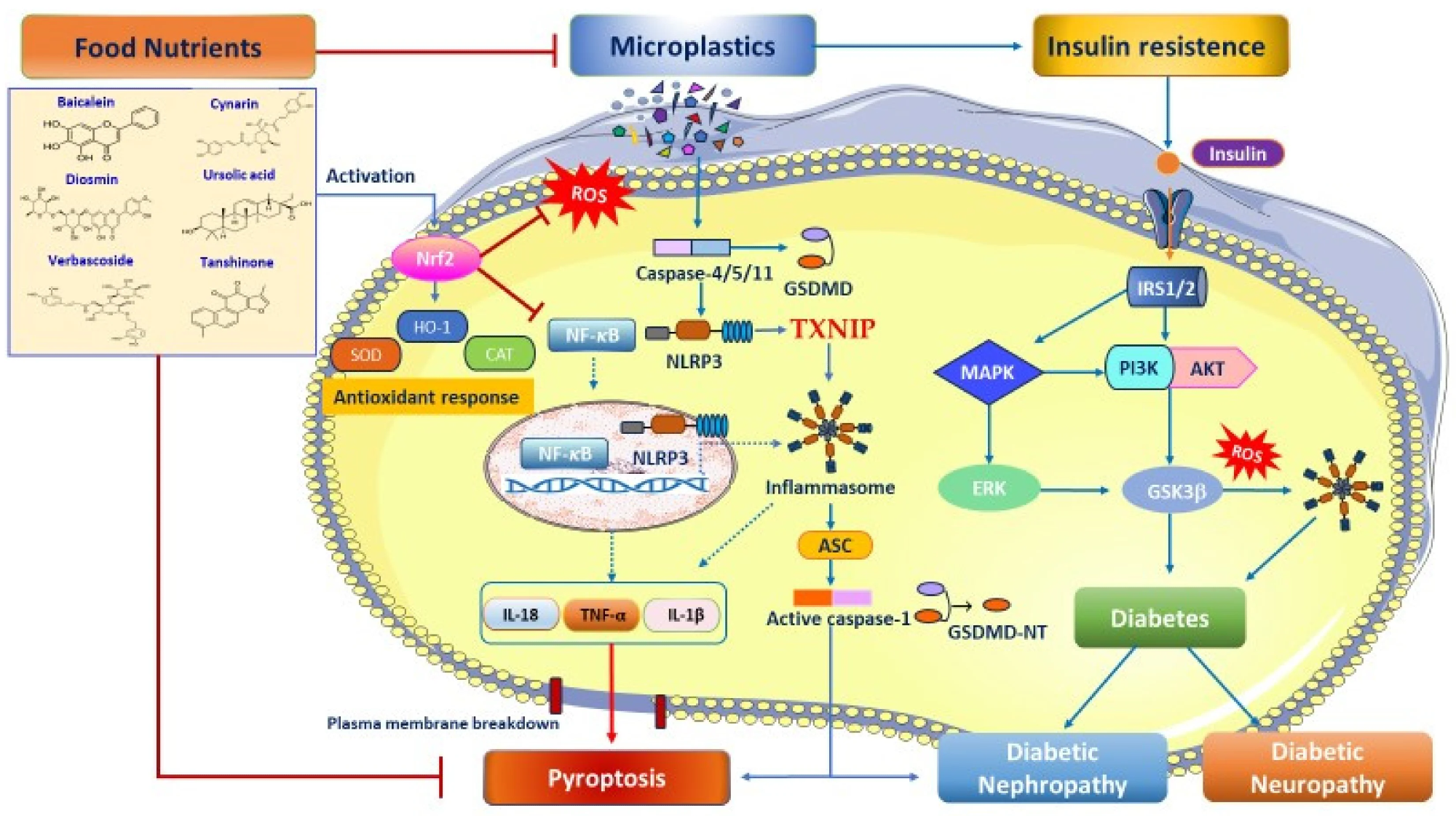
Schematic diagram of nutritional medicine targeting Nrf2 signaling pathway to inhibit microplastic-induced NLRP3 inflammasome activation and pyroptosis in diabetes and related complications. ROS - reactive oxygen species; Nrf2 - nuclear factor erythroid 2-related factor 2; NF-κB - nuclear factor kappa-light-chain enhancer of activated B cells; HO-1 - heme oxygenase-1; SOD - superoxide dismutase; CAT - catalase; NLRP3 - NLR family pyrin domain containing 3; GSDMD - gasdermin D; TXNIP - thioredoxin-interacting protein; IL-18 - interleukin-18; TNF-α - tumor necrosis factor alpha; IL-1β - interleukin-1 beta; ASC - apoptosis-associated speck-like protein containing a CARD; GSDMD-NT - gasdermin D N-terminal; IRS1 - insulin receptor substrate 1; IRS2 - insulin receptor substrate 2; MAPK - mitogen-activated protein kinase; ERK - extracellular signal-regulated kinase; PI3K - phosphoinositide 3-kinase; Akt - protein kinase B; GSK3β - glycogen synthase kinase-3 beta.
Nutrients Targeting Nfe2l2 in Diabetes and Oxidative Stress
Nutrients and nutraceuticals have been shown to prevent diabetes and its progression, primarily in preclinical studies, with some supporting but limited human clinical data, depending on the compound. Natural exosome-like nanoparticles in mung bean sprout juice were found to attenuate oxidative stress in the livers of diabetic murine models by stimulating the phosphoinositide 3-kinase/protein kinase B (PI3K/Akt) pathway and activating the Nrf2 pathway and stress-resilience genes, such as superoxide dismutase (SOD) and heme oxygenase 1 (HO-1).
Further, a bioactive compound from Panax ginseng, notoginsenoside-R1, ameliorated palmitic acid-induced insulin resistance (IR) by upregulating the Nrf2 pathway, thereby reducing oxidative stress. Polyphenols from pomegranate peel have demonstrated potential as preventive agents and functional foods for improving pancreatic β-cell dysfunction; in particular, they activate the PI3K/Akt pathway and promote Nrf2 nuclear translocation.
A randomized, controlled study showed that a synergistic trans-resveratrol–hesperitin combination reversed IR in obese and overweight individuals by increasing glyoxalase 1 expression, which counters methylglyoxal accumulation via the Nrf2 pathway. Furthermore, supplementation with omega-3 polyunsaturated fatty acids has been reported to increase Nrf2 expression and improve antioxidant capacity in individuals with type 2 diabetes.
A study showed that treatment with baicalein, an isoflavone derived from the roots of Scutellaria baicalensis, preserved renal function in diabetic rats by suppressing nuclear factor κB (NF-κB) activation. Baicalein has also been reported to protect β cells and maintain their function by decreasing oxidative stress and apoptosis. Cynarin, a polyphenol found in artichoke, is known for its anti-diabetic, hepatoprotective, and antioxidant properties.
A 100 mg/kg daily dose of artichoke leaf and flower for 28 days improved hepatic function and biomarkers in diabetic rats by suppressing inflammation and oxidative stress and enhancing SOD and glutathione peroxidase activities. Cynarin has also shown potential for treating diabetic nephropathy; a 28-day treatment with artichoke leaf extracts significantly reduced triglycerides, blood glucose, and total cholesterol in rats.
Moreover, the same treatment for 60 days decreased kidney marker levels and renal organomegaly in high-fat diet-fed rats. Diosmin is a flavonoid found in citrus fruits; preclinical studies have shown its inhibitory effects on enzymes involved in diabetes. A six-week co-treatment with diosmin and luteolin was found to enhance antioxidant enzyme activity and insulin levels in the livers and kidneys of diabetic mice.
Food Nutrients Mitigating Micro- and Nanoplastic Toxicity
Experimental evidence shows that phenolic acids, primarily flavonoids and hydroxycinnamic and hydroxybenzoic acids, counteract MP-induced reactive oxygen species (ROS) damage in vitro. Likewise, resveratrol butyrate esters were found to reverse MP-induced hypertension in rats. Further, epigallocatechin-3-gallate, the primary polyphenol in green tea, has been shown to attenuate MP-induced colonic and hepatic inflammation in mice.
In murine models, quercetin treatment attenuated tissue damage and immune dysfunction induced by polystyrene nanoplastics and normalized serum insulin levels and gene expression. Further, tannic and glycyrrhizic acids have been shown to attenuate oxidative stress and toxicity caused by polyethylene MPs in Caenorhabditis elegans by modulating the expression of a gene encoding glutathione S-transferase 4 that is involved in detoxification processes.
The review emphasises a clear evidence hierarchy, with most findings derived from in vitro experiments, animal studies, or environmental exposure models, and, to date, no clinical trials directly testing dietary nutrients specifically to counteract MNP toxicity in humans.
Future Directions in Precision Nutrition and Stress Resilience
In sum, the health impact of MNPs is an emerging area of research, with growing interest in functional food nutrients that counteract their adverse effects. Plant-derived compounds modulate Nfe2l2 and stimulate the synthesis of stress-resilient, detoxifying, and antioxidant enzymes. The authors also highlight epigenetic regulation of Nrf2 signalling, variability in environmental exposure, and the potential for precision nutrition approaches guided by gene–nutrient interactions and biomarkers of stress resilience. A deeper understanding of the interactions between Nfe2l2 and nutrients could facilitate the development of novel strategies to promote cellular stress resilience and mitigate the detrimental effects of MNPs.
Journal reference:
- Scuto MC, Lombardo C, Musso N, et al. (2026). Micro- and Nanoplastics and Human Health: Role of Food Nutrients Targeting Nfe2l2 Gene in Diabetes. Nutrients, 18(4), 600. DOI: 10.3390/nu18040600, https://www.mdpi.com/2072-6643/18/4/600
 Common food preservatives may raise cancer risk