A major global analysis shows that survival gains are outpacing healthy aging, shifting the public health challenge from living longer to living better.
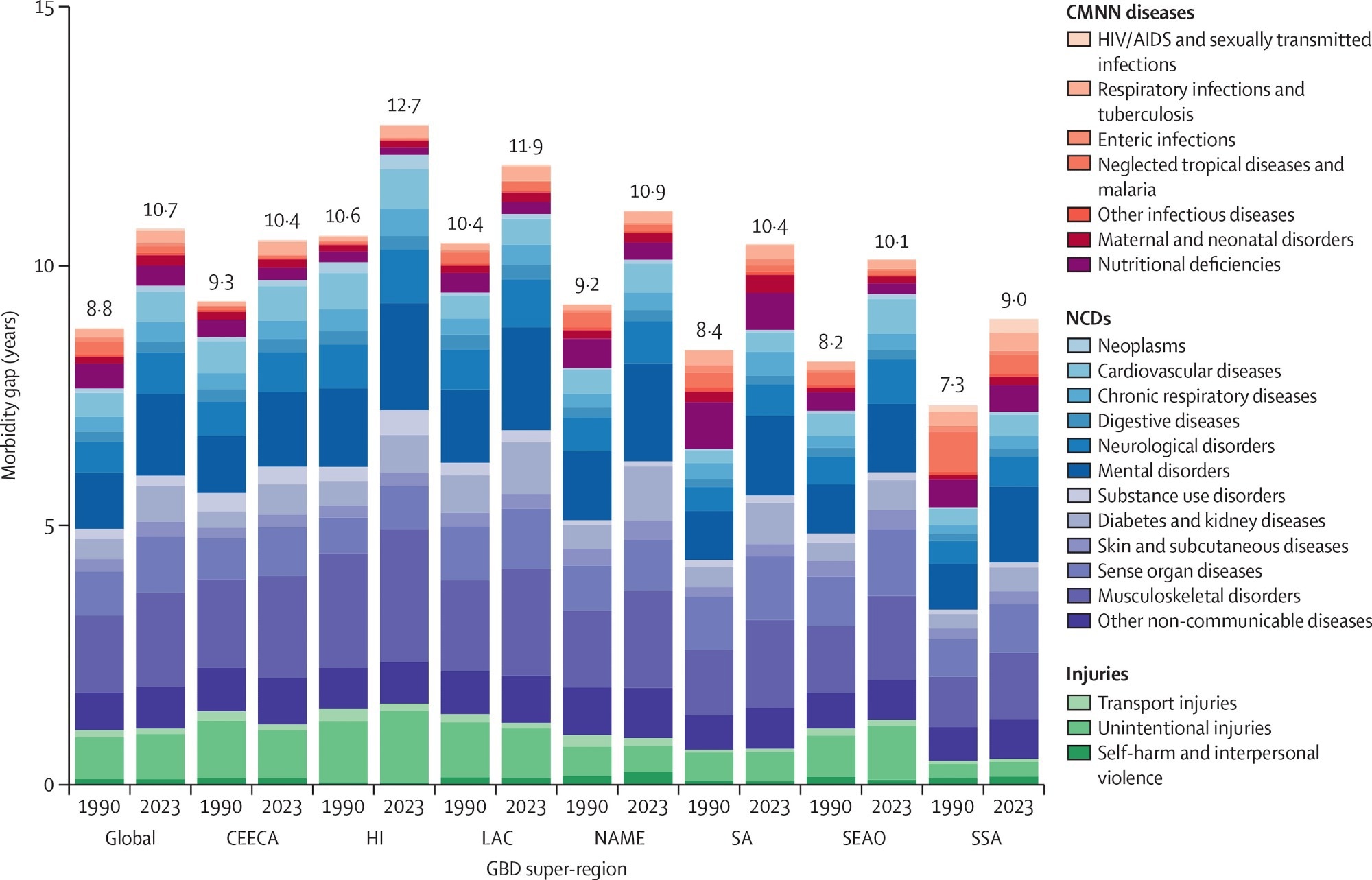
GBD Level 2 cause decomposition of the morbidity gap globally and by GBD super-region, 1990 and 2023. Study: GBD Level 2 cause decomposition of the morbidity gap globally and by GBD super-region, 1990 and 2023
In a recent study published in the journal The Lancet Public Health, researchers analyzed changes in the morbidity gap from 1990 to 2023 and identified the leading contributors to years spent in poor health.
Life expectancy has markedly increased over the past century, with attention shifting towards extending healthspan. The compression of morbidity hypothesis suggests that risk-reducing and health-promoting strategies can delay disability into a shorter period late in life. However, evidence for this hypothesis remains mixed, with earlier studies suggesting relative compression in some high-income settings, while more recent evidence increasingly supports morbidity expansion across populations.
About the study
In the present study, researchers evaluated trends in the morbidity gap and identified the leading diseases, injuries, and risk factors contributing to it. They leveraged data from the Global Burden of Diseases, Injuries, and Risk Factors Study (GBD) 2023 to analyze national, regional, and global trends in life expectancy, morbidity gap, and healthy life expectancy (HALE) between 1990 and 2023.
The team defined life expectancy as the number of years people are expected to live from birth, on average. HALE was the number of years of life at birth expected to be lived in full health. Morbidity gap was defined as the number of years spent in poor health and was calculated as the difference between life expectancy and HALE. Furthermore, the team assessed the proportional morbidity gap, defined as the proportion of life expectancy lived in poor health.
The proportional morbidity gap was calculated by dividing the morbidity gap by life expectancy. Morbidity gap was estimated globally, for 204 countries and territories and seven super-regions, and by sex and sociodemographic index (SDI) quintile. The morbidity gap was decomposed into cause- and risk-factor-specific contributions, based on proportional attribution and not implying direct causality. Disruptions in trends associated with the coronavirus disease 2019 (COVID-19) pandemic (during 2020-22) were also assessed.
Findings
Life expectancy worldwide rose from 64.6 years in 1990 to 73.8 years in 2023, whereas HALE increased from 55.9 years to 63.1 years. Meanwhile, the morbidity gap widened from 8.8 years to 10.7 years. Further, life expectancy gains were larger than HALE increases in all countries and territories except one. There were transient disruptions in these trends during the COVID-19 pandemic.
Specifically, in 2021, life expectancy and HALE decreased to 71.9 years and 61.7 years, respectively, compared to 2020. Moreover, the morbidity gap slightly reduced to 10.3 years in 2021. The largest morbidity gap (12.7 years) in 2023 was observed in the high-income super-region, and the smallest (nine years) in the sub-Saharan Africa super-region. At the country level, the United States (US) had the largest morbidity gap (14 years) in 2023, while Nauru had the smallest (6.9 years).
Further, point estimates indicated that the morbidity gap increased over three decades in all countries and territories except one, although uncertainty intervals overlapped for some country-level comparisons. Meanwhile, 84.8% of countries and territories had an increase in the proportional morbidity gap. Afghanistan showed the largest proportional morbidity gap at 17.9% (of life expectancy) in 2023. Morbidity gap varied across SDI quintiles, with the largest (11.7 years) observed in the high SDI group and the smallest (9.4 years) in the low SDI group in 2023.
The five leading cause groups accounted for 57.4% of the morbidity gap in 2023 and included musculoskeletal disorders, mental disorders, sense organ diseases (e.g., hearing loss), unintentional injuries (e.g., falls), and other noncommunicable diseases. Musculoskeletal and mental disorders accounted for a third of the morbidity gap in the high-income super-region.
Similar contributions were observed in high SDI settings. Nutritional deficiencies were among the top five contributors to the morbidity gap in low SDI settings. Among risk factors, increased body mass index (BMI), elevated fasting plasma glucose (FPG), child and maternal malnutrition, and tobacco use were the leading contributors to the morbidity gap in 2023.
High-income and high SDI settings had greater contributions from elevated FPG, tobacco use, and high BMI, while elevated FPG, air pollution, and child and maternal malnutrition were prominent in low SDI settings. Females lived longer and spent more time in poor health than males across geographies. The morbidity gap increased from 10 years in 1990 to 12.1 years in 2023 for females, and from 7.6 years to 9.3 years for males. Across SDI quintiles, females spent more years in poor health than males.
Conclusions
Collectively, although longevity increased from 1990 to 2023, these gains were not accompanied by decreases in the years lived in poor health. The morbidity gap has instead increased in virtually all countries, with most populations now experiencing poor health for a decade or more in life. These results have important implications for the built environment, labor markets, and social protection systems and underscore that progress in healthy aging should be assessed by gains in healthspan.
Journal reference:
- Hay, S. I., Nam, P., Saqib, H., et al. (2026). Global, regional, and national trends in the morbidity gap and contributing diseases, injuries, and risk factors, 1990-2023: A systematic analysis for the Global Burden of Disease Study 2023. The Lancet Public Health, 11(8), e487-e505. DOI: 10.1016/S2468-2667(26)00098-8, https://www.thelancet.com/journals/lanpub/article/PIIS2468-2667(26)00098-8/fulltext
 Filtered coffee links to slower biological aging while instant coffee shows the opposite