This article discusses how AI-driven continuous API production, enabled by in-line benchtop NMR and modular hardware, can be implemented to allow for real-time control, more resilient quality, and compact, scalable operations.
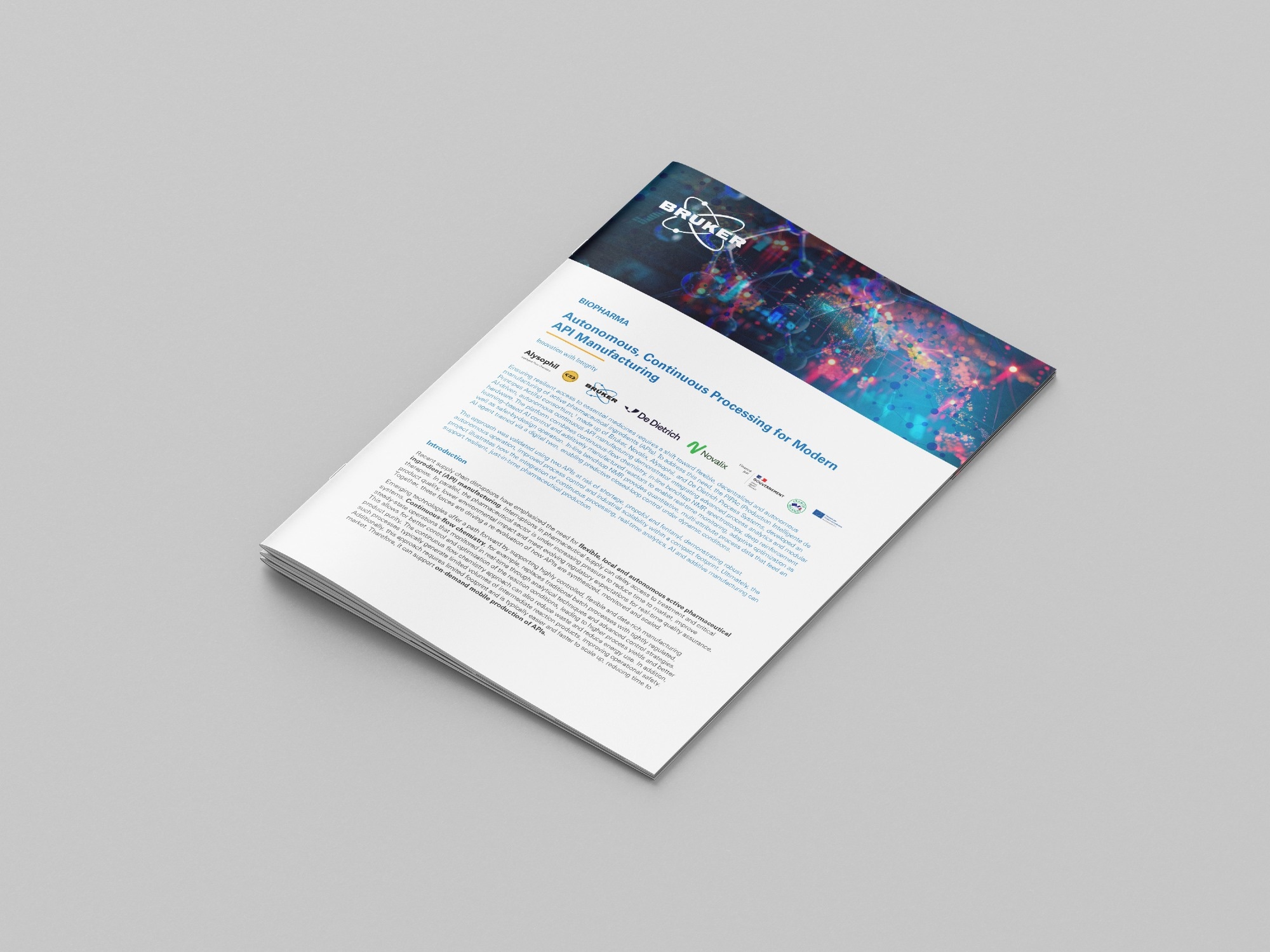
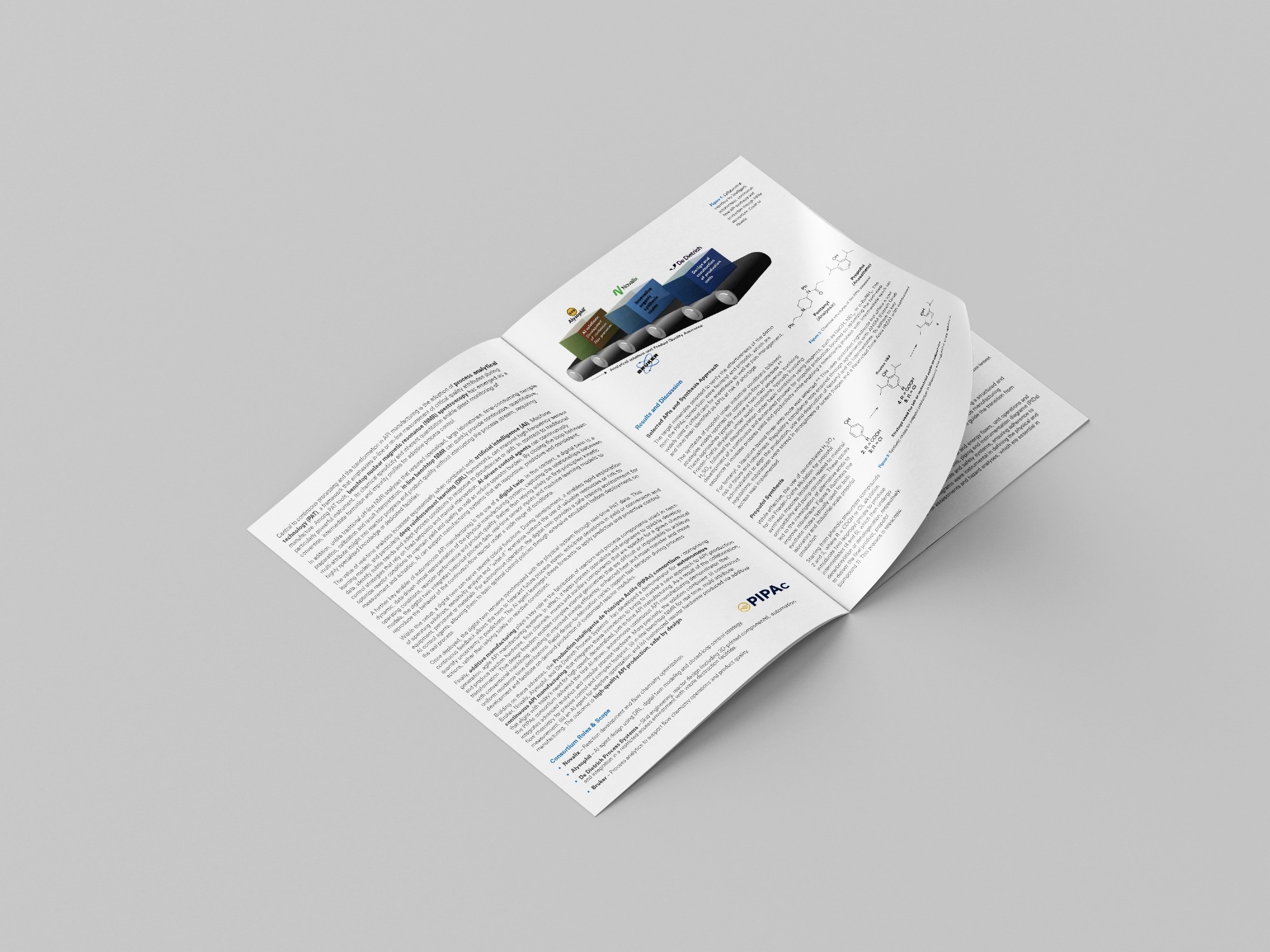
Key advantages and overall impact
The article introduces an autonomous, AI-driven continuous manufacturing demonstrator that has been developed by the PIPAc consortium (Bruker, Novalix, Alysophil, and De Dietrich Process Systems). It has been designed to support more resilient, just-in-time API production.
The platform integrates a digital twin, additively manufactured reactors, in-line benchtop NMR spectroscopy, continuous flow chemistry, deep reinforcement learning (DRL) control to allow for adaptive optimization, real-time monitoring, and operation that is safer by design.
Validated using fentanyl, the system demonstrates robust closed-loop control and clear potential for scalability in industry within a compact, restricted-access footprint.
Its PAT strategy centers on a Fourier 80 benchtop NMR (80 MHz) as a quantitative in-line sensor, supporting multi-attribute, chemically specific control. The modular skid architecture combined with ISA-88 orchestration, OPC UA connectivity, and ATEX-compliant implementation aligns with Pharma 4.0 and modern continuous manufacturing principles.
Three key points
- An integrated, autonomous platform combining continuous flow chemistry, benchtop NMR, AI-driven control, a digital twin, and additively manufactured reactors to support safer, high-quality API production.
- Validated API workflows for propofol and fentanyl have been adapted to continuous flow, incorporating in-line workups, scalable engineering, and GMP-oriented qualification steps.
- An AI-driven PAT framework leverages real-time NMR data for predictive control, enabling proactive yield stabilization and robust performance under dynamic operating conditions.
The full article provides a comprehensive overview of the experiment’s details, system architecture, and model workflows, including PFD/PID documentation and calibration processes.
It shows how combining continuous processing, real-time analytics, AI, and additive manufacturing can enable more resilient, on-demand pharmaceutical production.
About Bruker BioSpin Group
The Bruker BioSpin Group designs, manufactures, and distributes advanced scientific instruments based on magnetic resonance and preclinical imaging technologies. These include our industry-leading NMR and EPR spectrometers, as well as imaging systems utilizing MRI, PET, SPECT, CT, Optical and MPI modalities. The Group also offers integrated software solutions and automation tools to support digital transformation across research and quality control environments.
Bruker BioSpin’s customers in academic, government, industrial, and pharmaceutical sectors rely on these technologies to gain detailed insights into molecular structure, dynamics, and interactions. Our solutions play a key role in structural biology, drug discovery, disease research, metabolomics, and advanced materials analysis. Recent investments in lab automation, optical imaging, and contract research services further strengthen our ability to support evolving customer needs and enable scientific innovation.
Sponsored Content Policy: News-Medical.net publishes articles and related content that may be derived from sources where we have existing commercial relationships, provided such content adds value to the core editorial ethos of News-Medical.net, which is to educate and inform site visitors interested in medical research, science, medical devices and treatments.