Sponsored Content by SCIEXReviewed by Olivia FrostNov 4 2026
This article details a streamlined workflow suitable for developing a large-panel MRM database comprising more than 700 pesticides. A range of SCIEX OS software features, most notably automated compound optimization (ACO), were employed in accelerating the creation and optimization of a database of over 2100 MRM transitions.
High-resolution HR-MS/MS spectra were used to further authenticate these MRM transitions, affording the database developers additional confidence in precursor and product ion selection.
Leveraging a combination of MRM (aeMRM) on the novus V55 system, alongside sub-to-low ms pause and dwell times and fast polarity switching, enabled unscheduled MRM acquisition of the complete panel in a single injection, conserving reference materials and/or analytical standards and considerably accelerating retention time (RT) discovery (Figure 1).
The SCIEX OS ACO and aeMRM offer a range of benefits when utilized for large-panel MRM method development, including:
- Automated method development, including rapidly determined optimal MRM transitions via SCIEX OS ACO while simultaneously minimizing the need for manually tuning compound parameters
- A comprehensive large-panel pesticides MRM library was curated and validated against HR-MS/MS fragmentation data, including a final MRM database comprised of 1975 positive and 127 negative transitions
- Accelerated RT discovery, with aeMRM on the novus V55 system significantly speeding up RT discovery by facilitating unscheduled monitoring of all transitions in a single injection
- An optimized sMRM cycle time, including software visualization of MRM concurrency that helps to preserve cycle time for higher analyte coverage without compromising data quality
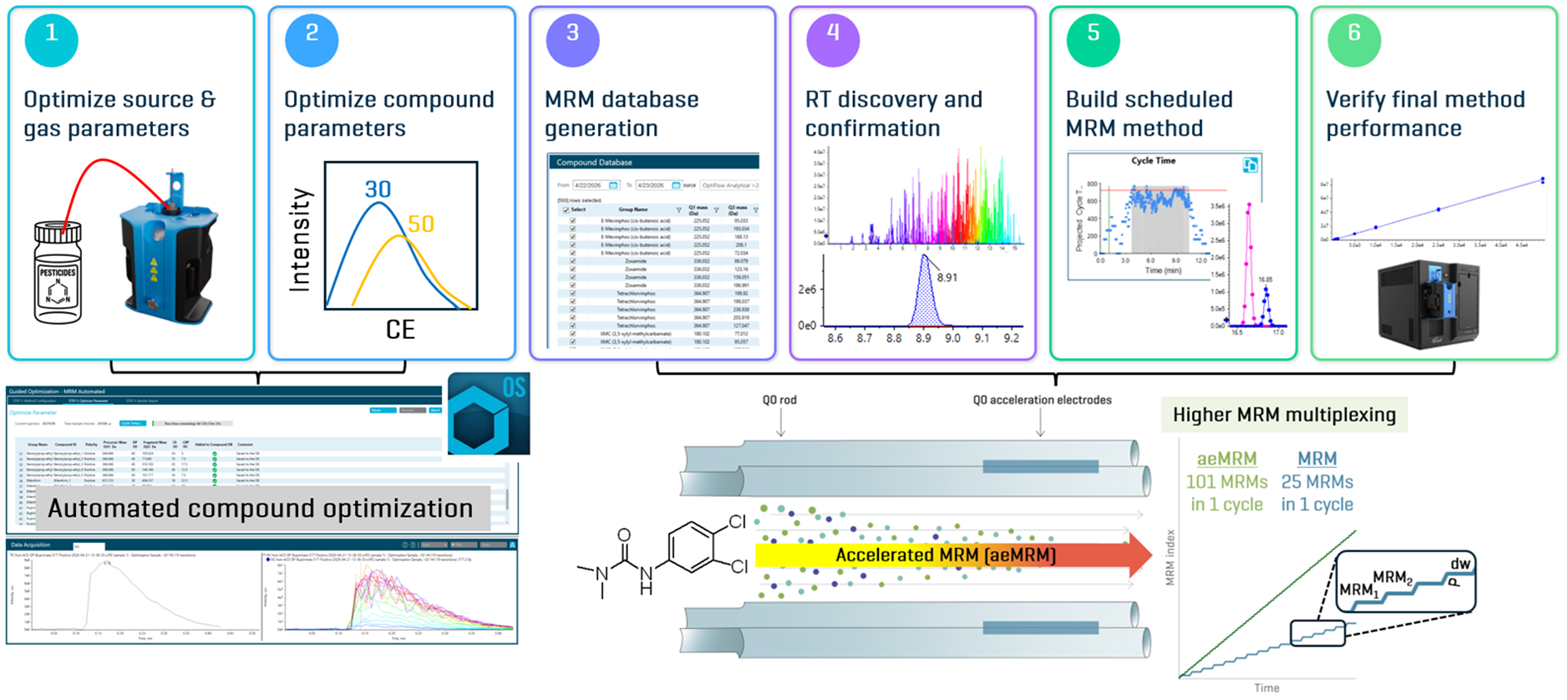
Figure 1. Large-panel MRM method development using software automation and aeMRM on the novus V55 system. Compound optimization was performed using automated compound optimization (ACO) in SCIEX OS software, resulting in a large-panel pesticide MRM database of 2,101 MRM transitions, with two to three fragments per target analyte.
Retention times (RTs) were initially identified using aeMRM on the novus V55 system, followed by MS/MS-based confirmation on the ZenoTOF 7600+ system. Software features, such as RT import and concurrency visualization plots, facilitated the development of a large-panel scheduled MRM (sMRM) method for quantitation on the novus V55 system. Image Credit: SCIEX
The ongoing discovery of new analytes and regulatory updates means that there is continually increasing demand for comprehensive targeted analysis in food testing.
There is also increasing pressure on laboratories to increase throughput and implement sustainability initiatives, prompting the growing adoption of large-panel methods able to reduce instrument time and operational costs by consolidating multiple assays into a single run.
Multiple reaction monitoring (MRM) continues to be the gold-standard approach for targeted quantitation, but there are significant challenges in developing and managing large panels of hundreds of analytes, such as those that have recently emerged in the food testing community.1,2,3
For instance, identifying optimal MRM transitions and optimizing source- and compound-specific parameters becomes increasingly unwieldy when working with larger panels.
Automated compound optimization in SCIEX OS and other software tools can streamline these processes by automating each parameter’s iterative ramping and adding optimized values to a new or existing in-house MRM database.
The study presented here utilized aeMRM on the novus V55 system to facilitate the rapid RT discovery of more than 2100 transitions in a single injection. These transitions were then authenticated via HR-MS/MS fragmentation data.4
The final pesticides MRM library facilitated scalable method development, enabling the implementation of optimized parameters for 1975 positive and 127 negative transitions suitable for incorporation into targeted scheduled MRM (sMRM) assays.
Experimental method
Standards
The Smart Solutions™ v700 PestiMix Kit 3 from LGC Standards was used to prepare 10 individual intermediate stock standards at 1 μg/mL in acetonitrile.
Intermediate mixes were prepared in either methanol or acetonitrile, with calibration standards prepared using an identical solvent composition to mobile phase A.
Chromatography
Two separate gradients were developed for RT discovery on the novus V55 system and MRM authentication on the ZenoTOF 7600+ system (Table 1 and Table 2).
Chromatographic separation was undertaken using an ExionAE LC system equipped with the Phenomenex Luna Omega Polar C18 column. This column featured two different configurations:
- RT discovery: 100 x 2.1 mm, 1.6 µm, P/N: 00D-4748-AN
- MRM authentication: 100 x 2.1 mm, 3 µm, P/N: 00D-4760-AN
Table 1. Fifteen-minute LC gradient conditions for RT discovery on the novus V55 system using the 100 x 2.1 mm, 1.6 μm Phenomenex column. Source: SCIEX
| Time [minutes] |
Flow rate [mL/min] |
Mobile phase A [%] |
Mobile phase B [%] |
| 0.0 |
0.4 |
98 |
2 |
| 1.0 |
0.4 |
98 |
2 |
| 3.0 |
0.4 |
70 |
30 |
| 7.0 |
0.4 |
30 |
70 |
| 9.0 |
0.4 |
2 |
98 |
| 12.0 |
0.4 |
2 |
98 |
| 12.1 |
0.4 |
98 |
2 |
| 15.0 |
0.4 |
98 |
2 |
Mobile phase A: 0.1% (v/v) formic acid in water with 2 mM ammonium acetate
Mobile phase B: 0.1% (v/v) formic acid in methanol with 2 mM ammonium acetate
Injection volume: 2 μL
Table 2. Thirty-minute LC gradient conditions for MRM authentication on the ZenoTOF 7600+ system using the 100 x 2.1 mm, 3 μm Phenomenex column. Source: SCIEX
| Time [minutes] |
Flow rate [mL/min] |
Mobile phase A [%] |
Mobile phase B [%] |
| 0.0 |
0.4 |
90 |
10 |
| 0.5 |
0.4 |
70 |
30 |
| 4.0 |
0.4 |
50 |
50 |
| 26.0 |
0.4 |
5 |
95 |
| 27.0 |
0.4 |
5 |
95 |
| 27.1 |
0.4 |
90 |
10 |
| 30.0 |
0.4 |
90 |
10 |
Mobile phase A: 90:10 (v/v) water/methanol with 5 mM ammonium formate
Mobile phase B: 90:10 (v/v) methanol/water with 5 mM ammonium formate
Injection volume: 10 μL
Mass spectrometry
Electrospray ionization on the novus V55 system was used to analyze the RT discovery workflow, while the ZenoTOF 7600+ system was used to analyze the MRM authentication workflow.
The ACO in SCIEX OS software was employed to automate the optimization of MRM transition pairs and compound-dependent parameters on the novus V55 system.
Data for the RT discovery workflow was captured using unscheduled MRM with at least two to three transitions per analyte. Optimized source and gas conditions (Table 3) were implemented alongside compound-dependent parameters.
This was done by leveraging aeMRM on the novus V55 system, with a polarity switching time of 10 ms, a pause time of 0.7 ms, and a minimum dwell time of 1 ms.
Data for the MRM authentication workflow was captured via SWATH data-independent acquisition (DIA). This was performed using the parameters outlined in Table 4 and with a total of 23 SWATH windows covering a start/stop mass range of 50–1000 Da.
Table 3. Source and gas parameters for pesticide analysis on the novus V55 system. Source: SCIEX
| Parameter |
Value |
| Polarity |
Positive/negative |
| Ion spray voltage |
2500 V |
| Curtain gas |
40 psi |
| CAD gas |
9 psi |
| Temperature |
400 °C |
| Ion source gas 1 |
45 psi |
| Ion source gas 2 |
70 psi |
Table 4. Source and gas parameters and SWATH DIA conditions for pesticide analysis on the ZenoTOF 7600+ system. Source: SCIEX
| Parameter |
Value |
Value |
| Polarity |
Positive |
Negative |
| Ion spray voltage |
5000 V |
4000 V |
| Curtain gas |
40 psi |
40 psi |
| CAD gas |
7 psi |
9 psi |
| Temperature |
450 °C |
450 °C |
| Ion source gas 1 |
60 psi |
60 psi |
| Ion source gas 2 |
60 psi |
60 psi |
| Parameter |
TOF MS |
TOF MS/MS |
| Declustering potential (DP) |
80 V |
60 V |
| Total scan time |
0.783 s |
0.783 s |
| Scan mode |
TOF MS |
TOF MS/MS |
| Start/stop mass range |
100–1000 Da |
50–1000 Da |
| Accumulation time |
0.1 s |
0.02 s |
| Collision energy (CE) |
10 V |
35 V |
| Collision energy spread (CES) |
0 V |
±15 V |
Note: Zeno pulsing set to enabled and fragmentation mode set to collision-induced dissociation (CID).
Data acquisition and processing
The SCIEX OS software (version 5.0) was used to acquire and process data. The SCIEX Pesticides high-resolution MS/MS spectral library and the SCIEX NIST 2023 tandem mass library were used to perform library searching. This was done in the Analytics module of the SCIEX OS software.
Automated compound optimization in SCIEX OS
Traditional compound optimization involves iteratively tuning parameters for each analyte. This primarily manual process creates a considerable bottleneck for large-panel MRM method development.
The process generally begins with a precursor ion scan to confirm the presence of the target precursors and their m/z. Declustering (DP) and entrance (EP) potentials are ramped to find the optimal values during this process.
A product ion scan is then performed to identify the most intense fragments for each precursor. Optimization of the collision energy (CE) and collision exit potential (CXP) is then completed.
An MRM scan can be used to optimize the source and gas parameters once an analyte’s precursor and product ion pairs are known.
The SCIEX OS software’s ACO feature combines these steps in an automated workflow. Precursor ion conditions, fragment ion selection, and compound-dependent parameters are all optimized sequentially, with the results stored in a database for use in future method creation (Figure 2).
The target analytes’ precursor masses are either entered manually or calculated from the molecular formula, with the optimization set to detect up to five fragments per precursor.
The analytes are injected directly into the mass spectrometer using flow injection analysis (FIA). This is done without chromatographic separation, generating a broad peak during which the precursor/fragment ions and compound parameters are optimized in line with signal intensity.
ACO provides the total injection count or the total sample volume required to optimize all the analytes. This is based on the parameter ramp settings, such as the start/stop range and the step interval, allowing the user to prepare sufficient standard quantities in advance.
Once ACO has been completed, the summary report details how many transitions have been successfully optimized and added to the compound database. The user can then revisit those transitions that failed during optimization.
In the study presented here, ACO was used to identify up to five transitions and to optimize transition parameters for each of the 724 pesticides in the Smart Solutions v700 LC PestiMix Kit 3.
An MRM database comprised of 3882 positive and 180 negative transitions was generated initially. This was further authenticated using HR-MS/MS fragmentation data.
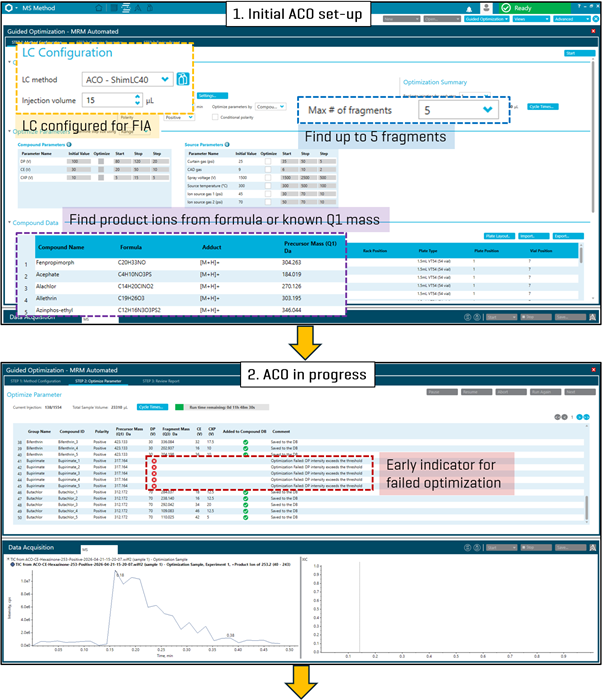
Figure 2. Automated compound optimization (ACO) workflow in SCIEX OS software. (1) ACO prerequisites include an LC system configured for flow injection analysis (FIA) and user input of target compound data, preferences for parameter ramping, and fragment identification.
(2) Upon starting the optimization, ACO identifies and ranks the most intense fragment ions for each target precursor, then sequentially ramps the compound-dependent parameters. The software provides a warning for failed optimizations, such as when the signal intensity has exceeded the threshold, to inform the user to dilute their standards before restarting ACO. Image Credit: SCIEX
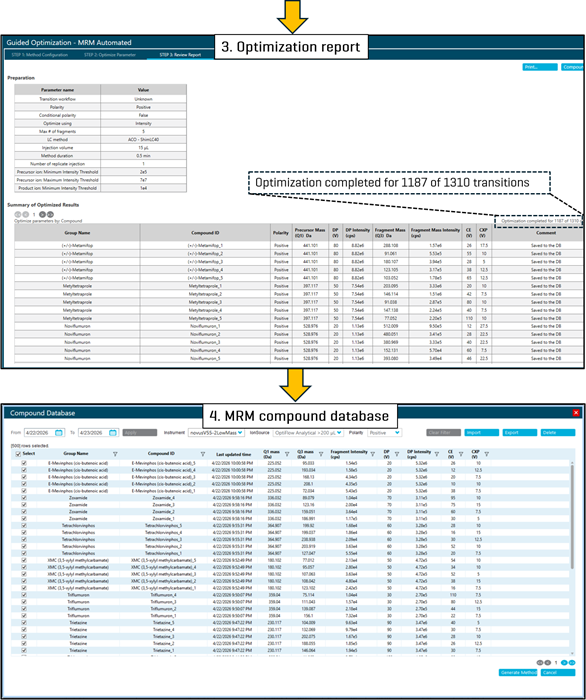
Figure 2 (continued). Automated compound optimization (ACO) workflow in SCIEX OS software. (3) Upon completion of the ACO process, a report is generated with a summary of the optimized results and a count of completed optimizations. (4) The final step of ACO shows a list of all optimized MRM transitions and their parameters that have been added to the compound database. The list can be filtered and edited by deleting or importing transitions from other ACO-generated databases, while the list itself can also be exported for sharing. Image Credit: SCIEX
MRM authentication by HR-MS/MS
Orthogonal HR-MS/MS data was employed in MRM database authentication. This was done by confirming the precise masses and fragmentation patterns of precursor/fragment ion pairs, offering improved confidence in the MRM assignment.
Figures 3 and 4 highlight the effectiveness of this workflow for two example pesticides: thiabendazole and vamidothion.
All five transitions identified for vamidothion exhibited the same RT of 4.99 minutes during ACO, and all five were found to be present in the HR-MS/MS spectrum (Figure 3). The isotopic pattern and library confirmation further confirmed the transition assignment.
The five transitions of thiabendazole exhibited two different RTs of 4.7 minutes and 6.9 minutes (Figure 4), however. Comparing these against the MS/MS spectrum confirmed that the three transitions (m/z 202>65, 202>131, and 202>175) that eluted at 4.7 minutes were correct.
The final MRM database was revised to 1975 positive and 127 negative transitions using this authentication workflow, with two to three fragments assigned to each pesticide.
The availability of multiple transitions improves method robustness by offering alternative ions for analyte confirmation and interference mitigation across variable sample matrices.
This database offers a useful starting point for food laboratories looking to develop and expand multi-residue screening methods.
High-throughput RT discovery
Traditional large-panel MRM method development necessitates the labor-intensive preparation of various standards, while RT verification of thousands of transitions across a single run requires multiple injections.
The LGC PestiMix kit streamlines standards preparation with pre-mixed multi-analyte solutions, reducing risk of error and analyst time requirements.
Combining the PestiMix standards’ comprehensive analyte coverage with aeMRM on the novus V55 system’s high-speed acquisition, it was possible to determine RT discovery for thousands of transitions in a single injection, substantially accelerating method development while conserving analytical standards.5
Figure 5 outlines the creation of an unscheduled MRM method consisting of the 2102 transitions imported from the ACO MRM database.
Leveraging a combination of a 0.7 ms pause time and a 1 ms dwell time from aeMRM acquisition with rapid polarity switching allowed RT identification of the entire panel, including two to three transitions per pesticide.
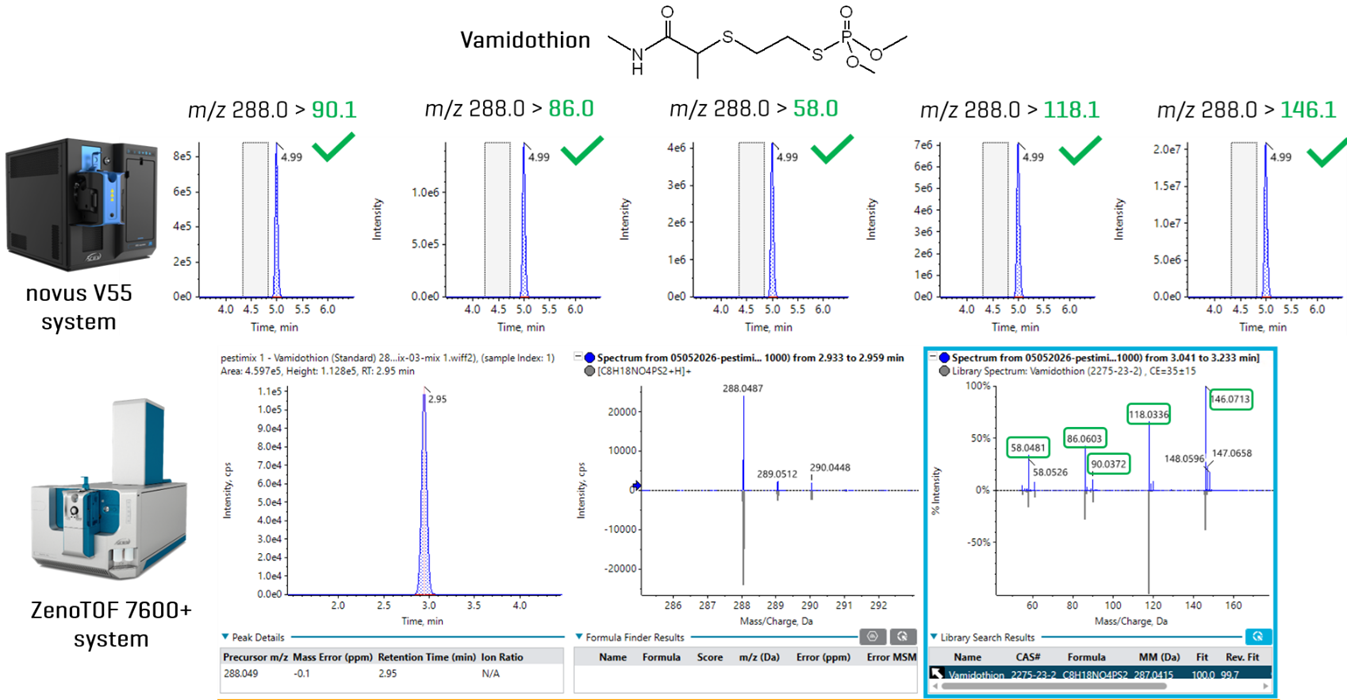
Figure 3. HR-MS/MS-based authentication of MRM database. Comparison of representative extracted ion chromatograms (XICs) of vamidothion acquired on the novus V55 system against their corresponding XIC, MS, and MS/MS spectra acquired on the ZenoTOF 7600+ system.
The five fragments identified from ACO were compared against the MS/MS fragmentation data. A green checkmark indicates the transition has been correctly assigned based on the presence of the fragment in the MS/MS spectrum, which is further corroborated by library confirmation. A red checkmark indicates the transition is not correct. Image Credit: SCIEX
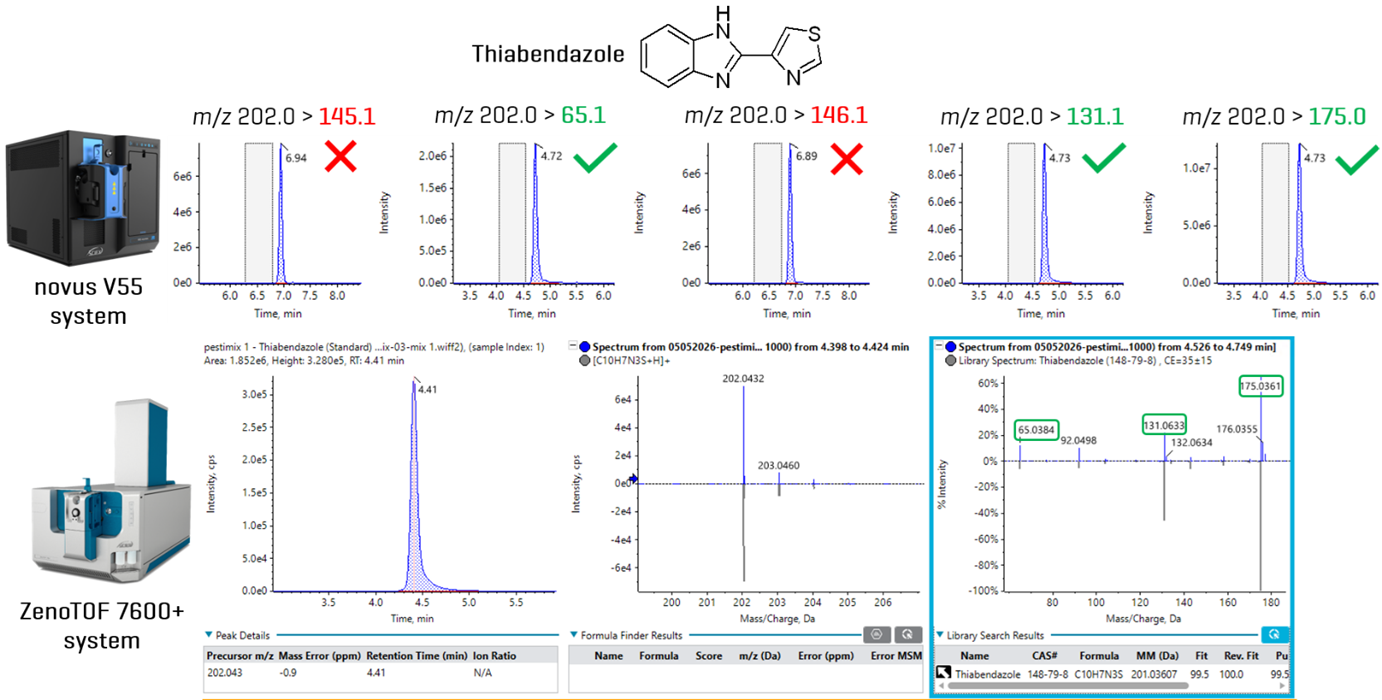
Figure 4. HR-MS/MS-based authentication of MRM database. Comparison of representative extracted ion chromatograms (XICs) of thiabendazole acquired on the novus V55 system against their corresponding XIC, MS, and MS/MS spectra acquired on the ZenoTOF 7600+ system.
The five fragments identified from ACO were compared against the MS/MS fragmentation data. A green checkmark indicates the transition has been correctly assigned based on the presence of the fragment in the MS/MS spectrum, which is further corroborated by library confirmation. A red checkmark indicates the transition is not correct. Image Credit: SCIEX
Transitions such as phorate and flonicamid, which exhibit multiple LC peaks (Figure 5), benefited from including additional transitions when confirming their RTs, reducing the need for reinjections.
The very low pause and dwell times employed may not provide sufficient data-point density for quantitation, but they are sufficient for reliable RT identification, enabling rapid RT discovery of the full range of analytes across both polarities in a single injection.
The resulting RTs were used in the development of a 15-minute sMRM method, utilizing visualization plots in SCIEX OS software to balance between concurrency and optimal cycle times (Figure 5).
The method overview, concurrency, cycle time, and dwell time plots dynamically update in line with changes to the acquisition method, allowing the method developer to visualize the impact of real-time parameter modifications such as pause time, dwell time, panel size, and RT window size.
Conclusion
The study presented here demonstrates an end-to-end workflow leveraging ACO and aeMRM to help streamline MRM method development for food laboratories looking to expand multi-residue panels.
ACO in SCIEX OS was used to address a significant method-development bottleneck by automating parameter optimization and fragment selection, thereby generating a large-panel pesticide database.
HR-MS/MS-based authentication improved database quality by confirming the transition assignments based on fragmentation patterns, mass error, and library searching.
Sub-to-low ms pause and dwell times employed in aeMRM RT discovery supported the streamlining of previous multi-injection workflows into a single-injection method, significantly reducing the standards consumption and time typically required for large-panel method development.
SCIEX OS visualization tools were used to further simplify final sMRM method creation by facilitating the real-time optimization of concurrency and cycle time.
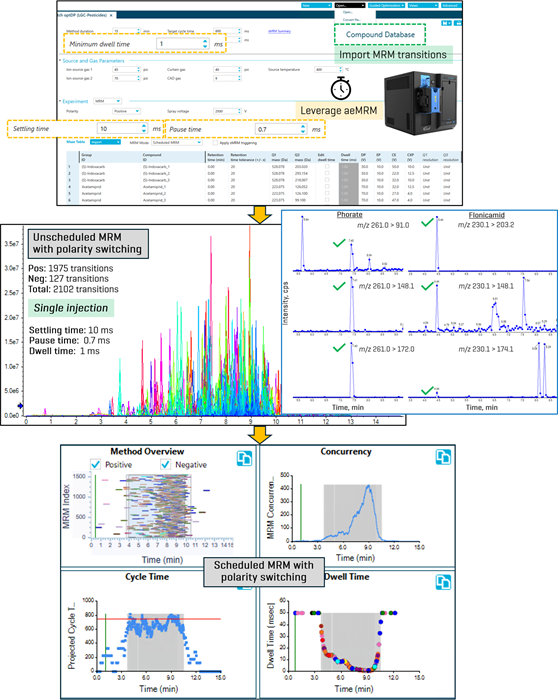
Figure 5. Leveraging aeMRM for sMRM method development. After importing 2102 optimized transitions from the ACO MRM database into the acquisition method, a pause time of 0.7 ms, minimum dwell time of 1 ms, and settling time of 10 ms were used to enable unscheduled MRM acquisition with polarity switching in a single injection.
This enabled simultaneous monitoring of the entire target panel, including multiple transitions for each pesticide, thereby significantly expediting RT identification and confirmation. Software visualization tools in SCIEX OS software facilitated cycle time optimization in the final sMRM method. Image Credit: SCIEX
References and further reading
- Steiner, D., et al. (2020). Realizing the simultaneous liquid chromatography-tandem mass spectrometry based quantification of >1200 biotoxins, pesticides and veterinary drugs in complex feed. Journal of chromatography. A, [online] 1629, p.461502. DOI:10.1016/j.chroma.2020.461502. https://www.sciencedirect.com/science/article/pii/S0021967320307779?via%3Dihub.
- Bessaire, T., et al. (2024). Enhanced surveillance of >1100 pesticides and natural toxins in food: Harnessing the capabilities of LC-HRMS for reliable identification and quantification. Foods, 13(19), pp.3040–3040. DOI:10.3390/foods13193040. https://www.mdpi.com/2304-8158/13/19/3040.
- Kenjeric, L., et al. (2026). Exploring the limits of UHPLC-MS/MS with polarity switching towards the quantification of 931 mycotoxins and other secondary metabolites in cereal-based food. Journal of Food Composition and Analysis, 151, p.108908. DOI:10.1016/j.jfca.2026.108908. https://www.sciencedirect.com/science/article/pii/S0889157526000517.
- SCIEX (2026). novus V55 system. SCIEX brochure. MKT-38393 -A. Available at: https://sciex.com/products/mass-spectrometers/triple-quad-systems/novus-v55-system.
- Folkerson, A., et al. (2026). Maximizing throughput with accelerated MRM (aeMRM) on the Novus V55 system. SCIEX. Available at: https://sciex.com/tech-notes/food-beverage/food-and-beverage/maximizing-throughput-with-accelerated-mrm-aemrm-novus-v55.
Acknowledgments
Produced from materials originally authored by Holly Lee and Andrew Folkerson from ABB Sciex, and Dan Biggerstaff, HuiChen Stavros, Joe Lackey, and Kelly Cheshire from LGC Standards.
About SCIEX
SCIEX mission is to deliver solutions for the precision detection and quantitation of molecules, empowering their customers to protect and advance the wellness and safety of all.
SCIEX has led the field of mass spectrometry for 50 years. From the moment we launched the first ever commercially successful triple quad in 1981, they have developed groundbreaking technologies and solutions that influence life-changing research and outcomes.
Today, as part of the Danaher family of global life science and technology innovators, they continue to pioneer robust solutions in mass spectrometry and capillary electrophoresis. But they don’t just develop products. It is what they do together with their customers that sets them apart. That’s why thousands of life science experts around the world choose SCIEX to get the answers they can trust to better inform critical decisions. Decisions that positively impact lives.
They proudly stand behind our tagline: The Power of Precision.
Sponsored Content Policy: News-Medical.net publishes articles and related content that may be derived from sources where we have existing commercial relationships, provided such content adds value to the core editorial ethos of News-Medical.net, which is to educate and inform site visitors interested in medical research, science, medical devices and treatments.