Scientists are detecting nanoplastics in human brain tissue and exploring how these particles may influence the risk of neurodegenerative diseases, but major questions about exposure, causation, and prevention remain unresolved.

Viewpont: The hidden world of nanoplastics colliding with neurodegenerative diseases. Image Credit: Maryshot / Shutterstock
In a recent viewpoint published in the Journal of Clinical Investigation, a group of authors evaluated emerging evidence linking nanoplastics to neuroinflammation and neurodegenerative disorders and identified critical research priorities in this synthesis-based perspective rather than new primary experimental research.
Background
Global plastic production now exceeds 400 million tons annually, but what happens when plastic fragments become too small to see? Nanoplastics are particles measuring between 10 nm and 1 μm and are increasingly detected in human blood and brain tissue.
Ultra-small fragments may potentially cross biological barriers, although the mechanisms and extent remain unclear, and their small size may allow more direct cellular interactions compared with larger particles.
Higher measured tissue plastic burdens have been correlated with cardiovascular diseases, including major adverse cardiovascular events, and neurological diseases.
Still, there is little information regarding how these materials enter the body, where they are located, and how long they persist. As plastic waste continues to rise worldwide, understanding whether nanoplastics threaten human brain health has become an urgent scientific and public health priority requiring further investigation.
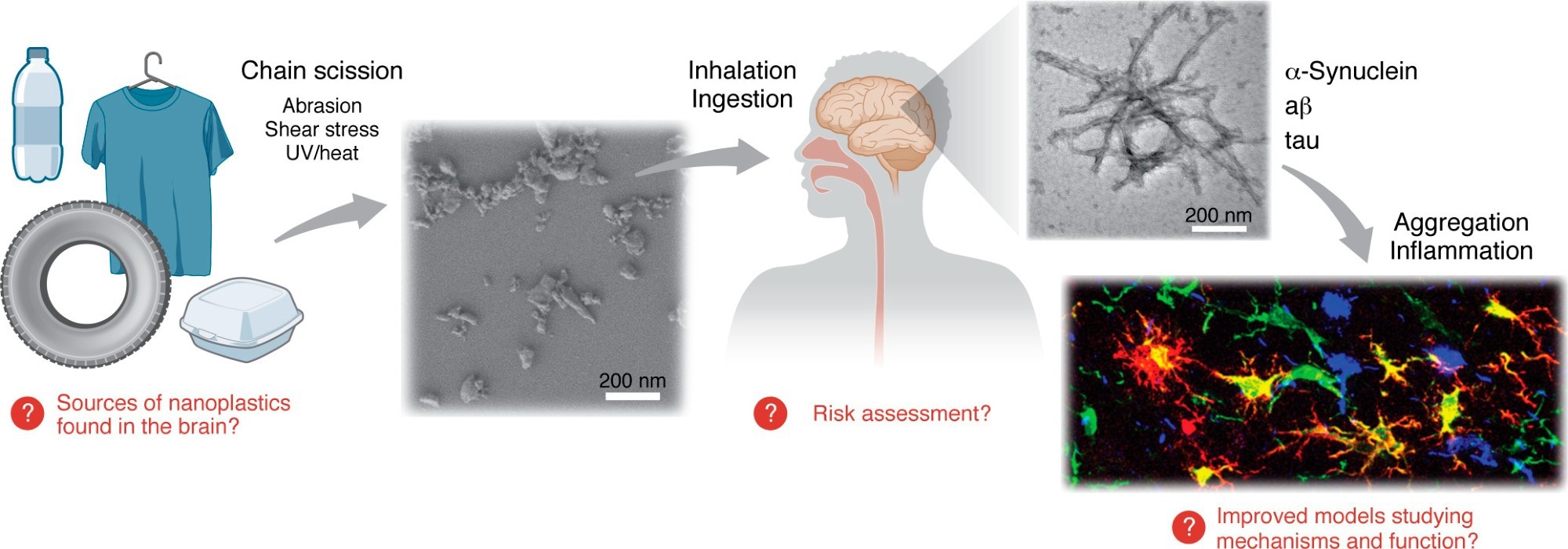
Nanoplastics in the environment and the brain and their links to neurodegenerative disease. Degradation of plastic-containing products, including food and beverage containers, clothing, construction materials, and rubber tires, occurs when the semicrystalline polymers that comprise the majority of commercial plastics undergo chain scission resulting from abrasion, shear stress, and UV/heat exposure. These deteriorating polymers produce micro- and nanoplastics, the latter of which is represented in the electron microscopy image. Inhalation of airborne nanoplastic particles and ingestion of nanoplastics in food and beverages are two routes of entry into the human body; nanoplastics have been identified in nearly every tissue, including the brain. The presence of nanoplastics in brain tissue is linked to pro-inflammatory states and to the aggregation of proteins such as α-synuclein, amyloid-β, and tau, which are implicated in the propagation of neurodegenerative diseases. Notably, the size and lipid-like biophysical properties of nanoplastics facilitate pathological interactions with these proteins. Red question marks highlight priorities for future investigations of nanoplastic reservoirs in the brain.
Unique Properties of Nanoplastics and Why They Matter?
Nanoplastics are fundamentally different from larger microplastics but represent part of a size continuum rather than a strict categorical divide. Because of their extremely small, fractured, and irregular dimensions, they exhibit greater potential biological accessibility rather than simply settling at the bottom of fluids.
These materials are difficult to detect using conventional microscopy, and humans may inhale them unknowingly, according to environmental exposure studies.
Examples of nanoplastic exposure sources include indoor air, bottled water, food packaging, textiles, and degraded tire materials. Nanoplastics can resemble organic biological substances and may therefore go undetected because they are not readily distinguishable from cellular fractions.
Detection Challenges and Emerging Human Tissue Evidence
Detecting nanoplastics in biological samples is technically challenging. No single technique can simultaneously measure particle concentration, size, shape, polymer type, and chemical additives.
Although methods such as pyrolysis mass spectrometry and hyperspectral stimulated Raman scattering microscopy have improved detection capabilities, methodological variation across studies makes direct comparison difficult.
Nevertheless, measurable nanoplastics have been detected in blood, carotid artery plaque, liver, kidney, and brain tissue, raising concerns about systemic distribution and bioaccumulation.
Disease Associations and Epidemiological Observations
Age does not appear to predict tissue accumulation, as both younger and older individuals can harbor measurable plastic burdens. Higher concentrations have been reported in association with more severe disease states, although causality has not been established. Individuals undergoing carotid endarterectomy for carotid artery disease who had measurable plastics in plaques experienced higher rates of major adverse cardiovascular events.
Brain tissues affected by Alzheimer’s disease or vascular dementia have shown greater plastic levels than neurologically normal controls. More recent biospecimens appear to contain higher concentrations than older archived samples, reflecting the global rise in plastic production.
Molecular Mechanisms, Protein Misfolding and Neuroinflammation
Laboratory findings provide biologically plausible mechanisms linking nanoplastics to neurodegeneration. Polyethylene and polystyrene nanoplastics may interact with alpha-synuclein, an important protein in the pathology of Parkinson’s disease, through electrostatic forces, van der Waals forces, and hydrophobic attraction.
These interactions may cause protein misfolding into aggregation-prone conformations. Protein aggregation is a hallmark of many neurodegenerative diseases, such as Alzheimer’s disease and Parkinson’s disease.
Some nanoplastic surfaces structurally resemble damaged lipid membranes, potentially facilitating pathological interactions or acquiring lipid coronas that alter cellular signaling.
Experimental and Animal Model Evidence
Experimental models reinforce concern, as oral exposure to environmentally realistic polyethylene nanoplastics induced intestinal inflammation and measurable cognitive impairment in mice.
In seabirds, higher ingested plastic burdens correlated with proteomic brain changes associated with neurodegeneration. However, many laboratory studies rely on engineered spherical nanobeads that differ structurally from irregular crystalline shards identified in human brain tissue.
Future studies must more closely replicate environmentally relevant particle characteristics to enhance translational relevance.
Exposure Pathways in Daily Life
The routes by which nanoplastics enter the brain remain unclear, but inhalation of indoor air particles and ingestion of contaminated food or beverages are probable pathways. Advanced imaging has identified more than 100,000 plastic particles per liter in bottled water, while steeped plastic teabags released billions of micro- and nanoparticles per milliliter.
These findings make exposure relatable to everyday behaviors. No evidence-based recommendations currently exist to prevent accumulation, and commercial claims of “nanoplastic detoxification” lack scientific validation.
Knowledge Gaps and Research Priorities
Absolute concentration may be less critical than particle characteristics such as size, surface charge, polymer composition, and additive release. It remains unclear whether nanoplastics cause disease, worsen existing conditions, or have no measurable impact.
Research is limited by insufficient environmental monitoring, a lack of standardized measurement protocols, and the fact that nanoplastics are not yet routinely quantified in environmental samples, restricting epidemiological inference.
Critical priorities include determining how nanoplastics cross the blood-brain barrier, identifying high-risk polymer types, clarifying long-term biological effects, and developing realistic exposure models that reflect human environmental conditions.
Conclusion
Nanoplastics have been detected in human blood, cardiovascular plaques, and brain tissue, with higher concentrations observed in association with cardiovascular disease and neurodegenerative disorders.
These findings suggest that these particles may plausibly contribute to neuroinflammation and potentially influence pathological protein aggregation associated with Parkinson’s disease and Alzheimer’s disease. However, causal relationships are not established, and definitive conclusions remain limited by methodological and exposure assessment uncertainties.
As plastic production and environmental contamination continue to increase globally, coordinated research is essential to clarify exposure pathways, biological mechanisms, and long-term health implications before nanoplastic accumulation becomes a larger public health concern.
Journal reference:
- West, A. B., Campen, M. J., Wiesner, M., Somarelli, J. A., & Arnold, J. W. (2026). The hidden world of nanoplastics colliding with neurodegenerative diseases. Journal of Clinical Investigation. 136(4). DOI: 10.1172/JCI204824, https://www.jci.org/articles/view/204824
 Oxaloacetate supplement may help reduce chemo brain in breast cancer survivors