A major immune pathway once known for detecting DNA damage is now being linked to brain aging, glial dysfunction, and neurodegenerative disease, raising hopes for more targeted therapies.
Review: Expanding roles of cGAS-STING signaling in neuroinflammation. Image Credit: Lightspring / Shutterstock
A recent review article published in the Journal of Clinical Investigation discusses the expanding roles of the cyclic GMP-AMP synthase (cGAS)–stimulator of interferon genes (STING) pathway in neuroinflammation.
Nucleic acid sensing is central to innate immunity. Pattern recognition receptors (PRRs) are molecular sentinels that detect endogenous signals and pathogen-derived nucleic acids. Various PRRs function as DNA sensors, including cGAS, which can directly detect double-stranded DNA (dsDNA) in the nucleus and cytosol independent of sequence. cGAS activates STING after binding to dsDNA, inducing a strong type I interferon (IFN-I) response.
Neuroinflammation is a hallmark of neurological diseases, including Parkinson’s disease (PD), Alzheimer’s disease (AD), and Huntington’s disease. The cGAS-STING pathway has emerged as a regulator of anti-tumor immunity, tumorigenesis, and neuroinflammation, and its dysregulation is implicated in brain aging and neurodegenerative diseases. In this review, researchers summarized the role and functions of cGAS-STING signaling in the brain and its therapeutic potential.
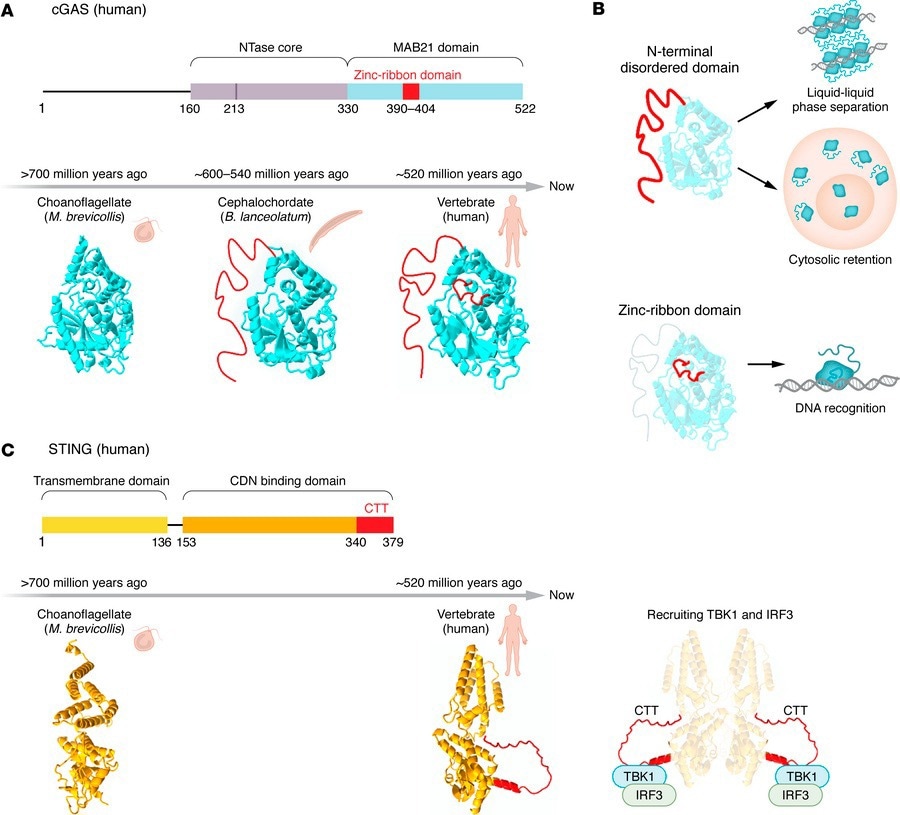
Evolutionary diversification of the cGAS-STING pathway. (A) Evolutionary timeline of cGAS across species. (B) Stepwise acquisition of cGAS functional domains. An N-terminal intrinsically disordered domain emerged in cephalochordates and promotes liquid-liquid phase separation and cytosolic retention, whereas the zinc ribbon domain arose later in vertebrates and is required for efficient DNA recognition and activation. (C) Evolution of STING signaling capacity. In vertebrates, STING acquired a C-terminal tail (CTT) that enables recruitment of TANK binding kinase 1 and interferon regulatory factor 3, driving robust type I interferon responses. This CTT-dependent signaling is absent in nonvertebrate STING homologs. The structures of cGAS and STING were downloaded from AlphaFold DB and modified by ChimeraX. CDN, cyclic dinucleotide.
cGAS-STING Signaling: Molecular Mechanisms
cGAS catalyzes the synthesis of cyclic GMP-AMP (cGAMP) upon binding to dsDNA, forming a ladder-like cGAS-DNA structure. cGAMP then binds to STING, an endoplasmic reticulum (ER)-resident adaptor protein, promoting its translocation to the ER-Golgi intermediate compartment. Activated STING recruits TANK-binding kinase 1 (TBK1), which phosphorylates STING, and subsequently recruits interferon regulatory factor 3 (IRF3).
IRF3 is phosphorylated and undergoes nuclear translocation to induce the expression of IFN-stimulated genes (ISGs) and IFN-I. In addition, the cGAS-STING pathway has other signaling programs. STING activates the nuclear factor kappa B (NF-κB) pathway by recruiting and activating kinases that phosphorylate and promote the degradation of inhibitor of kappa B (IκB). Consequently, NF-κB is translocated into the nucleus, driving the expression of pro-inflammatory cytokines.
In parallel, the cGAS-STING pathway intersects with lysosomal pathways and autophagy. Such non-canonical outputs highlight the functional scope of cGAS-STING signaling beyond IFN-mediated inflammation. Notably, cGAS is also present in the nucleus, tethered to nucleosomes, where it interacts with histones H2B and H2A. However, abnormal histone assembly leads to increased cGAS-mediated cGAMP synthesis.
Nuclear cGAS is activated in response to DNA damage after viral infection and synthesizes cGAMP, inducing a robust IFN-I response. Nuclear cGAS also shapes DNA damage repair; in particular, it interacts with poly (ADP ribose) polymerase 1 (PARP1) and disrupts PARP1-timeless complex formation, suppressing homologous recombination. Further, DNA-bound cGAS interacts with replication proteins, slowing replication fork progression and suppressing DNA damage sensitivity. However, these nuclear functions remain incompletely defined and may include STING-independent effects on chromatin organization and gene regulation.
Effectors of cGAS-STING Within the Central Nervous System
Sustained activation of the cGAS-STING pathway promotes astrocyte and microglia activation across several brain disorders, inducing ISGs and cytokines. These molecules act on neighboring cells in the central nervous system (CNS), amplifying neuroinflammatory responses. Although mainly expressed in innate immune cells, STING also regulates neuronal excitability, regeneration, and inflammation.
Neuronal STING has been found to promote axonal regeneration in dorsal root ganglion neurons or retinal ganglion cells. In contrast, loss of neuronal STING is associated with nociceptor hyperexcitability. Whether such roles extend to other neuronal subtypes is unknown. Further, cGAS-STING activation in brain endothelial cells induces IFN-I signaling and pyroptotic pathways, disrupting the blood-brain barrier and increasing leukocyte infiltration into the brain. However, STING’s effects on blood-brain barrier integrity appear context dependent, as microglial STING signaling may help preserve hippocampal barrier integrity during aging.
Targeting cGAS-STING in Neurodegenerative Diseases
Many proteinopathies across neurodegenerative conditions can generate cytosolic dsDNA capable of activating cGAS, with cytosolic mitochondrial DNA (mtDNA) as a major trigger. However, the review notes exceptions, including tau-PQBP1-mediated activation of cGAS via direct protein-protein interaction and possible cGAS-independent STING activation via organelle stress. Pharmacological inhibition of voltage-dependent anion channel 1 (VDAC1) or mitochondrial permeability transition pore (mPTP) mitigates neurodegeneration in TDP-43 models.
In models of AD, PD, and frontotemporal dementia, inhibiting cGAS-STING reduces NF-κB- and IRF3-induced inflammatory mediators, including cytokines and ISGs. Furthermore, cGAS ablation in AD models enhances amyloid-β clearance by elevating microglial recruitment to plaques, suggesting that targeting cGAS-STING could suppress inflammatory programs while preserving phagocytic capacity.
Concluding Remarks
Taken together, cGAS-STING signaling is increasingly recognized as a driver of chronic neuroinflammation, making it an attractive yet complex therapeutic target for neurological disorders. Sustained cGAS-STING activation in the CNS is linked to aging, neurodegeneration, and cognitive decline, underscoring the need for strategies that can selectively attenuate pathological signaling while preserving essential functions.
In preclinical neurodegeneration and brain injury models, cGAS or STING inhibition has shown promising results. However, chronic cGAS-STING inhibition may pose risks; specifically, given the role of the cGAS-STING pathway in tumor surveillance and antiviral defense, chronic suppression could impair immune function or increase infection risk. Therefore, partial, context-dependent, and potentially CNS-selective or temporally restricted modulation of cGAS-STING may be a potential therapeutic approach, with biomarkers needed to guide patient selection and treatment timing.
Download your PDF copy by clicking here.
Journal reference:
- Feng W, Aikedan A, Sinha SC, Gan L (2026). Expanding roles of cGAS-STING signaling in neuroinflammation. Journal of Clinical Investigation, 136(11), e204550. DOI: 10.1172/JCI204550, https://www.jci.org/articles/view/204550
 Brain-computer interface enables unresponsive ICU patients to control sounds