Researchers compared nasal microbial communities in young children with and without healthcare-worker parents to examine whether occupational exposures might extend into the home and influence early-life microbial environments.
Study: Bringing work home: the microbiota of children of healthcare workers. Image Credit: MP Art / Shutterstock
In a recent study published in the journal Pediatric Research, researchers examined the associations between parents' healthcare work and children's nasal microbiota composition.
Healthcare workers (HCWs) carry hospital-related microorganisms on their clothing, personal items, and skin, which can potentially affect the home microbial milieu. Early microbial exposures may help shape the infant microbiota. The potential links between parents' healthcare work and infant microbiota have yet to be investigated.
About the study
In the present study, researchers evaluated associations between parents' healthcare work and children's nasal microbiota composition. Parents and their six- to 24-month-old children were enrolled in two groups: children of HCWs and those of non-HCWs. Families were excluded if children had been born by cesarean delivery, were premature, had not been breastfed, had a chronic illness, or had recent infection, hospitalization, or antibiotic/probiotic use.
Nasal swab samples from both parents and children, along with sociodemographic data, were collected. Microbial deoxyribonucleic acid (DNA) was extracted from samples, and 16S ribosomal ribonucleic acid (rRNA) gene sequencing targeting the V3-V4 regions was performed. Alpha diversity was evaluated using the Shannon index, Chao1, Faith's phylogenetic diversity, and observed species. Beta diversity was assessed using weighted and unweighted UniFrac distances.
A multivariable regression analysis of covariance model assessed children's alpha diversity and taxa abundance, adjusting for sex, age, kindergarten attendance, and siblings. Parent analyses used linear mixed-effects models adjusted for sex, age, smoking status, and body mass index, with family as a random effect. The Benjamini-Hochberg correction was applied with a 0.20 false discovery rate threshold for this exploratory study. Permutational multivariate analysis of variance was used to evaluate beta diversity.
Findings
The study enrolled 37 families, with 17 children having at least one HCW parent (including six with both parents being HCWs) and 20 having no HCW parent. Thirty-three parent-child trios had microbiota data. HCW and non-HCW children groups showed comparable birth weight, pet exposure, kindergarten attendance, and sex distribution.
Children of HCWs were more likely to be the only child and were slightly older than those of non-HCWs. Children of HCWs showed significantly lower alpha diversity than those of non-HCWs, while beta diversity showed a non-significant trend toward separation. HCW children had lower abundances of Neisseria and Porphyromonas than non-HCW children, although only the reduction in Porphyromonas was statistically significant; Neisseria showed a similar non-significant trend.
In stratified analyses, alpha diversity declined stepwise with increasing numbers of HCW parents, and children with two HCW parents showed the most pronounced differences in both alpha and beta diversity. Nasal microbiota of parents did not differ in taxonomic composition or diversity between non-HCWs and HCWs. The absence of significant differences in parental nasal microbiota means the findings do not directly support a parent-to-child microbial transmission mechanism.
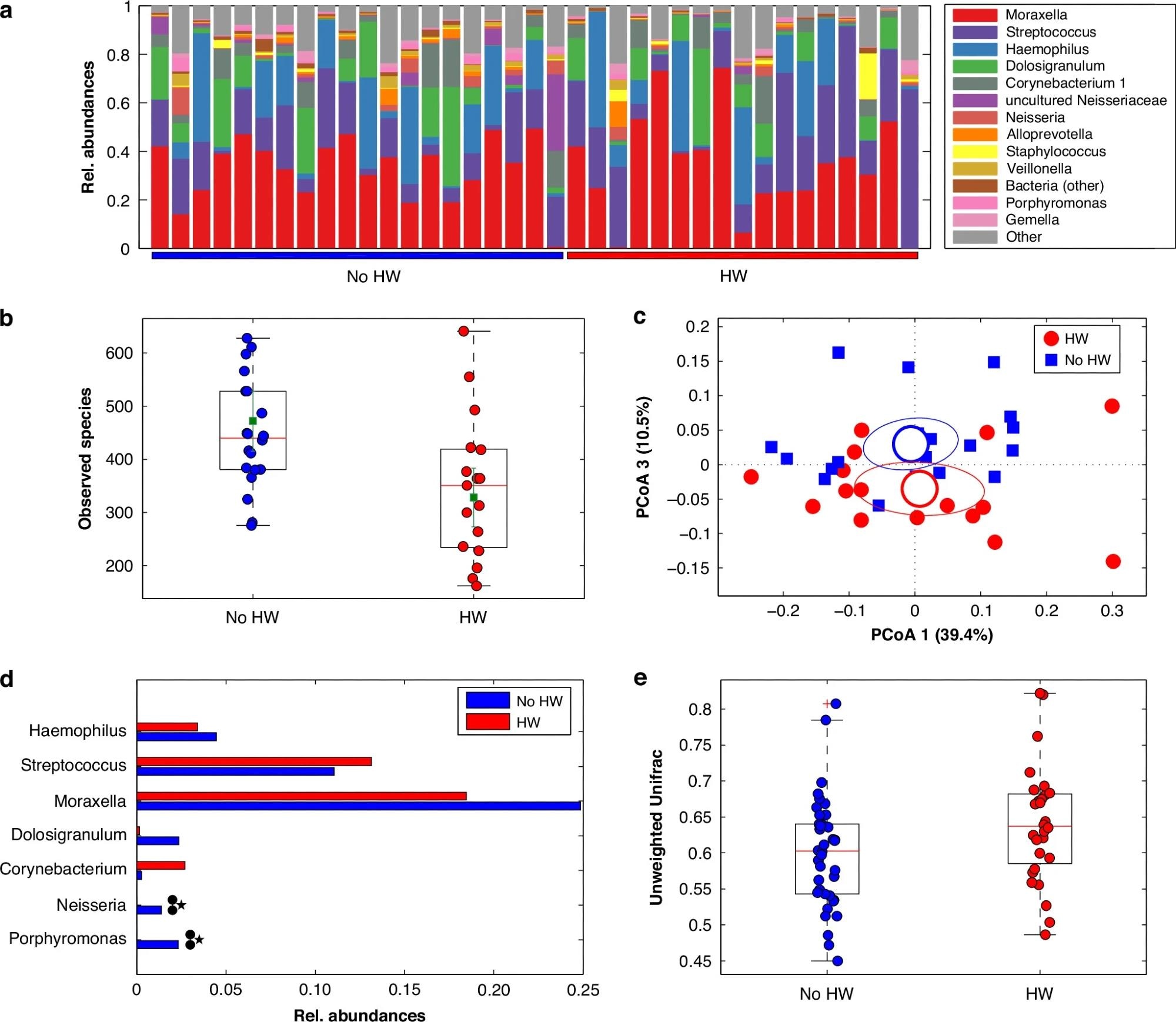
a Barplot showing the composition of the microbiota at genus level for individual samples. Low abundant genera (i.e., : <1% on average) are summed up into the “Other” category. b Boxplot depicting alpha-diversity comparison between no HW and HW groups for the “Observed species” (P = 0.001) metrics. Individual values for the 37 samples are superimposed to the plot. The green square represents the mean (with 95% CI) value estimated by a multivariable regression ANCOVA model adjusted for age, sex, siblings (yes/no) and kindergarten (yes/no). c Beta-diversity Principal Coordinate Analysis (PCoA) plot derived from the weighted UniFrac distance. Each point represents a sample, colored according to the experimental group, the centroid is the mean coordinate per group and the ellipse is the SEM-based confidence interval. Coordinates 1 and 3 are represented. d Barplots of the geometric mean of the relative abundance of bacterial genera for some selected genera over the experimental groups. Genera with FDR < 0.2 are indicated by a ★. e Boxplot of the distribution of unweighted UniFrac distances between each child and his/her parents divided by the latter being HW or no HW. Individual values are superimposed to the plot.
Conclusions
Taken together, the findings indicate lower diversity of the nasal microbiota in children of HCWs, especially those with two HCW parents. Porphyromonas was significantly less abundant in HCW children, while Neisseria showed a similar non-significant trend. Previous literature suggests that these genera may be involved in mucosal immune modulation, indicating possible biological relevance that requires confirmation.
The clinical meaning remains unclear because respiratory and allergic outcomes were not assessed, so the differences could be harmful, protective, or clinically neutral.
The study’s limitations include its exploratory, pilot nature, cross-sectional design, small sample size, and sole focus on the nasal microbiota. Some child swabs yielded relatively few bacterial reads, and incomplete feeding and sibling data may have left residual confounding.
Overall, HCW household status was associated with differences in children's nasal microbial composition. These preliminary results support the possibility of indirect, household-mediated pathways, but the cross-sectional design cannot establish causality.
Journal reference:
- Ferrari L, Severgnini M, Cugliari M, Favero C, Alberzoni M, Milani GP (2026). Bringing work home: the microbiota of children of healthcare workers. Pediatric Research. DOI: 10.1038/s41390-026-05474-7, https://www.nature.com/articles/s41390-026-05474-7
 Nationwide safety program successfully cuts hospital-onset MRSA infections