Fruit juice, puree, and powder appear across everything from drinks to dairy products, but what do their different classifications mean for the sugar information consumers see on food labels?
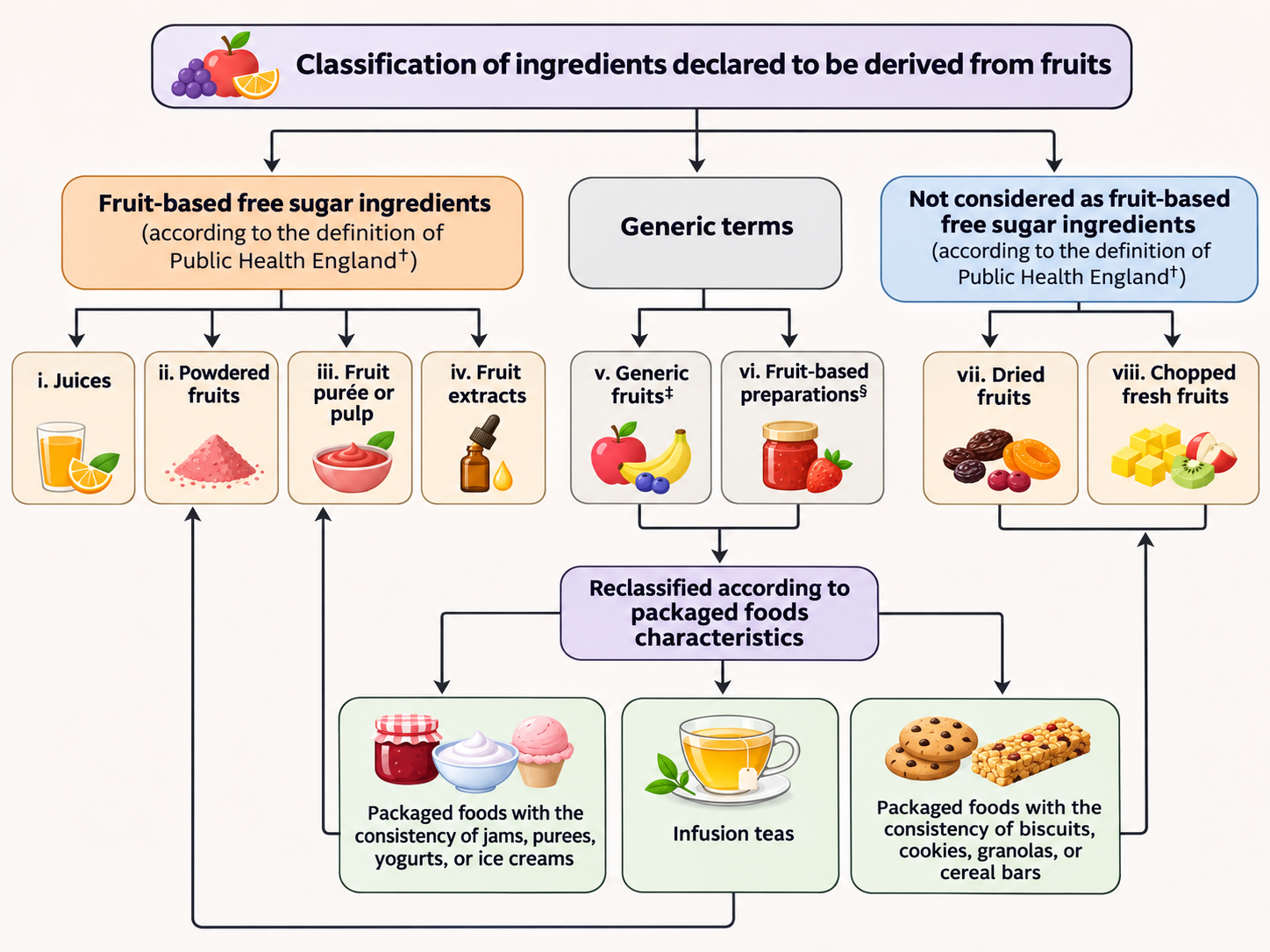
Decision flowchart for the classification of fruit-derived. ingredients declared on food labels.† According to Swan et al., 2018. ‡ Generic fruits refer to generic references to fruit without specifying the processing method (e.g., banana as an ingredient in a yogurt). This may include powdered fruits, fruit purée, fruit pulp, dried fruits, or chopped fruits. § Fruit-based preparations refers to processed fruit-based ingredients that may include fruit purée, fruit pulp, chopped fruits, or jelly (a fruit preserve, typically spread onto bread). Study: The Diversity of Fruit-Based Free Sugar Ingredients on Food Labels
Fruit juice, puree, and pulp may sound wholesome, but they can also be sources of free sugars in packaged foods. In a recent study published in the journal Nutrition Bulletin, the researchers examined fruit ingredients listed on Brazilian packaged food labels to catalog processed fruit ingredients that may qualify as free sugars.
The research was conducted by scientists from the Federal University of Santa Catarina in Brazil, Universidad de la República in Uruguay, and the University of New South Wales and Deakin University in Australia, including researchers from the George Institute for Global Health.
Dietary sugars
Sugars in packaged foods are grouped by origin. Added sugars are those added during manufacturing, cooking, or eating, while free sugars, as defined by the World Health Organization (WHO), also include those found naturally in fruit juices, syrups, and honey. The WHO recommends limiting free sugars to under 10% of daily energy.
Public Health England adopted a wider definition that also covers sugars in purees, pastes, and similar products where the fruit's cell structure has been broken down, but excludes dried or chopped fruit. The researchers used this broader definition to identify processed fruit ingredients as potential sources of free sugars.
Most research linking free sugars to heart disease, type 2 diabetes, tooth decay, and obesity has focused on fructose-containing sugars, such as corn syrup, while evidence for sugars from fruit is limited and contradictory, mostly restricted to fruit juice. Their effects may also vary with processing, sugar quantity, and the composition of the food containing them.
The current study
In this study, the team used a database built from a store survey of packaged foods and beverages at one of the 15 largest supermarket chains in Brazil. Label details were recorded with a mobile phone application developed through The George Institute's FoodSwitch program. The survey took place in November 2020, after Brazil approved new labeling rules but before they took effect, and provides a baseline for later comparisons.
The initial survey collected label information for 7,828 products. The researchers then removed single-ingredient foods, which need no ingredient list, along with alcohol, plain water, raw meats, fresh produce, and dried teas, herbs, or spices. Foods for children up to age 3 and baby formula were also excluded because separate rules apply for such foods. The final set consisted of 5,276 products, sorted into 24 food groups by product type and intended use.
After reviewing the ingredient lists and recording each fruit-derived ingredient, the team grouped extracts, puree and pulp, powdered fruit, and juices as fruit-based free sugar (FBFS) ingredients, since processing breaks down their cell structure.
Dried fruits and chopped fresh fruits, which retain more of their cell structure, formed separate groups. Vague entries such as generic fruit names were reassigned based on the product. Yogurts, jams, and ice creams were classified as puree and pulp; infusion teas were grouped under powdered fruit, while firmer foods such as cookies and cereal bars were assigned to dried or chopped fruit categories. Because 23.7% of fruit ingredient declarations did not specify the processing method, some classifications required the researchers' judgment.
The team calculated FBFS prevalence across the full sample and within individual food groups. It counted how many FBFS ingredients each product listed and summarized the results with the median, lowest, and highest values. Because ingredients are listed by descending weight, the team tallied products with FBFS ingredients in the first three positions, using position as an indirect indicator of quantity.
Major findings
The study found that about one in six packaged foods, or 15.7% of the 5,276 analyzed, listed at least one fruit-based free sugar ingredient. The researchers also identified 398 distinct terms describing fruit-related ingredients. In nearly two-thirds of those products, the ingredient was among the first three on the list, but the researchers could not determine its quantity or contribution to sugar content. Dried and chopped fresh fruit were analyzed separately because they are excluded from the adopted free sugar definition, although their effects on sugar release and metabolism remain uncertain.
Fruit juice was the most frequently declared FBFS category, followed closely by fruit puree and pulp. Powdered fruit and fruit extracts were far less common. Juices, such as lemon juice in meat products and grape must in vinegar, were the predominant FBFS category in beverages, meats, oils and nuts, and food additives. Puree and pulp were the most commonly declared FBFS ingredients in yogurts, sweet spreads, and plant-based dairy substitutes.
The prevalence differed widely by food group. All sampled juices, nectars, and fruit drinks contained these ingredients, as did about 62% of fruit pieces, jams, and similar items; 52% of dairy drinks, yogurts, and dairy desserts; and 48% of sweet spreads. Savory snacks (1.3%) and gravies, sauces, and ready-to-eat dishes (1.7%) had the lowest rates.
These findings matter for everyday shoppers because Brazil's current definition of added sugars excludes fruit juice, puree, pulp, and powdered fruit. Labels indicating added sugar levels may report less than the total free sugar content, but the study did not measure by how much. The authors suggested that this regulatory distinction could encourage manufacturers to replace conventional added sugars with processed fruit ingredients, but did not examine whether such substitution occurs. Because the products were surveyed before the revised labeling rules took effect, the study could not establish whether manufacturers subsequently changed their use of these ingredients.
The authors noted that the findings also raise questions about systems such as Nutri-Score and the Health Star Rating, which can assign positive nutritional value to certain processed fruit ingredients.
Conclusions
Overall, the study found that 15.7% of products surveyed at one Brazilian supermarket in 2020 declared at least one fruit-based free sugar ingredient, with nearly two-thirds listing it among their first three ingredients. Fruit juice was the most common, followed by puree and pulp, illustrating the variety of processed fruit ingredients declared on food labels.
These findings may inform revisions to current sugar labeling rules, which exclude these ingredients from added sugar declarations. The analysis did not measure the ingredients' contribution to free sugar intake or examine their health effects.
Source:
Journal reference:
- Padovan, M., Ares, G., dos Santos Kraemer, M. V., Coyle, D. H., Scapin, T., Milano, E., Pettigrew, S., Chaddad, M. C. C., Fernandes, A. C., Uggioni, P. L., Bernardo, G. L., & da Costa Proença, R. P. (2026). The diversity of fruit‐based free sugar ingredients on food labels. Nutrition Bulletin, Article nbu.70075. DOI:10.1111/nbu.70075, https://onlinelibrary.wiley.com/doi/10.1111/nbu.70075
 Does choosing organic baby food change its mineral content?