A long-overlooked immune organ may hold critical clues to longevity, with new imaging evidence linking thymic health to survival, cancer risk, and cardiovascular outcomes in adults.
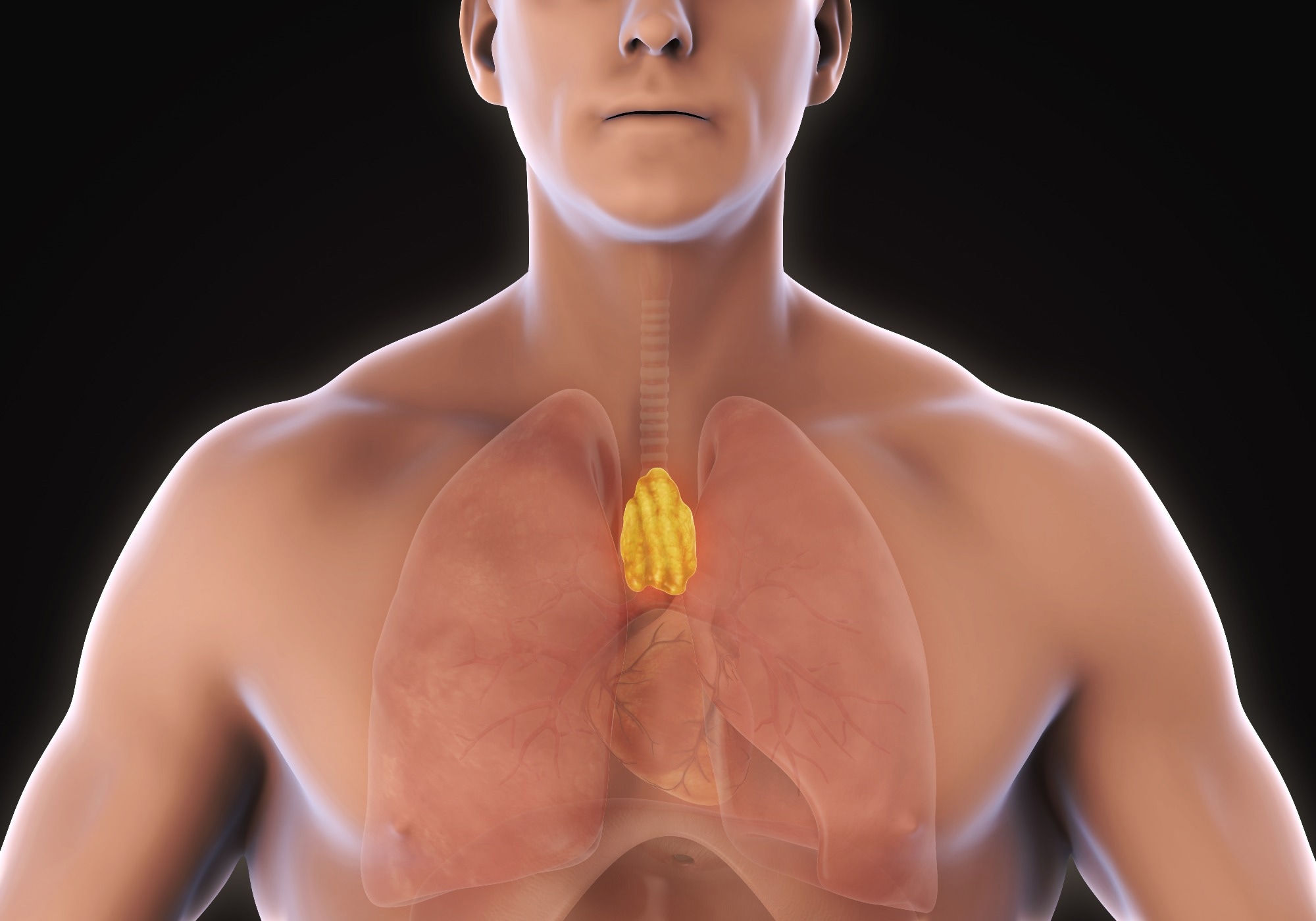
Study: Thymic health consequences in adults. Image Credit: Nerthuz / Shutterstock
In a recent study published in the journal Nature, a group of researchers examined how thymic health influences mortality, cancer, and cardiovascular outcomes in adults using imaging and large cohort data.
The Thymus and Immune Aging Process
What if a small organ you rarely think about could predict how long you live? The thymus produces T cells (a type of immune cell), but it shrinks with age and this process is called thymic involution.
It has traditionally been thought that the thymus becomes largely nonfunctional after childhood, but recent studies suggest that, as we age, the thymus is linked to the aging of the immune system and the development of chronic diseases.
With rising global rates of cancer, heart disease, and metabolic syndrome, understanding the mechanisms behind this decline could be essential to the future health of the population. Further research is needed on how thymus changes affect long-term health and well-being.
Large Cohort Imaging and AI Analysis Methods
The researchers conducted a large-scale observational study using data from two well-established cohorts: the National Lung Screening Trial (NLST) and the Framingham Heart Study (FHS). 27,612 participants underwent computed tomography (CT).
Using these CT images, a deep learning (DL) model was built using convolutional neural networks and self-supervised learning to quantify overall thymic health from imaging data.
The model predicted the status of the thymus based upon its structural features generating a continuous score (scaled from 0–100 for interpretability) to serve as an imaging-based proxy for the functional status of the thymus rather than a direct measurement of thymic function.
Group classification was based on population percentiles into low, average and high thymic health categories. The project's 12-year outcomes for all-cause mortality, lung cancer incidence, and cardiovascular disease were analyzed statistically using Kaplan-Meier survival curves and Cox proportional hazards models, adjusting for age, gender, smoking status, pack years, and body mass index (BMI).
Additional analysis of thymic health was performed by evaluating associations with metabolic markers, lifestyle habits and the presence of inflammatory proteins. For the purpose of understanding the underlying biological mechanisms associated with thymic decline, blood-based biomarkers including C-reactive protein, cholesterol, and inflammatory cytokines such as interleukin 6 were measured.
Thymic Health Linked to Survival Outcomes
Thymic health varied widely across individuals, even among those of similar age, highlighting that immune aging is not uniform. Higher thymic health was consistently associated with better survival outcomes.
Based on the study, participants who had a healthy thymus were approximately half as likely to die from all causes as those with poor thymus health (13.4 % versus 25.5 %) over 12 years, with mortality rates remaining substantial after controlling for other risk factors such as smoking, age, and history of illness.
The same direction of association was observed in the FHS, although statistical significance was not retained after full multivariable adjustment, thus providing partial but more limited replication across the two cohorts.
Reduced Cancer Risk with Better Thymic Function
It was observed that participants with better thymic health had a lower risk of developing lung cancer and had lower lung cancer mortality. In a study, the incidence of lung cancer was decreased to 3.4% in the high thymic health group compared to the low thymic health group at 5.3%.
Deaths due to lung cancer were reduced almost by half in people who had better thymic function. These associations remained after adjustment for smoking-related variables, and these findings suggest that thymic health may contribute to cancer risk beyond traditional risk factors, although subgroup analyses showed mixed results for incidence depending on smoking status.
Cardiovascular Benefits of a Healthy Thymus
Individuals with high thymic health had substantially lower cardiovascular mortality, with risk reductions of up to 63% in the NLST and numerically greater but less statistically robust reductions in the FHS. Besides, the rate of heart attacks and heart failure were also lower, although some associations were attenuated after adjustment for age, sex, and smoking, indicating more modest or borderline effects for specific cardiovascular events.
Inflammation, Lifestyle, and Immune Health Links
Beyond major diseases, thymic health is related to overall health. Lower thymic health is associated with increased mortality from pulmonary, metabolic, and digestive diseases. These findings suggest that the thymus influences overall resilience against multiple diseases rather than a single condition.
Lifestyle and metabolic factors are important for thymic health. Smoking damages the thymus, while better metabolic health supports its function. Chronic inflammation can also weaken the thymic health. Persistently elevated systemic inflammatory markers were associated with lower thymic scores, indicating a relationship between immune aging and systemic inflammation linked to multiple chronic diseases.
Implications for Longevity and Disease Prevention
This study demonstrates that thymic health remains a crucial determinant of adult health, influencing survival, cancer risk, and cardiovascular outcomes. Even though the thymus has historically been viewed as largely inactive after childhood, it continues to support and maintain immune function throughout life. Importantly, individual differences in thymic health can be substantial, reflecting each person’s unique lifestyle and metabolic factors.
Thymus research has demonstrated that this gland may be a target for disease prevention strategies and longevity promotion. However, because this was an observational study, the findings do not establish causality, and it remains unclear whether reduced thymic health drives disease risk or reflects underlying health decline.
Additionally, the study populations were predominantly White and included specific cohorts, such as heavy smokers in the NLST, which may limit generalizability to broader populations. Differences in imaging protocols across cohorts mean that standardized clinical thresholds are not yet established. Improved lifestyle behaviors, reduced inflammation, and preserved immune function could work together to enhance one’s long-term health and quality of life.
Journal reference:
- Bernatz, S., Prudente, V., Pai, S., Attermann, A. K., Cao, Y., Chen, J., Lyass, A., Foldyna, B., Nürnberg, L., Bressem, K., Abbosh, C., Swanton, C., Jamal-Hanjani, M., Lu, M. T., Murabito, J. M., Lunetta, K. L., Birkbak, N. J., & Aerts, H. J. W. L. (2026). Thymic health consequences in adults. Nature. DOI: 10.1038/s41586-026-10242-y, https://www.nature.com/articles/s41586-026-10242-y
 Severe COVID and flu infections increase risk of lung cancer