Idiopathic pulmonary fibrosis (IPF) is a chronic lung disease characterized by repetitive epithelial damage, abnormal repair, and excess extracellular matrix deposition. Many people with IPF have also been diagnosed with obstructive sleep apnea (OSA), indicating a connection between the two diseases.
Intermittent hypoxia (IH), a defining feature of OSA, induces oxidative stress and inflammation, which are associated with fibrosis. Until recently, the molecular processes underpinning IH's contribution to IPF development and progression were elusive.
Aim
To investigate how IH contributes to lung fibrosis and determine the molecular causes.
Methods: How the VelO2x was used
Male C57BL/6J mice were used in a bleomycin (BLM)-induced lung fibrosis paradigm. Mice were exposed to IH using the VelO2x in vivo hypoxia chamber to simulate OSA settings (i.e., hypoxia and re-oxygenation).
Oxygen levels were varied between normoxia (21% O2) and hypoxia (down to 7% O2) at 30 cycles per hour for eight hours each day. The researchers carried out histological examination of lung injury, collagen deposition, and molecular analyses of pro-fibrotic and ER stress indicators using qPCR and western blotting.
Results
The VelO2x allowed researchers to investigate the effects of IH on lung fibrosis. IH had minimal influence on BLM mice, but it exacerbated the effects, especially when IH exposure occurred beforehand.
The fine-tuned control of oxygen cycling revealed that pre-exposure to hypoxia resulted in more weight loss, lung damage, and collagen deposition than BLM alone.
Conclusion
The study found that IH exacerbates lung fibrosis, particularly when it precedes fibrotic damage, implying that OSA may play a causative role in aggravating IPF.
This research demonstrates that IH serves as a modulator, rather than a fundamental cause, of fibrosis. Clinically, this supports the notion that treating OSA may help slow the progression of fibrosis in IPF patients.
Product highlight and the three Rs approach (reduce, replace, refine)
The VelO2x facilitates precise tuning of oxygen levels (in 0.1% increments), cycling timing, and exposure durations, assuring consistency and biological relevance, hence eliminating the need for repeated tests.
The non-invasive chamber may hold either one or two mouse cages, ensuring that animals never have to leave their home. As a result, the VelO2x is also suitable for group living, which reduces animal stress. Oxygen levels rise and fall quickly, limiting the animals' overall exposure to hypoxia.
During hypoxic exposure, gases are stable and automatically managed, avoiding fluctuations and human-handling variability, reducing unexpected stress responses, and ensuring improved welfare throughout chronic studies.
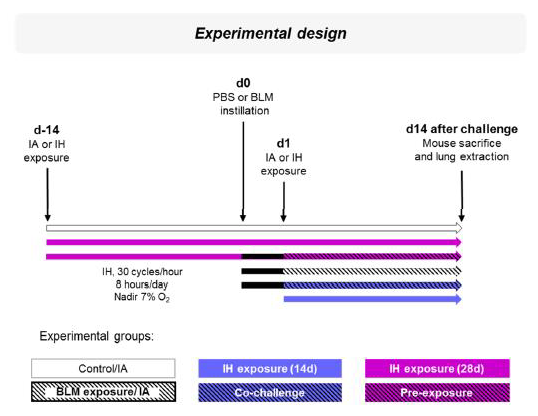
Figure 1. Experimental design of Bleomycin instillation and Intermittent Hypoxia exposure. Mice were exposed to Intermittent Hypoxia (IH; 30 cycles/hour, eight hours/day, Nadir 7% O2, magenta color) or intermittent air (IA, white color) (day-14).
Fourteen days later, Bleomycin (BLM, black color) or PBS was instilled intratracheally (day 0). Mice were then exposed at d1 to IA or IH; black hatched bars are for BLM/IA exposure, blue color for IH exposure (14 days), blue hatched black for the Co-challenge group, and magenta hatched black for the Pre-exposure.
Two weeks later (d14), mice were sacrificed, and their lungs were extracted for molecular and histological analyses. Image Credit: Scintica Instrumentation Inc.