Researchers from Switzerland's Institute for Research in Biomedicine have demonstrated the necessity of both anesthetic choice and vital monitoring during anesthesia use with experimental animals. Their results were published in Lab Animal.1
Mice were anesthetized with isoflurane or ketamine-xylazine following a surgical procedure and kept under anesthesia for an additional period. Mice given isoflurane recovered quickly after anesthetic removal, whereas mice under only ketamine–xylazine (KX) led to 100 % lethality before the end of the procedure.
Due to vital monitoring during the procedure, the ketamine-xylazine was found to cause a severe hypoxic event coupled with bradycardia, resulting in decreased tissue oxygen delivery.
Figure 1 shows that the researcher's proper intervention of oxygen supplementation (KXO2) considerably lowered the observed mortality rate with ketamine-xylazine anesthesia.
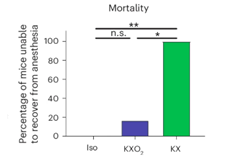
Figure 1. Effect of the Anesthetic Protocols on Mouse Survival. Mortality rate for each group indicated as the percentage of mice unable to recover from anesthesia over the total number of mice anesthetized. Image Credit: Figure and text adapted from Virgilio, T. et al. Lab Animal. 2025.
Importance of monitoring vitals
Throughout the procedure, the researchers used the Indus Rodent Surgical Monitor system to monitor vital signs and assess the animal's stability while anesthetized.
Monitoring of respiration, oxygen delivery to tissues (SpO2), and heart rate revealed abnormalities near the end of the procedure in the ketamine-xylazine group. These results emphasized the importance of vital sign monitoring and timely intervention with researcher-supplemented oxygen to maintain the animal's physiological stability during anesthesia.
Respiration
Monitoring respiration revealed a significant decrease in respiratory rate as the procedure came to an end in the ketamine-xylazine group (Figure 2). Identifying this trend in real time is crucial so the researcher can intervene in a timely manner.
Detecting abnormal respiration rates enables the researcher to deliver 100 % oxygen using a face mask as a rescue technique, or to consider using mechanical ventilation in future protocols to prevent respiratory collapse.
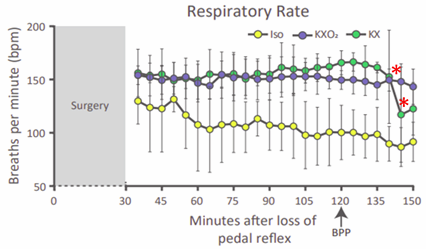
Figure 2. Effect of the Anesthetic on Mouse Vital Parameters. Respiratory rate over time. Red asterisk highlights oncoming respiratory failure. Image Credit: Figure and text adapted from Virgilio, T. et al. Lab Animal. 2025.
Oxygen saturation
Figure 3 shows that the ketamine-xylazine group had continuously low oxygen saturation levels, indicating inadequate oxygen transport to tissues and a severe, acute hypoxic event with a SpO2 level of approximately 70 %.
Any value below 90 % indicates poor oxygenation, and detecting these low values in real time allows researchers to intervene quickly by providing supplementary oxygen through a face mask as a rescue measure.2,3
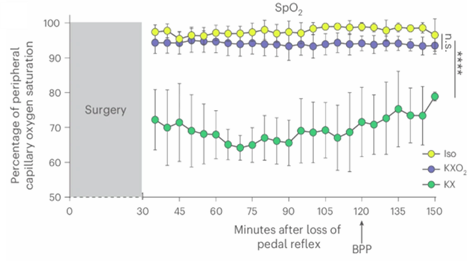
Figure 3. Effect of the Anesthetic on Mouse Vital Parameters. Oxygen saturation rate over time. Image Credit: Figure and text adapted from Virgilio, T. et al. Lab Animal. 2025.
Heart rate and ECG abnormalities
Monitoring heart rate revealed a considerable decrease in cardiac activity near the conclusion of the procedure in the ketamine-xylazine group, with episodes of severe bradycardia and probable progression to arrhythmias, as seen in Figure 4.
These findings highlight the significance of continuous cardiac monitoring during anesthesia, since variations in heart rate and rhythm can be early signs of physiological decompensation.
If cardiac arrest symptoms are observed, the researcher can instantly provide 100 % oxygen via a face mask to increase oxygen supply and support cardiac function, or initiate chest compressions if cardiac function continues to drop.
Cardiac arrest is reversible in a significant majority of cases, and prompt treatment is critical to averting the animal's death.4,5
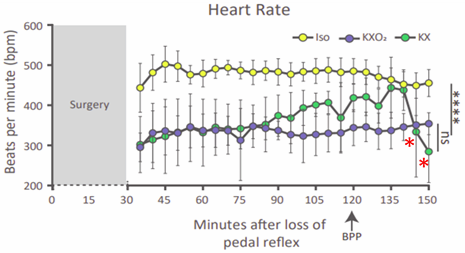
Figure 4. Effect of the Anesthetic on Mouse Vital Parameters. Heart rate over time. Red asterisk highlights oncoming cardiac arrest. Image Credit: Figure and text adapted from Virgilio, T. et al. Lab Animal. 2025.
References
- Virgilio, T., et al. (2025). Impact of prolonged isoflurane or ketamine–xylazine anesthesia with or without buprenorphine and oxygen on mouse vitals and immune responses. Lab Animal, 54(10), pp.270–277. DOI: 10.1038/s41684-025-01614-4. https://www.nature.com/articles/s41684-025-01614-4.
- Bhutta, B., Alghoula, F. and Berim, I. (2024). Hypoxia. National Library of Medicine. Available at: https://www.ncbi.nlm.nih.gov/books/NBK482316/.
- Mayo Clinic (2023). Hypoxemia (low blood oxygen). Mayo Clinic. Available at: https://www.mayoclinic.org/symptoms/hypoxemia/basics/definition/sym-20050930.
- Andersen, L.W., Lauge Vammen and Asger Granfeldt (2024). Animal research in cardiac arrest. Resuscitation Plus, 17, pp.100511–100511. DOI: 10.1016/j.resplu.2023.100511. https://www.sciencedirect.com/science/article/pii/S2666520423001546?via%3Dihub.
- Attri, J., et al. (2016). Perioperative death: Its implications and management. Saudi Journal of Anaesthesia, 10(4), p.436. DOI 10.4103/1658-354x.177338. https://journals.lww.com/sjan/fulltext/2016/10040/perioperative_death__its_implications_and.14.aspx.
About Scintica Instrumentation Inc.
At Scintica, we advance science and medicine by supplying researchers with reliable research instrumentation and equipment. Our carefully selected portfolio of imaging systems, research tools, and supporting technologies is designed to reduce complexity and help scientists focus on what matters most, generating
meaningful results.
We partner closely with the preclinical research community to connect teams with solutions that are scientifically robust and built to support research challenges. From system selection through long-term support, our goal is to make research more productive, efficient, and impactful.
Sponsored Content Policy: News-Medical.net publishes articles and related content that may be derived from sources where we have existing commercial relationships, provided such content adds value to the core editorial ethos of News-Medical.net, which is to educate and inform site visitors interested in medical research, science, medical devices and treatments.