Transverse aortic constriction (TAC) is a well-known surgical procedure in preclinical research. This method induces a pressure overload cardiac hypertrophic response in the left ventricle, which eventually leads to heart failure and organism death, and is intended to mimic one of the most common pathways in human heart failure.
TAC allows researchers to investigate the fundamental processes underlying heart failure and identify potential therapeutic strategies. As a result, developing meaningful and reproducible animal models of this pathology is essential.
Researchers recently characterized an enhanced, minimally invasive mouse model of transverse aortic constriction (mTAC) that prevents the opening of the pleural cavity while generating a reproducible cardiac remodeling similar to conventional TAC models (cTAC).
Figure 1 shows a schematic of suture placement on the aortic arch via a small neck-chest incision in the mTAC procedure.
cTAC requires a thoracotomy, which is more invasive, causing inflammation, increasing perioperative mortality, further complicating cardiac outcomes, and lowering experimental validity and repeatability.
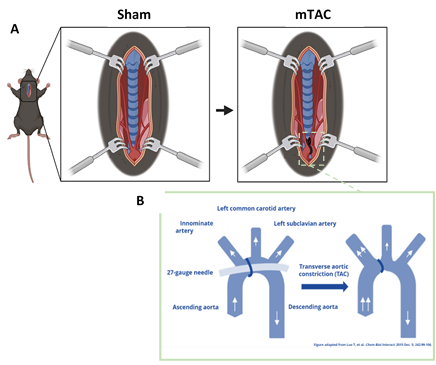
Figure 1. TAC Procedure.
A) A schematic showing the novel approach of the TAC procedure from the neck-chest rather than a partial thoracotomy as in conventional TAC procedures. The suture is tightened around the aortic arch. B) Arrows showing the changes in blood flow velocity in specific vessels before and after the TAC procedure. This change in hemodynamics creates cardiac pressure overload.
Image Credit: Figure adapted from Navarro-Garcia et al., Journal of Cardiovascular Aging 3(3): 31, 2023.1
Confirmation of successful TAC surgery
The researchers used ~2 mm diameter ultrasonic probes when performing postoperative Doppler ultrasound to ensure accurate blood flow measurements.
Blood flow velocity measurements showed a considerable increase in right-to-left carotid flow velocity ratio (RC/LC) (≈5.9 compared to 1.2 in controls), indicating effective aortic constriction.
In SHAM-operated animals, the RC/LC ratio should be approximately one because blood flow velocity is comparable in both branches under normal circumstances. In TAC models, however, there will be jet stenosis of the right carotid with minimized blood flow to the left carotid, substantially raising the RC/LC ratio (representative images in Figure 2).
Serial echocardiography over eight weeks revealed progressive left ventricular (LV) remodeling consistent with heart failure and a lower ejection fraction (Figure 3), reflecting the pathophysiology of human decompensated cardiomyopathy.
This minimally invasive approach generates constant and reproducible heart pressure overload, which closely mimics the human disease course, starting with compensatory hypertrophy and progressing to systolic failure and atrial remodeling.
The mTAC model had a low perioperative mortality (9 %) and an eight-week survival rate of 70 %. Importantly, all mice that survived to eight weeks acquired significant left ventricular dysfunction.
The goal of simplifying the TAC technique is to reduce phenotypic variability observed in conventional TAC models, thereby making heart failure studies more reproducible and robust.
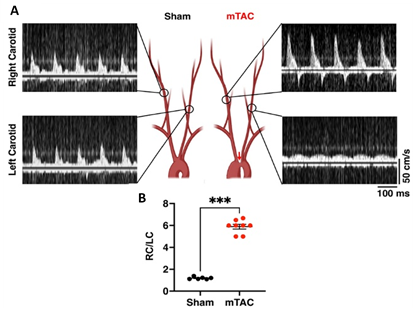
Figure 2. TAC Stratification Imaging in SHAM and TAC mice.
A) Schematic illustration of the aortic arch with no ligation (sham; left panel) and ligation (mTAC; right panel), and representative recording patterns of blood flow in the right carotid and left carotid. B) Quantification of RC/LC (right carotid to left carotid) ratios in sham (n = 6) versus mTAC (n = 8) mice. Highlighting the RC/LC ratio as a reproducible verification of successful TAC surgery. Data shown mean ± SEM. ***P < 0.001 using student’s t-test.
Image Credit: Figure adapted from Navarro-Garcia et al., Journal of Cardiovascular Aging 3(3): 31, 2023.1
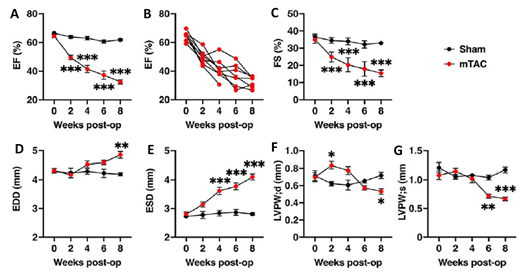
Figure 3. Heart failure with reduced ejection fraction induced by mTAC.
A) Average ejection fraction (EF) at the different time points in sham (black plots, n = 6) and mTAC (red plots, n = 8) mice. B) Individual EF changes in mTAC mice at different time points.
(C–G) Average of C) fractional shortening (FS), D) end-diastolic diameter (EDD), E) end-systolic diameter (ESD), F) left ventricular posterior wall at diastole (LVPW;d), and G) LVPW in systole (LVPW;s), at the different timepoints in sham and mTAC mice. Data shown mean ± SEM. *P < 0.05, **P < 0.01, and ***P < 0.001, using 2-way ANOVA with Bonferroni’s multiple-comparison correction.
Image Credit: Figure adapted from Navarro-Garcia et al., Journal of Cardiovascular Aging 3(3): 31, 20231.
References
- Navarro-Garcia, J.A., et al. (2023). Characterization of atrial and ventricular remodeling in an improved minimally invasive mouse model of transverse aortic constriction. The Journal of Cardiovascular Aging, [online] 3(3), pp.31–31. DOI: 10.20517/jca.2023.18. https://www.oaepublish.com/articles/jca.2023.18.