Essential to modern laboratories, microplate readers support a range of applications across drug discovery, academic research, biotechnology, quality control, and routine assay workflows.
However, due to their importance and role, selecting the right instrument can be a difficult task in itself. Therefore, owing to the diverse range of detection modes, optical systems, software capabilities, and usability features available, the reader most appropriate for one lab may be unnecessarily complex or insufficient for another.
Rather than focusing on headline specifications, laboratories should consider how the microplate reader will support current assays, future workflows, and everyday usability. Distinguishing the essential features from the beneficial and unnecessary ones is central to making a well-informed purchasing decision.
Understanding who uses microplate readers
Microplate readers serve a broad range of laboratories, each with their own distinct priorities.
Drug discovery laboratories typically demand high-throughput, low-volume compatibility, and exceptional assay performance. Here, researchers are frequently dependent on reliable sensitivity, speed, and automation compatibility to facilitate large-scale screening workflows.
Research and development laboratories in universities, biotech companies, and core facilities tend to emphasize flexibility over speed. These labs typically perform a diverse range of assays and gain more from multiple detection technologies and experimental formats.
Other laboratories may employ a specific microplate reader for a single application, such as ELISA, DNA quantification, or an upstream or downstream process. In these instances, flexibility can be compromised in favor of reliability, user-friendliness, and consistent performance for a single repeated workflow.
The starting point for microplate reader selection is defining which assays will be performed, who will operate it, and the degree of flexibility required.
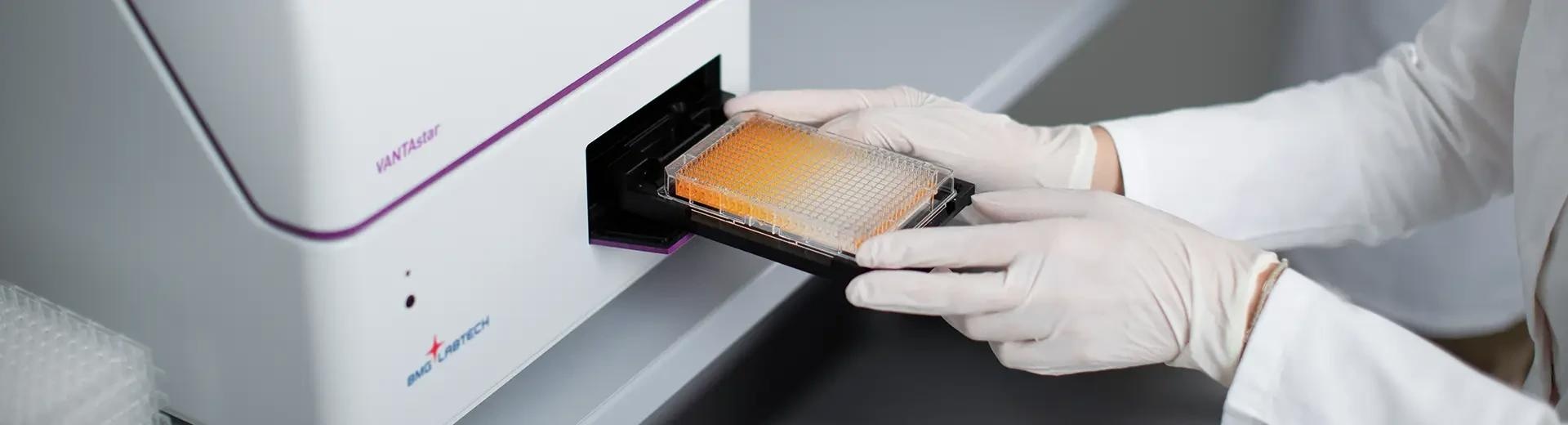 Image Credit: BMG LABTECH
Core detection modes: The foundation of microplate reading
The majority of microplate-based assays are dependent on three core detection modes: absorbance, fluorescence, and luminescence.
Absorbance, also known as colorimetric detection, is used extensively in ELISA workflows and spectrophotometric measurements. Fluorescence assays support a wide variety of biological and chemical applications, while luminescence is frequently used in reporter gene assays, CellTiter-Glo assays, BRET detection, and related methods.
More specialized detection modes, including TR-FRET, Alpha technology, and fluorescence polarization, extend these capabilities further. TR-FRET and Alpha assays are commonly used as automation-friendly alternatives to conventional ELISAs since each can reduce or eliminate wash steps that have to be performed manually or by another device. Fluorescence polarization is frequently used for studying protein-protein interactions, drug binding, and other molecular events.
The assay requirements being run in the lab should be the primary driver of reader choice. A lab performing only absorbance-based ELISAs has less need for a maximum sensitivity multi-mode instrument than a drug discovery group running complex fluorescence and luminescence assays.
Why wavelength selection matters
Accurate wavelength selection is essential when taking absorbance-, fluorescence-, and luminescence-based measurements. The reader light source, in many cases a Xenon flashlamp, usually emits many different wavelengths at the same time, and the reader must be able to isolate the wavelengths required for excitation and detection while blocking unspecific signals not related to the sample.
Poor discrimination can increase background noise, reduce sensitivity, and negatively impact the limit of detection. Therefore, filters, monochromators, and spectrometers are employed for appropriate wavelength selection.
Filters: High performance with less flexibility
Filters are among the oldest and simplest technologies used in microplate readers as they facilitate the transmission of specific wavelengths while blocking others. They are available for most commercially used assays.
The primary advantage of filters is their efficiency, as they use a short optical path and transmit light effectively. They generally offer greater sensitivity and strong wavelength blocking, and are compact, reliable, and relatively cost-effective.
For labs that perform established assays at pre-determined wavelengths, filter-based systems deliver exceptional performance. However, they are not as flexible as tunable systems. So, when a lab needs to adjust assay wavelengths frequently or support a broader range of applications, filters may quickly reach their limits.
Monochromators: Flexible but not always equal
Monochromators offer tunable wavelength selection, granting users the power to select various wavelengths without having to change filters. Traditional grating-based monochromators have been around for decades and are typically used in absorbance and fluorescence assays.
Flexibility is the main benefit on offer here. However, more complex optical paths can lead to photon loss and increased scattered light. Widening the bandpass to allow more light through can degrade performance at the peripheral boundary of the wavelength window.
This presents significant challenges when dealing with more complex assays, such as BRET, NanoOrange protein assays, and dual-glow luminescence methods.
BMG LABTECH´s patented Linear Variable Filter (LVF) Monochromators offer a solution to this problem, as, like traditional filters, they use interference-based wavelength selection while enabling continuous tunability. This brings together the flexibility of a monochromator with the efficient light transmission of filters, improving sensitivity for fluorescence and luminescence assays, providing a filter-like performance.
Spectrometers: Rapid full-spectrum measurements
Spectrometers tend to capture a full absorbance spectrum in a single pass by eliminating the need to read the plate several times at different wavelengths. This can be invaluable when multiple wavelengths are needed.
Full-spectrum collection also makes it easier to identify interference from other compounds, confirm peak quality, and track both product and substrate simultaneously. For example, when working with enzyme assays, measuring both the product and the substrate concurrently can enhance data quality and timing accuracy.
Spectrometers are especially useful for absorbance-based workflows where speed, spectral information, and multi-wavelength measurements are equally important.
Balancing performance, flexibility, and budget
Choosing a microplate reader typically involves trade-offs between performance, flexibility, and budget.
A high-performance, flexible system may include filters, monochromators, lasers, and additional advanced features, but tends to cost more. A simple system designed for one assay type may be more affordable and easier to justify, but it may not be future-proof.
For a drug discovery laboratory, performance may be the leading priority, whereas for a core facility, flexibility is equally vital, especially when supporting multiple users and assay types. For a single-purpose laboratory, the best option may be a simple, reliable single-mode reader optimized for a single method.
The goal is to avoid paying for features that will not be used while ensuring the instrument remains future-proof for all applications.
Usability features that can improve assay performance
Beyond detection modes and wavelength selection, several features affect performance and ease of use. These may not always be obvious to first-time buyers, but they can make a significant difference in everyday operations.
Gain adjustment and enhanced dynamic range
Gain refers to the voltage applied to the detector and determines the sensitivity of the instrument when detecting photons. Setting the correct gain is vital: too low, and weak signals may go undetected; too high, and bright signals may saturate the system.
Most readers come with automatic gain adjustment as standard, but the quality of this feature can vary from system to system. Enhanced Dynamic Range (EDR) technology automatically adjusts the gain for each well without any manual intervention, allowing bright and dim samples to be measured accurately on the same plate.
This is especially useful for kinetic assays, and workflows where signal intensity can vary over time. It also reduces the need for users to manually optimize sensitivity settings, therefore increasing usability. For shared instruments or core facilities, automatic gain technologies can lower training requirements and boost confidence in results.
Top and bottom reading
Most microplate readers have the capacity to measure from the top of the plate, and the majority of assays are compatible with this configuration. However, bottom reading can provide many advantages for cell-based assays and complex workflows.
For adherent cells, the signal source originates at the bottom of the well, so reading from below brings the optics closer to the cells and avoids interference from turbid media, bubbles, condensation, or plate seals.
Bottom reading also improves consistency in long-term kinetic assays where evaporation can otherwise negatively impact well volumes; by measuring through the bottom of the plate, the reader maintains a consistent optical path.
Z-height adjustment
Z-height adjustment lets the reader focus the optics at the correct vertical position within the well. This is crucial for low-volume assays, adherent cell assays, unusual well geometries, and demanding fluorescence applications.
By focusing excitation light precisely where the sample is located, the reader can boost signal intensity and limit any unwanted background noise. This is extremely valuable when using 384- and 1536-well plates, where assay volumes are small and precise focusing is key.
Simultaneous dual emission
Many advanced assays, such as FRET, BRET, TR-FRET, fluorescence polarization, dual-reporter assays, and assays involving multiple fluorescent proteins, require measurement at two emission wavelengths.
Simultaneous dual emission uses two detectors to measure both wavelengths simultaneously. This boosts speed and enhances precision by eliminating variation between sequential measurements. For assays where signals can deteriorate rapidly, or conditions change during the read, simultaneous measurement can considerably improve data reliability.
Although this feature adds cost, it can make the difference for laboratories running advanced ratiometric assays.
Atmospheric control for live-cell assays
For laboratories performing long-term cell-based assays, atmospheric control is important. Mammalian cells generally require 37 °C and 5% CO2 to remain healthy outside an incubator for extended periods.
A reader with integrated CO2 and O2 control can support live cell measurements over hours or days, enabling tracking of GFP expression, cell motility, apoptosis, luminescence changes, and other kinetic events.
Oxygen control is also crucial for hypoxia research, cancer biology, bacterial growth studies, and experiments requiring low-oxygen conditions. Readers designed specifically for gas regulation can offer the controls needed to ensure a more stable environment.
Well scanning for heterogeneous samples
Most readers, by default, measure the center of each well. This works well for homogeneous samples, but biological assays are not always uniform.
Cells can grow unevenly, away from the well center, form plaques, cluster at the edges, or exhibit inconsistent transfection efficiency. Moreover, bubbles and pipetting artifacts can also introduce greater variability.
Well scanning allows the reader to measure multiple points within a well using orbital, spiral, or matrix scan patterns. Averaging these measurements can provide a more representative result. Matrix scans can also generate a heat map of signal distribution, helping users understand well-to-well or within-well variability.
Reagent dispensers for fast reactions
Integrated reagent dispensers are important for assays where the signal changes rapidly after reagent addition. Examples include calcium flux assays, flash luminescence, chemiluminescence, and certain luciferase workflows.
If a reaction is complete before the plate can be manually transferred to the reader, being able to dispense inside the instrument is essential. The capability to simultaneously dispense and read is an important feature when running fast kinetic assays.
Flexible dispensing options, such as adding different volumes to different wells, can also support more complex experimental designs.
Reducing cross-talk in luminescence assays
Cross-talk occurs when light from one well is detected in a neighboring well or elsewhere on the plate. This is particularly problematic in luminescence and Alpha technology assays, where very bright and very dim wells may be present on the same plate.
Even a small amount of cross-talk can distort results. For example, a very bright well can artificially increase the apparent signal in a neighboring low-signal well, making it difficult to distinguish true activity from optical artifact.
For assays with a wide dynamic range, cross-talk control is crucial for reliable data acquisition. Therefore, good optical design, focusing systems, physical masks or apertures, and algorithmic correction methods can all help reduce cross-talk
Software: A critical part of the instrument
A microplate reader is only as useful as its software: poor software can make even a well-designed instrument difficult to use, limiting productivity and increasing the risk of user error.
Good control software should make any frequently used functions easy to find, guide users toward appropriate settings, and support advanced options when necessary. It should also include practical data analysis tools, such as standard-curve generation and basic data reduction.
Data export is another key consideration, as it should be easy to export any results to Excel, CSV, text, or other common formats. For laboratories integrating readers into automated workflows, compatibility with network drives, databases, and third-party analysis tools is an essential consideration.
For laboratories subject to routine regulation, data security is critical. Software that supports 21 CFR Part 11 compliance, electronic signatures, audit trails, and secure data handling is vital for quality control, manufacturing, and other regulated environments.
Automation compatibility
Automation is not limited to high-throughput screening laboratories; any lab that reads multiple plates can benefit from stackers, barcode readers, and robotic integration.
When assessing automation compatibility, users should consider whether the reader integrates with plate stackers, supports barcode reading, and is accessible to robotic arms. It is also worth taking the time to ask whether the manufacturer has the expertise needed to integrate the reader with common automation platforms.
A reader designed with automation in mind will typically be easier to integrate and more reliable in automated workflows.
Soft factors: What the brochure does not tell you
Support, service, manufacturing quality, and company expertise can all affect long-term satisfaction, meaning not every purchasing decision can be made from specifications alone.
When evaluating a supplier, consider whether the company specializes in microplate readers, whether its support staff understands the technology, and whether its service engineers are readily accessible. The quality of support after installation can be just as important as the instrument’s day-one performance.
Manufacturing quality should be taken into consideration, as instruments designed and built in the same location may benefit from closer communication between engineering and production teams. Consistency in build quality, fit, finish, and robustness can influence long-term reliability.
Software licensing and upgrade policies should also be carefully reviewed, as the cost of ownership and maintenance may be affected by applicable fees or by the difficulty or cost of installing software on multiple computers.
Service packages, preventative maintenance, qualification support, and upgrade options should also be discussed prior to purchase, particularly for regulated or high-use laboratories.
Choosing the right reader for your lab
Selecting a microplate reader requires having a clear understanding of present and future needs. Laboratories should first identify the assays they will typically run, the required detection modes, the desired level of flexibility, and the users responsible for operating the instrument.
For some labs, a simple absorbance reader may be sufficient. For others, a multi-mode reader with filters, monochromators, atmospheric control, dispensers, dual-emission detection, and automation compatibility may be necessary.
The most sophisticated instrument is not inherently the best choice. Rather, a reader that balances performance, flexibility, usability, and support for the laboratory’s needs and specific applications is ideal.
Through careful consideration of both technical specifications and practical workflow requirements, laboratories can ensure they select a microplate reader that supports reliable data generation, improves productivity, and continues to meet their needs as research demands evolve.
About BMG Labtech

BMG LABTECH has been committed to producing microplate readers for more than thirtyfive years. By focusing on the needs of the scientific community, the company’s innovative microplate readers have earned the company the reputation of being a technology leader in the field.
BMG LABTECH has developed a wide range of dedicated single- and multi-mode microplate readers for life sciences applications and high-throughput screening.
All BMG LABTECH microplate readers are "Made in Germany" and are conceived, developed, assembled, and tested entirely at our headquarters in Germany.
Since our establishment in Offenburg, Germany in 1989, BMG LABTECH has expanded to offer a worldwide sales and support network with offices in the USA, UK, Australia, Japan and France. Our subsidiaries, regional offices and distributors are committed to bringing you innovative microplate reader technology with the quality and reliability you expect from a German company.
Our team of engineers and scientists from various disciplines – including biology, biochemistry, analytical chemistry and physics – is united by a common goal: to provide you with the best possible support and the microplate readers best suited to your requirements
Sponsored Content Policy: News-Medical.net publishes articles and related content that may be derived from sources where we have existing commercial relationships, provided such content adds value to the core editorial ethos of News-Medical.net, which is to educate and inform site visitors interested in medical research, science, medical devices and treatments.