A fluorescence plate reader (long form: fluorescence microplate reader; short form: fluorescence reader; also called spectrofluorometers and fluorometers.) is an instrument with the capacity to detect and quantify the light photons emitted by a fluorescent sample present in a microplate upon excitation with light at specific wavelengths.
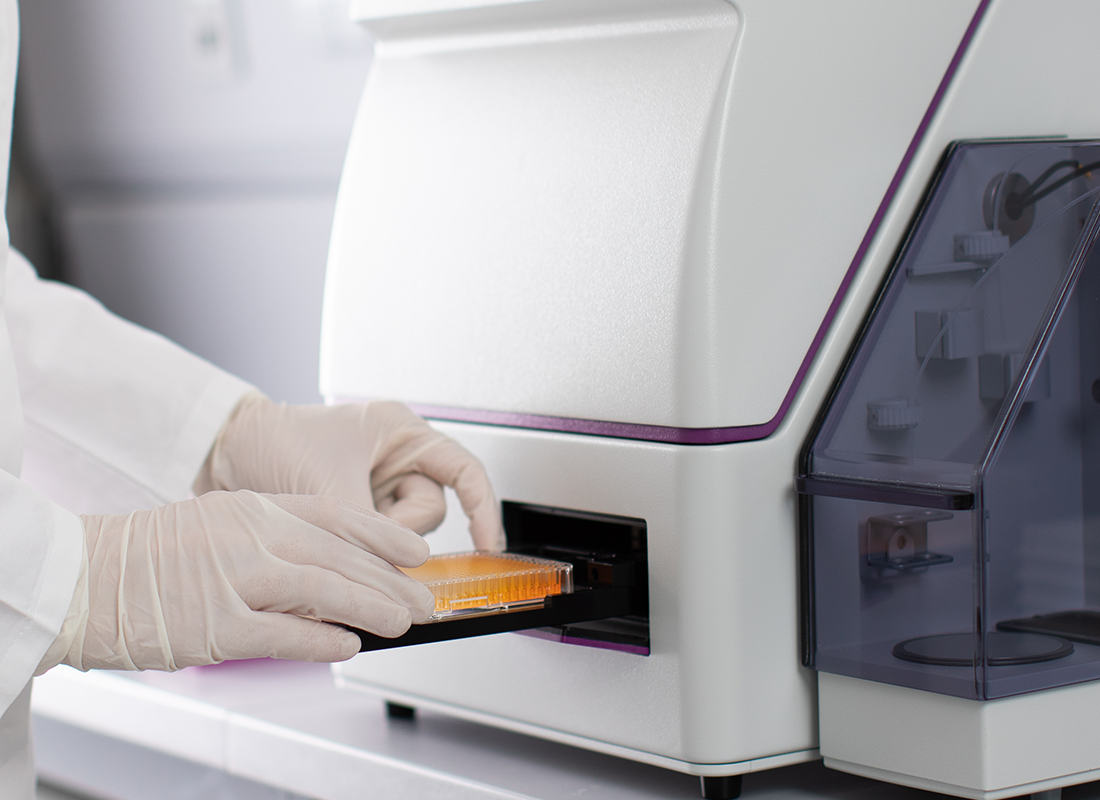 Image Credit: BMG LABTECH
Fluorescence plate readers are typically used to evaluate fluorescence intensity and FRET. Other modes of detection, which include fluorescence polarization, luminescence, absorbance or time-resolved fluorescence, can only be determined by multi-mode microplate readers.
Fluorescence microplate readers commonly consist of a light source, an optical system for selecting the incoming light (i.e., filters and/or monochromators), a second optical system for selecting the emitted light, and a detector, usually a photomultiplier tube (PMT).
The entire system converts the photons emitted by fluorescent or luminescent dyes into electrical signals that the microplate reader can then quantify. This generates a numerical output by which a sample is quantified.
In contrast to absorbance measurements, fluorescence detection is generally not considered an absolute measurement. Instead, the intensity of the fluorescent signal is typically relative to other measurements such as a reference measurement obtained by an instrument. As a result, fluorescence plate readers measure a sample’s emitted light signal in relative fluorescent units (RFU).
Fluorescence plate readers are available either as stand-alone, dedicated instruments (fluorometers) or as component of multi-mode microplate readers that combine it with other detection modes such as absorbance or luminescence detection.
These readers are employed in a wide range of applications across various fields, including academic life science research, drug discovery and screening, clinical laboratories, synthetic biology and food or water quality monitoring.
Considerations when choosing a microplate reader for fluorescence detection
Video Credit: BMG LABTECH GmbH
When it comes to onboarding a fluorescence microplate reader (single- or multi-mode), there are several factors to consider, as the instrument can significantly impact the quality of research results.
Sensitivity
For quantification applications, fluorescence plate readers tend to provide greater sensitivity compared to absorbance readers. A highly sensitive fluorescence microplate reader can deliver data with improved statistical quality, lower variability among replicates, and a larger delta (distance) between responding and non-responding samples.
Moreover, improved sensitivity means the volume of reagents and/or samples used can be reduced while still achieving high-quality results, helping to reduce costs.
Dynamic range
In fluorescence detection, samples typically exhibit a broad range of concentrations. When measuring with a fluorescence microplate reader, signals may vary significantly, from very dim to very bright.
In addition, it can be difficult to predict the intensity of the signal in enzymatic or cell-based kinetic assays, as the maximum signal gradually increases over the course of kinetic analysis.
In such cases, capturing all samples in a single measurement with one setting can be extremely difficult. The brightest samples may saturate the microplate reader's detector, or it may become almost impossible to distinguish extremely weak samples from the blank samples.
A fluorescence plate reader with a wide dynamic range allows researchers to capture highly divergent intensities in a single run. This avoids reagent waste and saves time by reducing the need to run several trial-and-error measurements to find the correct ratio of dilution to fluorescence gain.
The enhanced dynamic range feature available on the PHERAstar FSX, CLARIOstar Plus, and VANTAstar provides one of the largest dynamic ranges on the market (eight concentration decades). This facilitates the automatic measurement of assays with both extremely strong and dim signals in a single measurement, without the need for manual adjustments.
Wavelength selection
Having the capacity to select wavelengths in fluorescence microplate readers is compulsory for both excitation and emission. This helps limit any nonspecific background or noise that occurs as a result of light scatter or autofluorescence from both the sample and the microplate. Filters or monochromators with a good blocking behaviour can be employed if this is a likely occurrence.
Filters generally offer greater sensitivity, whereas monochromators offer improved flexibility. A notable exception is the Linear Variable Filter (LVF) Monochromator system available on the CLARIOstar Plus and VANTAstar.
The filter-like performance of LVF monochromators makes the CLARIOstar Plus one of the most sensitive monochromator-based microplate readers available on the market. They can be used for fluorescence intensity and luminescence measurements and can generate excitation or emission scans.
Moreover, the ability to simultaneously detect two emission channels is advantageous for FRET assays. This option reduces measurement time by around 50% and limits data variability. Simultaneous dual-emission (SDE) detection comes as standard on the PHERAstar FSX and is an additional option on the LUMIstar Omega and FLUOstar Omega.
Compatible plate formats
In life science research, it is common practice to measure basic fluorescence assays using 96-well microplates. However, when it comes to multiple samples, high-throughput requirements, or work with micro-volumes to save precious reagents or time, it is possible to employ 384-well and 1536-well plate formats.
In such cases, it is crucial to ensure that the fluorescence microplate reader can read the plate formats used. Moreover, different detection modes such as absorbance, fluorescence, and luminescence often require different plate types.
Reagent injectors
When selecting a fluorescence plate reader, it is important to consider the nature of the assay being performed. For enzymatic kinetic measurements or real-time cell-based responses, using reagent injectors can offer a significant advantage, as manually pipetting reagents into the wells increases the risk of critical data loss during the reaction.
This is particularly true for fast responses, where the event of interest for detection may have disappeared before it can be recorded.
Some of BMG Labtech’s fluorescence plate readers can be equipped with reagent injectors that inject and detect the signal of a well simultaneously, and then move directly to the next.
Environmental control
In research contexts that use long-term live-cell-based assays (e.g., cell-viability studies), it is not practical to consistently move the microplate between a fluorescence microplate reader and an incubator. Therefore, an appropriate reader for these approaches should ideally be able to control its internal gas environment.
The Omega series, the VANTAstar, and the CLARIOstar Plus can be fitted with BMG Labtech’s Atmospheric Control Unit (ACU). The ACU creates an optimal environment for any application involving living cells by independently regulating both O2 and CO2 gas levels within the microplate reader chamber.
When used in conjunction with shaking and temperature incubation, the ACU offers a true “walk-away” solution for any cell-based assay from standard cell growth to hypoxia studies.
Software for data reduction
The software used to run a microplate reader is an often-overlooked aspect of the whole system. For some readers, the software is limited to controlling the measurement process and providing raw assay data; for others, it can run complex analyses.
Comprehensive, dynamic, and user-friendly software can simplify detection and data analysis, so instruments are run at their optimal capacity. For fluorescence assays, the most pragmatic calculation features include automatic blank subtraction, automatic calculation of concentrations based on standard curves, and enzymatic constants, including Km and Vmax.
The BMG LABTECH software package includes predefined quick-run assay-specific protocols and dedicated analysis templates for the most commonly used fluorescence assays. These dedicated solutions facilitate single-click acquisition and analysis of results, allowing researchers to conduct experiments quickly and easily.
About BMG Labtech

BMG LABTECH has been committed to producing microplate readers for more than thirty-five years. By focusing on the needs of the scientific community, the company’s innovative microplate readers have earned the company the reputation of being a technology leader in the field.
BMG LABTECH has developed a wide range of dedicated and multi-mode microplate readers for life sciences applications and high-throughput screening.
All BMG LABTECH microplate readers are "Made in Germany" and are conceived, developed, assembled, and tested entirely at BMG LABTECH’s headquarters in Germany.
Since its establishment in Offenburg, Germany in 1989, BMG LABTECH has expanded to offer a worldwide sales and support network with offices in the USA, UK, Australia, Japan and France. BMG LABTECH’s subsidiaries, regional offices and distributors are committed to bringing you innovative microplate reader technology with the quality and reliability you expect from a German company.
The company’s staff includes engineers and scientists from the fields of biology, biochemistry, analytical chemistry, and physics.
Sponsored Content Policy: News-Medical.net publishes articles and related content that may be derived from sources where we have existing commercial relationships, provided such content adds value to the core editorial ethos of News-Medical.net, which is to educate and inform site visitors interested in medical research, science, medical devices and treatments.