Microplate readers are laboratory instruments used to measure various reactions, properties, and analytes within the well of a microplate across the chemical, biological, and physical sciences. A microplate comprises multiple small wells in which individual reactions take place, facilitating the analysis of multiple samples.
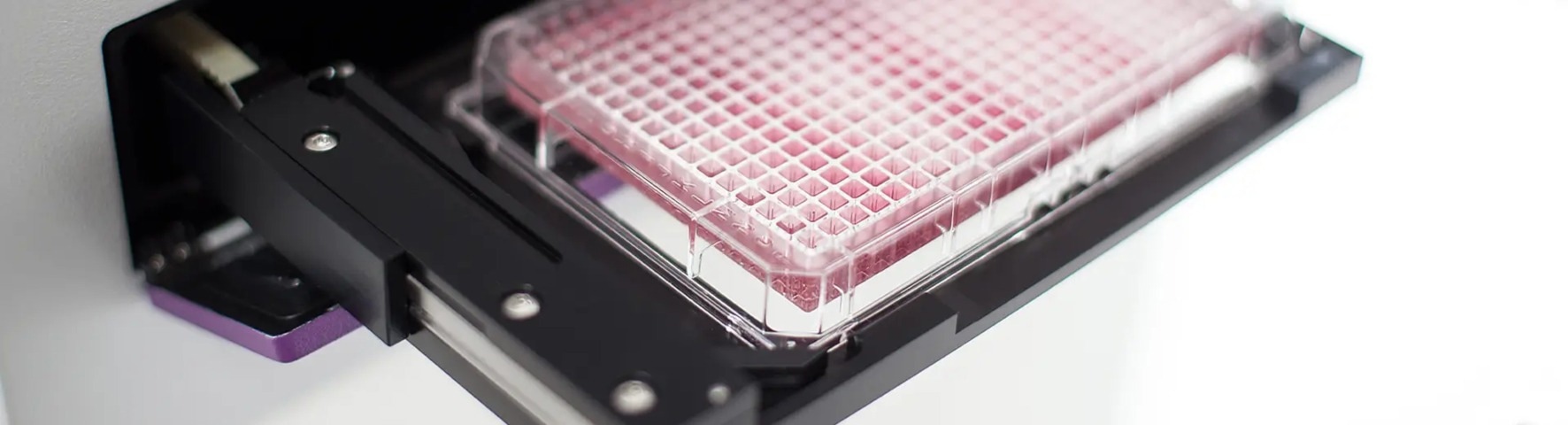 Image Credit: BMG LABTECH
In the microplate, the presence of an analyte or the progression of biochemical processes is transformed into optical signals during these reactions. These signals are detected by an optical system within the microplate reader to quantify a particular parameter of interest.
Researchers working in the life sciences and pharmaceutical industries (e.g., drug discovery) endeavor to improve routine processes and efficiency in their laboratories by taking advantage of products or instruments that offer time savings.
Depending on the model, microplate readers can process up to 3456 samples in a matter of minutes or even seconds. A plate reader helps minimize operational time and save reagent costs, granting more time for data analysis and the generation of actionable insights.
What is a microplate reader used for?
Microplate readers are typically employed for quantifying a variety of biological and chemical assays in microplate format. The sheer abundance of reagent kits available today allows researchers to exploit multi-mode plate readers, that are equipped with multiple detection technologies, across various fields for many different applications.
Beyond biological, cellular, biochemical, and pharmaceutical research and drug development, microplate readers are finding utility in drug discovery and environmental research, as well as in the food and cosmetics industries.
Working principle of a microplate reader
A microplate reader detects light signals generated at specific wavelengths by samples pipetted into a plate. These samples produce a diverse range of optical properties as a direct result of the various biological, chemical, biochemical, or physical reactions.
Distinct analytic reactions are selected for analysis, including absorbance, fluorescence intensity, and luminescence. These properties are among the most popular and widely used detection modes in laboratories worldwide.
Moreover, advanced modes including fluorescence polarization, time-resolved fluorescence, and AlphaScreen® are also available on multi-mode microplate readers.
Measurements taken from microplate-based assays capture the light signals that are either produced by, converted by, or transmitted through a sample.
In the plate reader, a detector, typically a photomultiplier tube (PMT), is used to measure incoming light signals. PMTs convert photons into electrical signals that the microplate reader can read and quantify. The end result is a set of numerical values that can be used for data analysis.
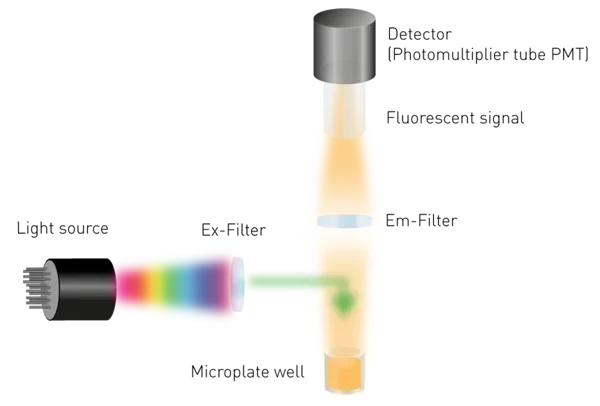
Simplified set-up of a fluorescence intensity detection system in a microplate reader. Image Credit: BMG LABTECH GmbH
Microplate samples may need an additional light source, usually a broadband xenon (Xe) flash lamp, for exciting at specific wavelengths depending on the nature of the optical signals and consequently on the measurement mode.
The targeted excitation at specific wavelengths is achieved by filtering the broadband light of the Xe flash lamp using specific monochromator- or filter-based optics.
The optical system also incorporates specific filter- or monochromator-based optics on the emission side to increase sensitivity and specificity of the measured emission signals. Filter or monochromator slides are typically positioned between the sample and the detector. The configuration of an optical system combined with the PMT determines the reader’s wavelength range.
How to find the right microplate reader
Video Credit: BMG LABTECH GmbH
What assays are required?
When deciding whether a plate reader is a necessary instrument, applications that require measurement have usually already been determined. However, time and attention should be given to addressing any key questions to help identify the appropriate, future-proof single- or multi-mode reader for your laboratory.
Commonly performed assays often include basic tests, e.g. for quantifying nucleic acid or protein samples, reporter gene assays for gene expression analysis, and cell viability assays. In each of these applications, a number of solutions are available, based on various principles, technologies, and sensitivities.
Therefore, it is crucial to have the details of the exact name and supplier of the kit or the chemistry to be used on the plate reader.
Conversely, there are a plethora of tests that can help answer specific biological questions, meaning a simple solution, based on microplates, may be at hand rather than using cumbersome tests to find the answer.
Therefore, a comprehensive review of day-to-day lab work should be performed alongside the collection of all relevant information about how colleagues plan to use the microplate reader before investing in a model.
Which detection modes are needed?
Different assay kits require different detection methods, even if they answer the same fundamental biological question. If using a commercial kit, the required measurement mode is usually found in the product insert.
A single-mode microplate reader can include one of the following modes or a combination thereof in the case of multi-mode readers:
- Fluorescence intensity (including FRET)
- Luminescence intensity (including BRET)
- Time-resolved fluorescence
- Fluorescence polarization
- AlphaScreen
- Nephelometry
- TR-FRET
- Absorbance
About BMG Labtech

BMG LABTECH has been committed to producing microplate readers for more than thirtyfive years. By focusing on the needs of the scientific community, the company’s innovative microplate readers have earned the company the reputation of being a technology leader in the field.
BMG LABTECH has developed a wide range of dedicated single- and multi-mode microplate readers for life sciences applications and high-throughput screening.
All BMG LABTECH microplate readers are "Made in Germany" and are conceived, developed, assembled, and tested entirely at our headquarters in Germany.
Since our establishment in Offenburg, Germany in 1989, BMG LABTECH has expanded to offer a worldwide sales and support network with offices in the USA, UK, Australia, Japan and France. Our subsidiaries, regional offices and distributors are committed to bringing you innovative microplate reader technology with the quality and reliability you expect from a German company.
Our staff includes engineers and scientists from various fields, including biology, biochemistry, analytical chemistry, and physics with a shared goal of providing you with personal support and the perfect instruments for your needs.
Sponsored Content Policy: News-Medical.net publishes articles and related content that may be derived from sources where we have existing commercial relationships, provided such content adds value to the core editorial ethos of News-Medical.net, which is to educate and inform site visitors interested in medical research, science, medical devices and treatments.