A six-phase study with LH-anchored cycle tracking found that strength and mood do not move in lockstep across the menstrual cycle, suggesting coaches may need more individualized, cycle-aware ways to monitor readiness and performance.
Study: The effects of the menstrual cycle on physical and psychological parameters in female athletes. Image Credit: Dee-sign / Shutterstock
In a recent study published in the journal Scientific Reports, researchers in Germany investigated how the six distinct phases of the menstrual cycle were associated with differences in physical strength and psychological well-being among female athletes. The study sample included 18 eumenorrheic women whose menstrual cycle phases were timed using urinary luteinizing hormone (LH) ovulation tests as a physiological anchor, rather than full hormonal profiling.
Comparing these phase-specific measurements with participants' dynamic maximal strength and psychological variables revealed that dynamic strength peaked during the late follicular phase and ovulation, while mood and vigor significantly declined in the late luteal phase. These findings suggest that more individualized, cycle-aware monitoring may be more useful than uniform training models for optimizing training readiness and performance in female athletes.
Menstrual Cycle and Athletic Training Background
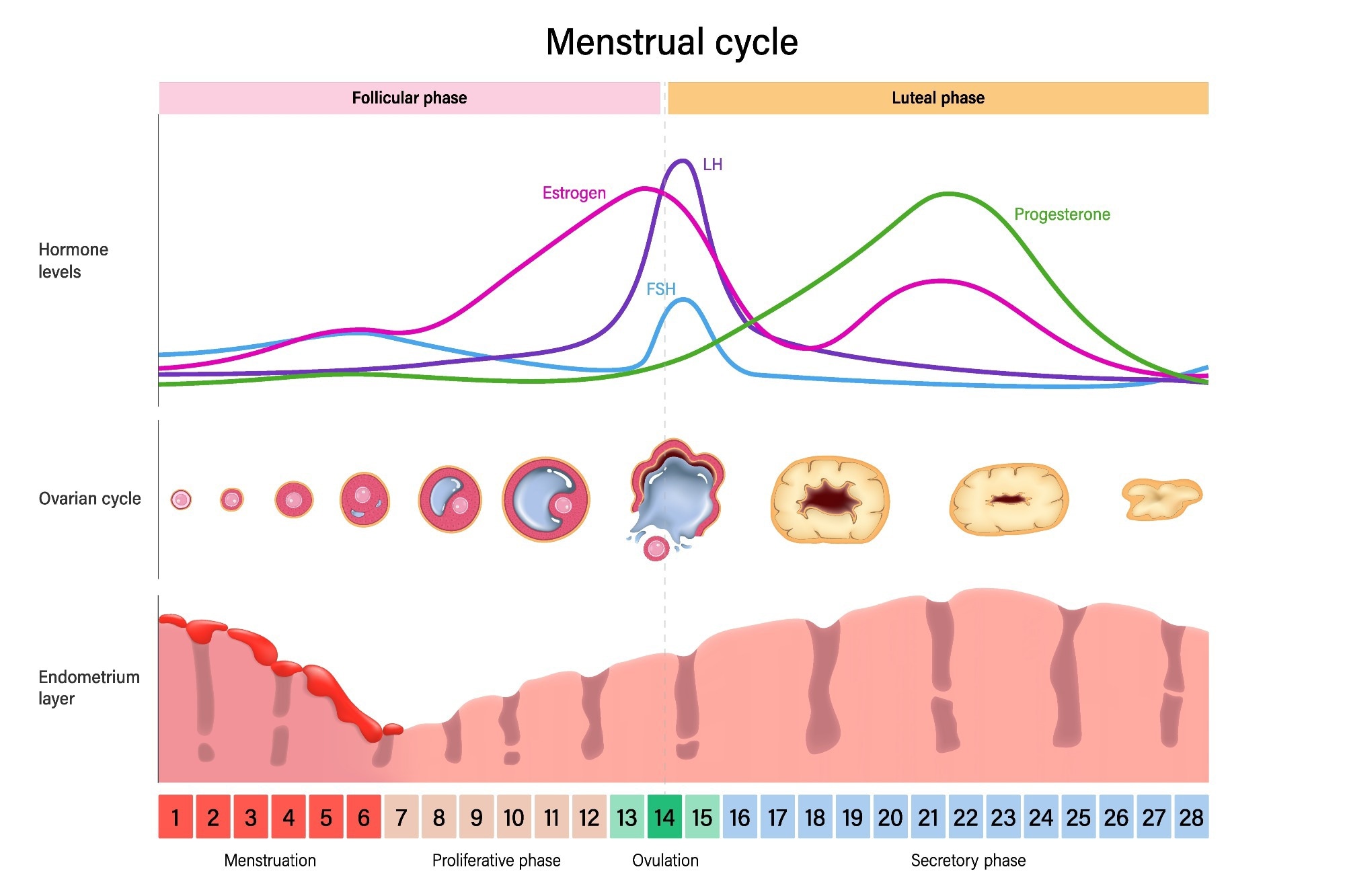
Decades of research have revealed that the human female menstrual cycle is a complex biological process regulated by multisystemic interactions involving the hypothalamus, pituitary gland, and ovaries, typically spanning 26 to 32 days. McNulty and colleagues (2020) conceptualized a framework that divides this cycle into six distinct phases: 1. Early follicular (EF), 2. Late follicular (LF), 3. Ovulation (OV), 4. Early luteal (EL), 5. Mid luteal (ML), and 6. Late luteal (LL) phases.
Subsequent research established that these phases are characterized by dramatic hormonal fluctuations, primarily estrogen and progesterone, alongside significant phase-specific variations in energy metabolism, neuromuscular activation, and central nervous system (CNS) excitability.
However, despite a recent surge in scientific studies investigating cycle-sensitive training, reviews on the topic highlight that current evidence remains heterogeneous due to methodological inconsistencies, including small sample sizes and reliance on calendar-based phase determination rather than biochemical confirmation. Consequently, female athletes continue to be subjected to "one-size-fits-all" athletic training models developed largely from research on men.
While biochemical research indicates that estrogen is believed to exert predominantly excitatory effects on neural activity, and progesterone possesses inhibitory properties that potentially influence corticospinal excitability and intracortical inhibition, all of which have been theoretically linked to alterations in athletic performance, scientists have yet to elucidate the role of these neuroendocrine mechanisms within the real-world context of menstrual cycles, preventing the development of evidence-based strategies that optimize female athletes’ performance while mitigating their injury risk.
Female Athlete Study Design and Measures
The present study aimed to address this knowledge gap and inform future female athlete training schedules by using a repeated-measures study design involving 18 physically active women (mean age = 23.6 years). Study participants were classified as "Tier 2" athletes (training volume ≥ 3 sessions per week).
To ensure high internal validity for each participant’s specific menstrual phase, physical performance and psychological assay time points were physiologically anchored using urinary luteinizing hormone (LH) ovulation tests. However, the researchers did not measure estradiol or progesterone directly, so ovulation and luteal phase sufficiency were not biochemically confirmed.
The study assessed physical performance using two primary modalities: 1. Dynamic lower-body strength measured using a one-repetition maximum (1RM) test in the half squat, and 2. General neuromuscular function was measured using an isometric handgrip test.
Psychological parameters were quantified using the short version of the Profile of Mood States (POMS-16), which encapsulated vigor, fatigue, depression, and anger. Subjective markers, including participants’ motivation and sleep quality, were recorded via visual analog scales (VAS). Finally, participants’ rating of perceived exertion (RPE) was estimated using the Borg scale.
Menstrual Cycle Strength and Mood Findings
Study analyses revealed distinct, phase-dependent trajectories for physical and psychological domains. Evaluations of dynamic maximal strength found that participants’ performance peaked during the late follicular phase and at ovulation, highlighting a statistically significant “phase effect” (p < 0.001, η2p = 0.98). The authors cautioned that this unusually large effect size should be interpreted carefully.
Specifically, the study found that participants’ half-squat loads averaged 94.43 kg during the late follicular phase, compared with 87.24 kg during the late luteal phase. Unexpectedly, isometric handgrip strength did not conform with these findings, instead peaking during the late luteal phase (p < 0.001, η2p = 0.21).
When evaluating psychological data, study analyses revealed that "vigor" (energy) was highest in the follicular phases but declined sharply toward the cycle's end. By contrast, fatigue and depression scores were observed to follow the opposite trend, significantly increasing in the late luteal phase (p < 0.001).
Finally, the study identified a significant negative correlation between half-squat performance and depression scores (r = −0.60, p = 0.009), suggesting that higher depression scores were associated with lower half-squat performance. However, this finding was correlational and does not establish causality. Other measured variables, including motivation, sleep quality, and RPE, remained statistically stable throughout the study.
Cycle-Aware Training Implications for Athletes
The present study suggests that the menstrual cycle may influence both the female athlete's body and mind, but emphasizes that its effects are not uniform. Given the substantial interindividual variability observed, the researchers conclude that rigid, group-level training prescriptions are less effective than individualized load management.
Future athletic coaching should integrate a small number of informative markers of strength and well-being to adjust training loads based on an athlete's current physiological and psychological readiness. The findings also support better menstrual cycle literacy among athletes and support staff, while underscoring that individual responses should take precedence over rigid phase-based expectations.
Journal reference:
- Niering, M., Schilling, V., Beurskens, R., & Seifert, J. (2026). The effects of the menstrual cycle on physical and psychological parameters in female athletes. Scientific Reports, 16(1). DOI – 10.1038/s41598-026-47706-0. https://www.nature.com/articles/s41598-026-47706-0
 Nighttime coughing could be due to air pollution levels, research suggests