A major global study suggests that eating with others may be a simple, measurable sign of stronger social connection and better wellbeing, while rising rates of dining alone in the US raise fresh concerns about everyday isolation.

Study: Sharing meals is associated with greater wellbeing. Image Credit: BrightGridVisuals / Shutterstock
A large global study published in the journal Scientific Reports suggests that something as simple as sharing a meal may play a powerful role in wellbeing.
Researchers found that the frequency of eating with others, a marker of social connectedness, was associated with better wellbeing and had predictive power comparable to that of some major socioeconomic indicators, such as income and unemployment.
Drawing on global past-week survey data and US daily time-use and wellbeing data, the study shows that shared meals are linked to higher happiness and lower stress, while dining alone, an increasingly common trend in the United States, especially among younger adults, correlates with poorer wellbeing outcomes.
Social connections underpin health, happiness, and prosperity, shaping outcomes that range from mental wellbeing to longevity.
People who maintain strong social ties report greater life satisfaction, lower stress, and reduced disease risk, while also demonstrating higher levels of trust, cooperation, and civic engagement.
In contrast, loneliness and isolation are linked to poorer health, shorter lifespans, and adverse social outcomes.
Emerging research suggests that shared meals may offer a simple yet meaningful pathway to strengthen these connections, with studies associating meal sharing with better nutrition, improved mood, and lower depressive symptoms.
Despite its near-universal nature, however, the link between social eating patterns and wellbeing remains surprisingly underexplored.
Average life evaluations by number of meals shared in the past week Gallup World Poll, 2022-2023
Global and US Meal Sharing Study Design
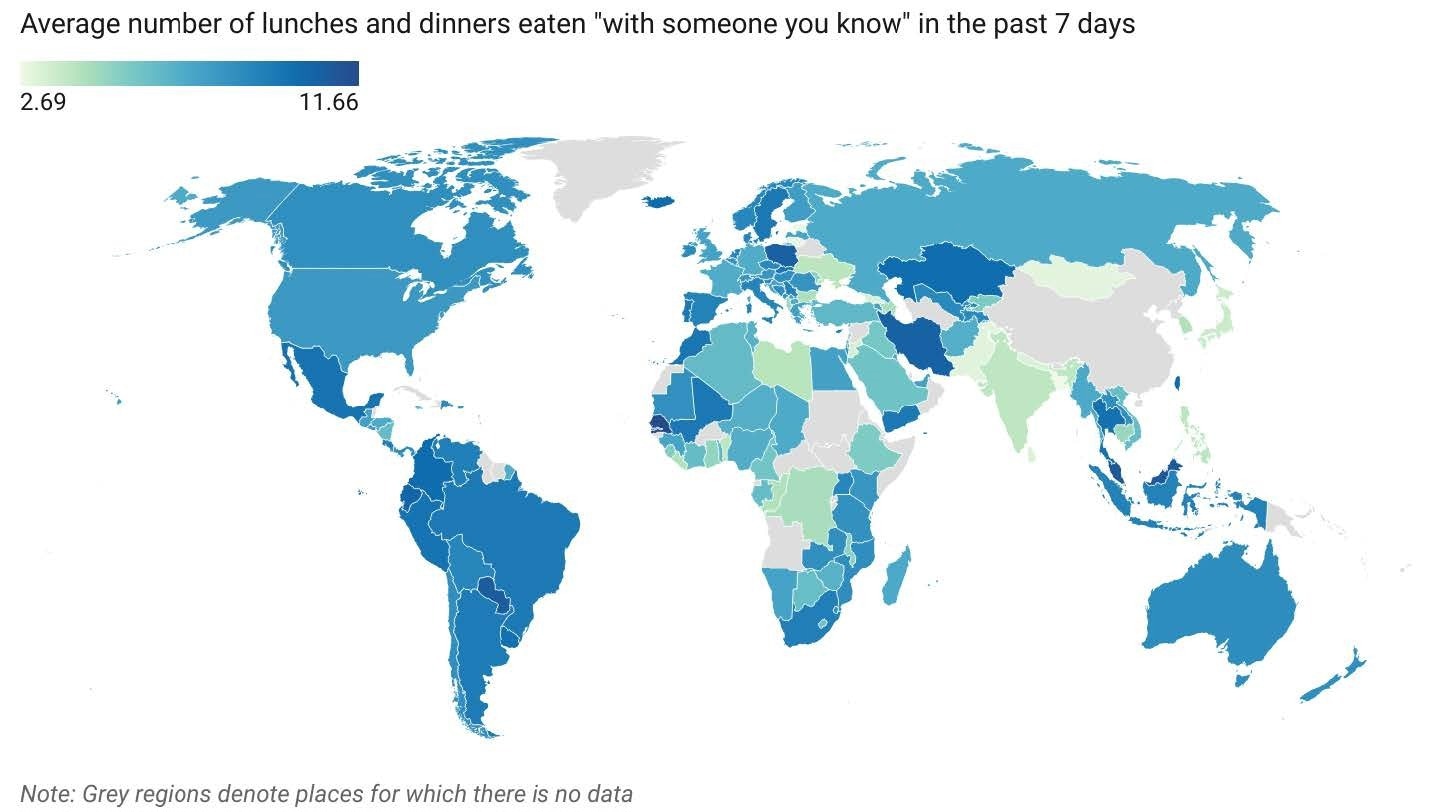
In the present study, researchers combined global and national datasets to examine associations between eating with others and wellbeing. They analyzed data from the 2022–2023 Gallup World Poll (GWP), covering over 150,000 respondents across 142 countries and territories.
Participants reported the number of days they shared lunch or dinner with someone they knew in the previous week.
To capture trends over time in the United States (US), the team also used the 2003–2023 American Time Use Survey (ATUS), spanning more than 239,000 respondents, alongside its Wellbeing Module, which captured emotional experiences from more than 25,000 participants using the Day Reconstruction Method.
The researchers applied linear regression models to examine associations between meal sharing, life ratings, and both favorable and adverse emotional states.
They controlled for demographic and socioeconomic variables, including age, gender, education, income, employment status, and household size, alongside country fixed effects in the global analyses and county fixed effects in the US analyses.
Additional models examined variation across different household compositions using interaction terms.
In the US sample, the team compared individuals who ate all meals alone with those who shared at least one meal, estimating wellbeing differences using weighted analyses to ensure population representativeness.
They also explored subgroup variation by marital status, employment, and remote working patterns. A series of robustness checks confirmed the consistency of findings, with most analyses conducted using ordinary least squares regression.
Meal Sharing and Wellbeing Results
The analysis revealed a significant positive association between meal sharing and wellbeing across almost all world regions.
On average, sharing one additional meal per week was associated with a 0.2-point increase in wellbeing on a 0–10 scale, an effect comparable to the wellbeing cost associated with a 1.5 percentage-point rise in inflation.
Notably, even one shared meal made a difference: individuals who shared at least one meal reported better overall life ratings than those reporting no shared meals (5.2 vs. 4.9), a gap approximately half the size of the wellbeing loss linked to unemployment.
These associations remained robust even when controlling for education, income, and employment, with meal sharing explaining as much variation in wellbeing as key socioeconomic indicators. The pattern held across age and gender groups and extended to both favorable and adverse emotional states.
Globally, Latin America reported the highest frequency of eating with others, while South and East Asia showed lower levels.
The strength of this relationship was particularly pronounced in Australia, New Zealand, and North America, though the regional pattern was neither entirely linear nor uniform.
Dining Alone Trends in the United States
In the US, trends over two decades showed a marked rise in dining alone, with 26% of adults reporting that they ate every meal by themselves in 2023, a more than 50% increase since 2003. Individuals who primarily ate alone reported life ratings about 0.5 points lower than those who ate with others, along with lower happiness and higher stress, pain, and sadness.
Although older adults had higher absolute rates of dining alone, younger adults showed some of the sharpest increases over time.
The findings underscore the strong, consistent link between social eating and wellbeing, suggesting that even modest increases in shared meals could yield meaningful benefits at both the individual and population levels.
Shared Meals as a Wellbeing Strategy
Taken together, these findings position shared meals as a simple, scalable lever to support wellbeing at both individual and societal levels. Since meal sharing is a universal and easily measurable behavior, it offers researchers and policymakers a practical proxy for social connectedness and a potential target for intervention.
The sharp rise in dining alone, particularly among younger adults in the US, highlights an urgent need for deeper investigation into its underlying drivers and long-term consequences.
Future research should move beyond association to examine causal pathways, including the role of interaction quality, work patterns, and cultural context. If confirmed, promoting shared meals could represent a low-cost, actionable strategy to strengthen social ties and improve population wellbeing.
 Chronic stress and social support affect how cognitive abilities change with age