A 24-year “population autopsy” reveals how stalled cardiovascular progress, rising metabolic disease, deaths of despair, and COVID-19 combined to deepen the US mortality disadvantage.

Study: Causes of Excess Deaths in the US Compared With Other High-Income Countries. Image Credit: izzuanroslan / Shutterstock
In a recent study published in JAMA Network Open, researchers investigated the causes of excess U.S. mortality relative to 17 other high-income countries (HICs) from 1999 to 2022. The study adopted a repeated cross-sectional design and analyzed 63.5 million U.S. deaths, which were found to account for 12,675,646 excess deaths.
Alarmingly, the study found that these excess deaths increased steadily before the COVID-19 pandemic, surged in 2020 and 2021, and remained high in 2022, with annual figures rising from 346,166 in 1999 to 905,159 in 2022. These findings indicate that while circulatory diseases remain the primary contributor to excess mortality within the country, a rapid and relatively recent escalation in alcohol-related deaths, drug poisonings, and suicide has disproportionately impacted younger cohorts, widening the mortality gap significantly over the last two decades.
U.S. Excess Mortality Background
The United States (U.S.) spends heavily on healthcare and has access to advanced medical technology, yet international mortality data indicate mortality rates are higher than in other high-income countries (HICs).
Historical records reveal that this divergence of U.S. life expectancy from its peer nations began around 1980, with the country falling to 50th in global rankings by 2023. Previous analyses suggest that in the ~40 years between 1980 and 2021, an estimated 13 million American deaths could have been averted if U.S. mortality rates had matched those of other HICs.
Previous literature has hypothesized several potential risk factors contributing to these unexpected patterns, especially cardiovascular disease and the American opioid epidemic. However, while both have been implicated in the U.S.’s mortality rate, even their combined effects have failed to fully explain its severity.
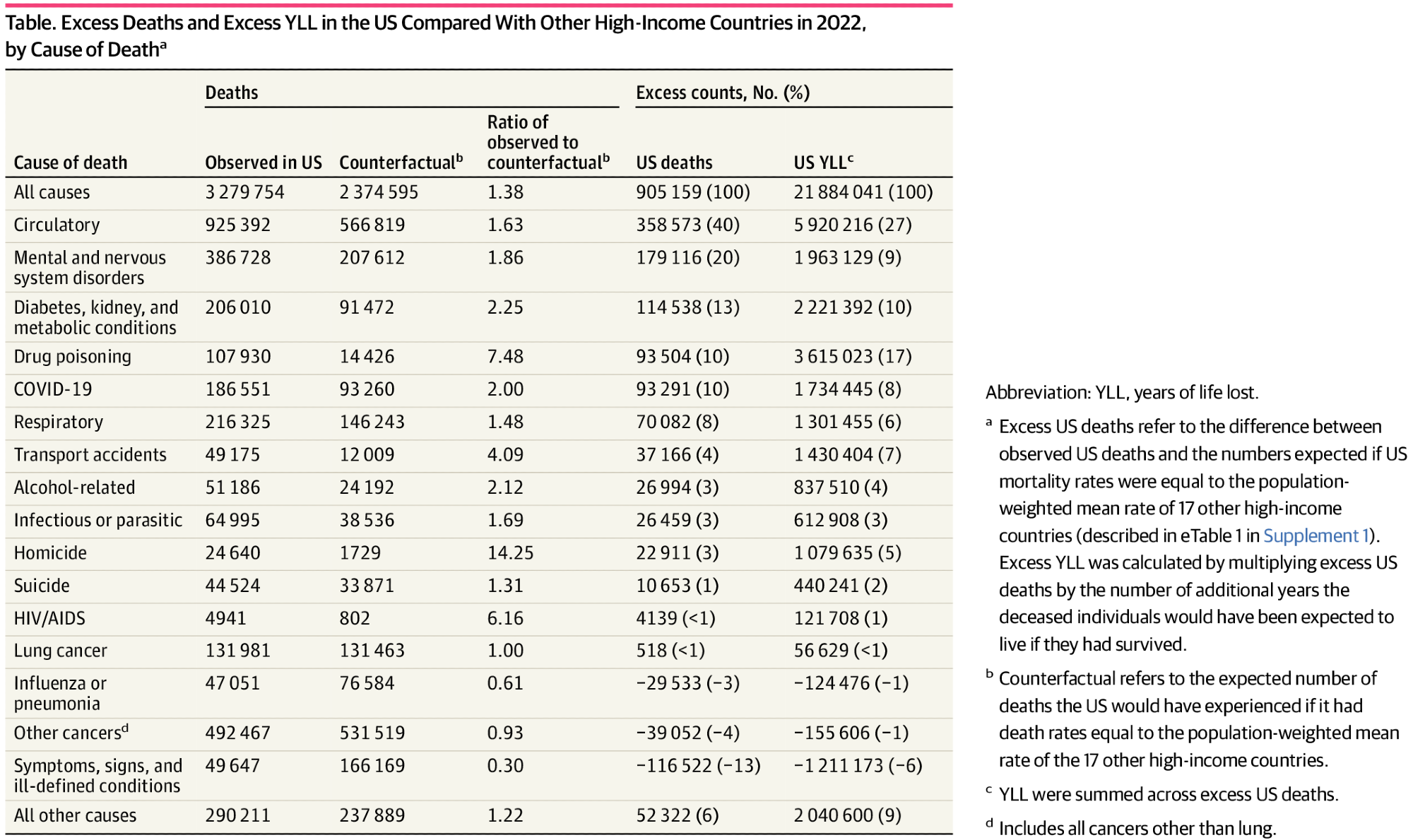
Excess Deaths and Excess YLL in the US Compared With Other High-Income Countries in 2022, by Cause of Death
High-Income Country Mortality Study Design
The present study aims to conduct a longitudinal "population autopsy" to bridge existing gaps in the historic dataset, aggregating data examining the transition of mortality drivers before, during, and after the acute phase of the COVID-19 pandemic, and subsequently comparing the U.S. observations against population-weighted rates from 17 other wealthy, non-Soviet bloc HICs.
The study dataset was derived and curated from the World Health Organization (WHO)’s Mortality Database and the Human Mortality Database (HMD) and comprised raw death counts and population denominators from 17 comparator HICs (e.g., Japan, Switzerland, France, and Australia). These comparator HICs were selected based on 2021 GDP per capita exceeding $24,000, not having been formerly part of the Soviet Union or the Eastern bloc, and meeting the mortality data completeness and quality criteria for the study period.
The study first defined and calculated “excess deaths”, the absolute difference between observed U.S. deaths and a counterfactual expected value based on peer-country rates for the same age, sex, year, and cause-of-death strata.
These results were subsequently used to compute “years of life lost” (YLL), calculated by multiplying excess deaths by the mean life expectancy at the time of death for that specific age and sex cohort, and “mortality rate ratios”, comparisons of age-standardized death rates between the U.S. and comparator HICs.
Furthermore, statistical analyses aggregated causes of deaths into 17 mutually exclusive International Statistical Classification of Diseases and Related Health Problems, Tenth Revision (ICD-10) categories. Joinpoint regression models were used to assess changes in slope and patterns (e.g., trend breaks) between 1999 and 2019.
Circulatory Disease and Despair Death Findings
Summary statistics revealed that, of the 63,547,318 US deaths identified and analyzed during the study period, 99% had a valid underlying cause recorded. These statistics further estimated the cumulative mortality burden in America to be 314,307,151 excess YLL over the 24 years.
Joinpoint regression models verified circulatory diseases as a major driver of excess American death, finding it to be the leading cause of excess deaths every year except 2010. While excess deaths in this category declined by 7,809 per year from 1999–2009, the trend reversed sharply thereafter, increasing by 15,474 annually from 2009–2019. By 2022, circulatory death rates were 1.63 times higher in the U.S. than in peer HICs.
Furthermore, this study quantified the contribution of “deaths of despair”, with excess deaths from drug poisonings, alcohol, and suicide rising from a negative value (-5,762) in 1999 to 131,151 in 2022. Alarmingly, in 2022, drug poisoning deaths were 7.48 times higher in the U.S. than the 17-HIC mean.
Metabolic conditions (2.25 times HIC mean), homicide (14.25 times HIC mean), and HIV/AIDS-associated deaths (6.16 times HIC mean) were also highlighted as rarely reported yet potent drivers of America’s mortality disadvantage relative to the 17 comparator high-income countries.
COVID-19 and Mortality Data Limitations
COVID-19 was also a major contributor to excess U.S. deaths during the pandemic years, accounting for 19% of excess deaths in 2020, 23% in 2021, and 10% in 2022. However, excess deaths from other causes, including circulatory diseases, metabolic conditions, drug poisonings, alcohol, and suicide, also increased during this period.
The authors cautioned that the estimates should be interpreted in light of cross-national differences in death certification, coding practices, diagnostic patterns, data completeness, imputation assumptions, and pandemic-era reporting.
U.S. Mortality Gap Research Priorities
This study establishes a severe acceleration in the excess U.S. mortality beginning around 2010, highlighting that this mortality disadvantage is increasingly characterized by drug poisoning, alcohol-related mortality, and suicide, accounting for most of the increase in excess deaths among people aged 0–44 years, alongside stalled or worsening circulatory and metabolic disease trends in midlife and older adults. In 2022 alone, 40% of excess deaths were attributed to circulatory diseases and 20% to mental and nervous system disorders.
Future research must address the specific structural drivers behind the rapid increase in drug poisonings among young adults and the rising mortality from mental and nervous system disorders among older adults.
Download your PDF copy by clicking here.
Journal reference:
- Bor, J., Raquib, R. V., Himmelstein, D., Woolhandler, S., & Stokes, A. C. (2026). Causes of Excess Deaths in the US Compared With Other High-Income Countries. JAMA Network Open, 9(5), e266147. DOI, 10.1001/jamanetworkopen.2026.6147. https://jamanetwork.com/journals/jamanetworkopen/fullarticle/2848779
 New white paper calls for integrating oral and general healthcare