Italy’s oldest populations are expanding unevenly, and new regional data show how disease burden, diet, obesity, and southern longevity hotspots may shape the future of healthy aging.

Study: Beyond the Blue Zones: Healthy Aging and Extreme Longevity in Italy (1982–2025) - An Ecological Analysis of Demographic, Metabolic, and Nutritional Correlates. Image Credit: ChatGPT / OpenAI
In a recent study published in the journal Nutrients, researchers analyzed temporal trends in extreme longevity and population aging in Italy using an ecological, population-level design.
Population aging represents a challenge for global public health and economic sustainability. Europe has some of the highest proportions of people aged ≥65 years, with Italy, France, and Spain leading in centenarian prevalence. Increased survival into advanced ages intersects with the burden of noncommunicable diseases (NCDs). Despite substantial research interest, comprehensive studies of regional longevity patterns and NCD mortality in Italy remain limited.
About the Study
In the present study, researchers explored temporal trends and regional patterns in extreme longevity and population aging in Italy. Age-standardized mortality rates (ASMRs) for five NCDs, chronic lower respiratory diseases, diabetes mellitus, ischemic heart disease, neoplasms, and cerebrovascular disease, were obtained for 1990, 2001, 2011, and 2023 from the European Health for All (HFA) database.
Population counts for 1982, 2001, 2019, and 2025 were acquired from the Italian National Institute of Statistics. The HFA-Italy database was used to obtain 2024 data on nutritional and behavioral indicators for individuals aged ≥65 years. Further, longevity indicators included the 85+ and 90+ ratios, aging tendency, longevity index (LI%), female-to-male ratio (F/M), and centenarity index (CI%).
The 85+ and 90+ ratios were the proportions of people aged ≥85 and ≥90 years, respectively, in the total population. LI% was the ratio of people aged ≥90 years to those aged ≥65 years. CI% was the ratio of people aged ≥100 years to those aged ≥90 years. The aging trend reflected the proportion of people aged ≥65 years in the total population.
F/M was the ratio of females to males among centenarians and nonagenarians. Choropleth maps were used to assess the spatial distributions of ASMRs of NCDs. Macro-regional line charts were used to examine temporal trends. Spearman’s rank correlation was used to examine ecological associations between longevity indicators and NCD mortality, as well as between nutritional and behavioral indicators, rather than causal effects at the individual level.
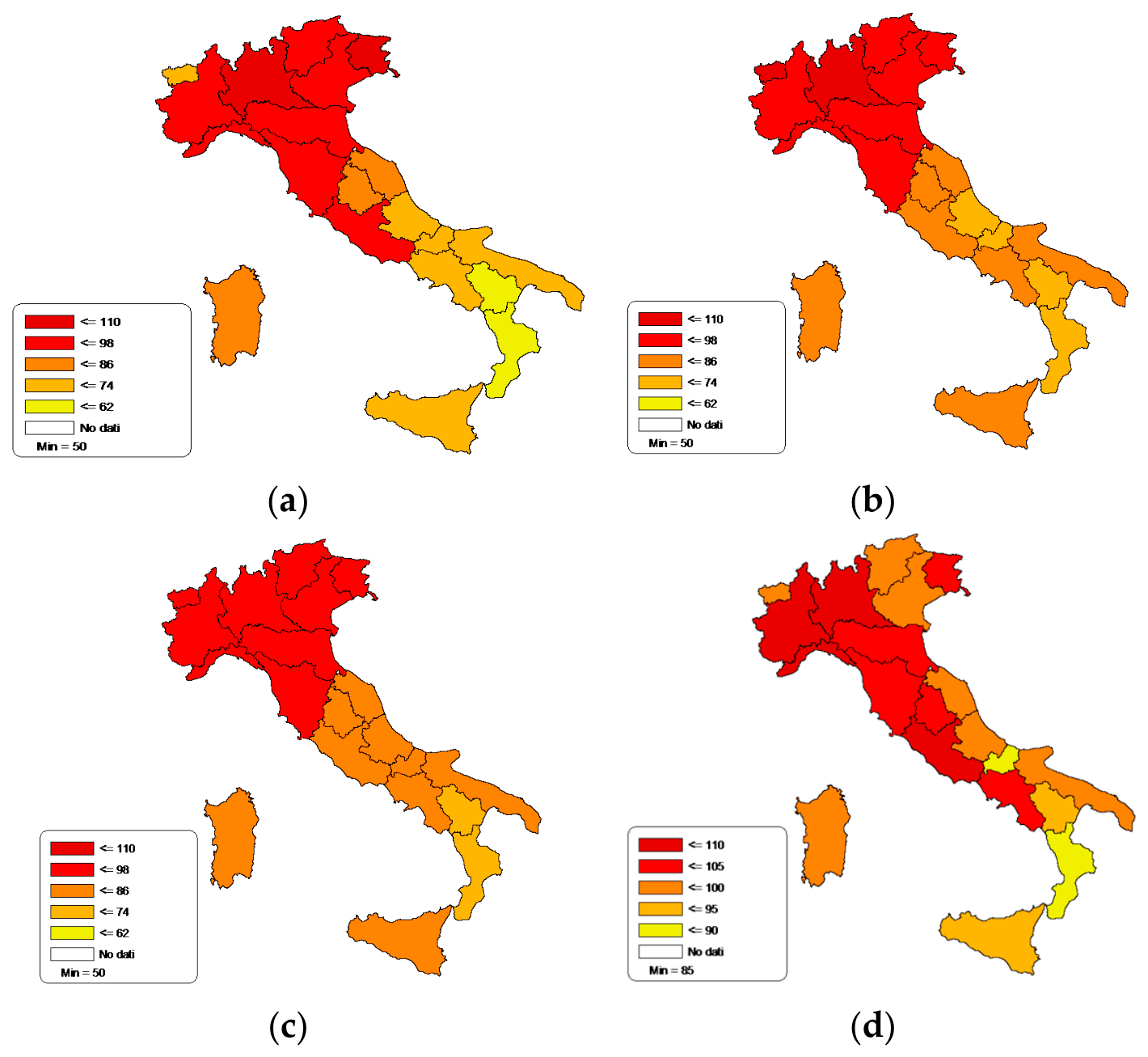
Choropleth map of age-standardized mortality rates from neoplasms among individuals aged ≥65 years in Italian regions: (a) 1990; (b) 2001; (c) 2011; (d) 2023. Maps were generated directly from the WHO European Health for All Database (HFA-DB)/HFA-Italy online platform. ‘No dati’ indicates regions with no available data.
Findings
Demographic analysis of the four time points, 1982, 2001, 2019, and 2025, showed a continuous, regionally variable aging process in Italy. There was a steady increase in the proportion of people aged ≥65 years. Aging tendency and the 85+ and 90+ ratios showed an upward trajectory over time, with the central and northern regions having the most advanced aging profiles. The Liguria region had the highest aging tendency in 2025, followed by Emilia-Romagna and Tuscany.
In contrast, Calabria and Campania had a lower aging tendency. Liguria, Marche, and Molise showed among the largest gains in the 85+ population, whereas Liguria, Tuscany, Emilia-Romagna, and Trentino-Alto Adige recorded among the highest proportions of people aged ≥90 years in 2025. Molise, Calabria, and Friuli Venezia Giulia had the highest CI% in 2025, while Liguria recorded the highest LI%, with northern and central regions generally showing advanced longevity profiles, and some smaller regions also showing high values. There was a pronounced survival advantage in females across time points and regions.
The highest F/M was observed in Valle d’Aosta, Lombardy, and Friuli-Venezia Giulia, and the lowest in Basilicata and Calabria in 2025. There was substantial regional heterogeneity in total mortality rates in people aged ≥65 years in 2025, with the lowest and highest rates of 4,026 and 67,672 per 100,000 in Lombardy and Basilicata, respectively. The study noted that crude mortality rates in smaller, older populations may be more variable due to denominator effects. Further, NCDs showed an overall reduction in ASMRs between 1990 and 2023, with regional variations.
In general, ischemic heart disease and neoplasms had higher rates in the central and northern regions at earlier time points, whereas cerebrovascular disease and diabetes mellitus maintained higher rates in the Islands and southern regions across time points. Lower long-term mortality from diabetes mellitus and cerebrovascular diseases showed some of the strongest regional correlations with higher LI% and CI%. Furthermore, there was a North-South gradient for most behavioral and nutritional indicators. The central and northern regions had higher proportions of vegetable consumers than the southern regions.
Likewise, more people in the central and northern regions reported consuming an adequate breakfast. Fish intake was higher in the southern and central regions. Southern regions had a higher prevalence of overweight and obesity than northern regions. LI% was positively correlated at the regional level with vegetable intake and negatively correlated with the prevalence of overweight and obesity. CI% showed similar positive correlations with vegetable intake and negative correlations with obesity. However, these contemporary behavioral and nutritional indicators do not represent life-course exposures of centenarian cohorts and should not be interpreted as individual-level causal evidence.
Conclusions
In sum, the findings illustrate a profound demographic transition toward extreme longevity in Italy, characterized by regional heterogeneity and varying burdens of vascular and metabolic disease. Central and northern regions generally showed advanced aging profiles and many of the highest LI% values. Meanwhile, specific southern areas, including the Cilento, showed promising survival into extreme old age, with indicators reported in an aggregated comparison as comparable to Sardinia and above the Campania regional average. Overall, these findings may inform regionally tailored healthy-aging strategies, while remaining hypothesis-generating rather than proof of individual-level causal effects.
Journal reference:
- Aliberti SM, Nurzynska D, Capunzo M (2026). Beyond the Blue Zones: Healthy Aging and Extreme Longevity in Italy (1982–2025): An Ecological Analysis of Demographic, Metabolic, and Nutritional Correlates. Nutrients, 18(12), 1952. DOI: 10.3390/nu18121952, https://www.mdpi.com/2072-6643/18/12/1952
 Fluorescent sensors could help researchers see diabetes in action