What happens to the bacteria living inside us as societies modernize? A study spanning 12 countries examines how lifestyle, diet, and genetics relate to gut microbial communities and the body's intestinal immune responses.
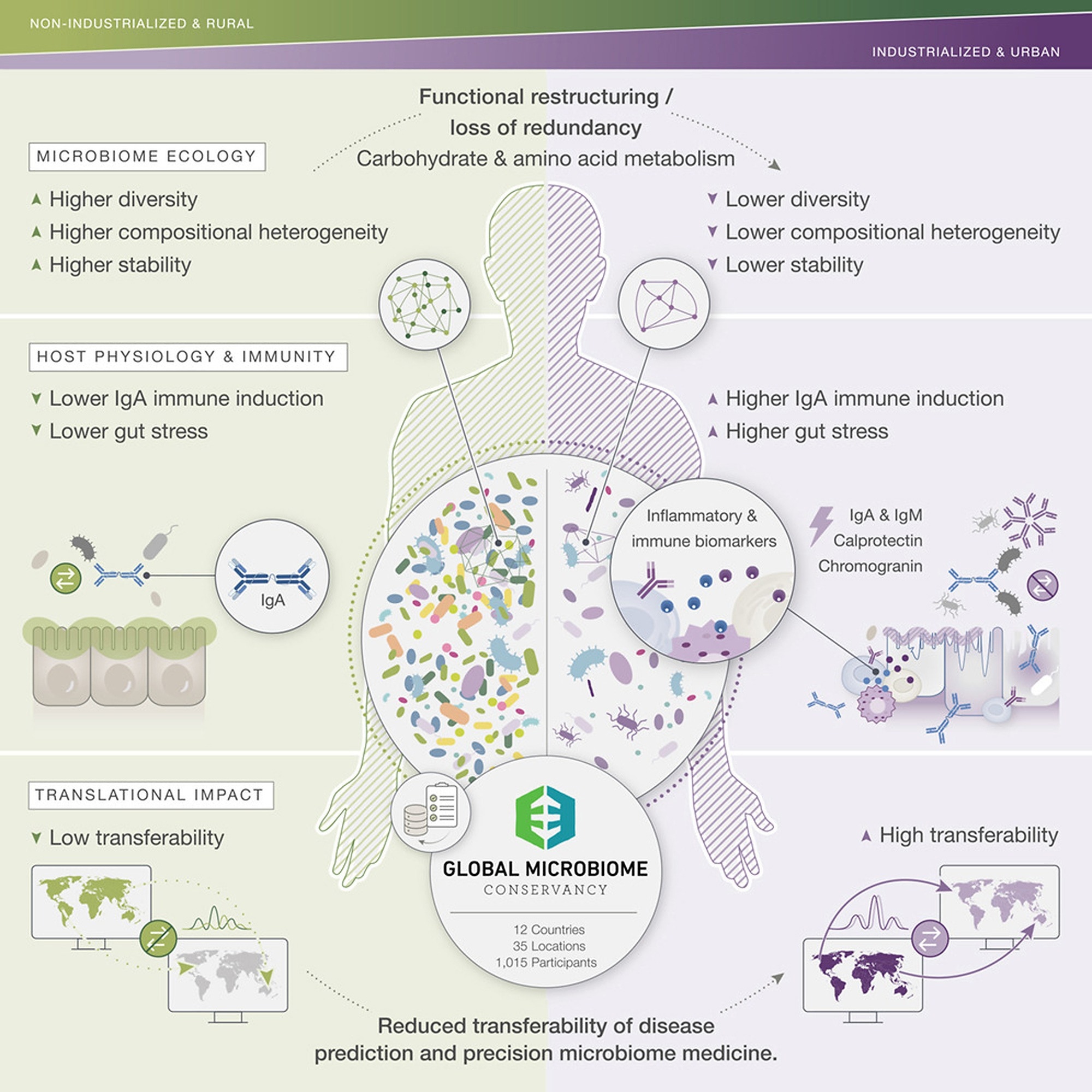
Study: Industrialization drives convergent microbiome and host physiological shifts in the human metaorganism
In a recent study published in the journal Cell, researchers investigated the microbial and physiological changes associated with industrialization in the human metaorganism.
The study evaluated 1,015 adults across 12 countries who reported no chronic disease or infection to examine associations between industrialized lifestyles and gut microbial diversity, host mucosal immunity, and intestinal stress.
Industrialization was associated with convergent losses in participants’ bacterial diversity. More-industrialized populations also showed greater similarity in microbial community structures and lower stability in computational network analyses.
These microbial alterations were accompanied by higher intestinal stress markers and elevated mucosal immunoglobulin A (IgA) secretion, without a consistent rise in intestinal inflammation across the cohort. A microbiome-based health index developed using data from industrialized populations also performed poorly when applied to non-industrialized populations.
Background
The growing burden of non-communicable chronic diseases, including autoimmune disorders, metabolic syndrome, and inflammatory bowel disease (IBD), has prompted research into the effects of changing lifestyles on human health.
Researchers have linked changes in disease patterns to humanity’s transition to modernized, industrialized lifestyles, alongside changes in sleep, diet, and physical activity. The relative contributions of these factors remain uncertain.
A substantial body of microbiome research has linked industrialization to the depletion of bacterial taxa common in less-industrialized populations and to reduced microbial richness.
The broader physiological ramifications of these community-wide disruptions within the human metaorganism (defined as “the integrated biological system comprising the human host and its associated microbiome”) remain poorly understood.
Previous studies have often compared populations with different sampling approaches, making it difficult to separate lifestyle factors from geographical ancestry, local infectious burdens, and dietary variations.
The relative contributions of host genetics, diet, and industrialization to mucosal immune activation, gut physiology, and the reliability of microbiome-based health measures remain uncertain across geographically diverse populations. Separating these influences would help researchers interpret microbiome differences more accurately.
About the study
The researchers characterized the Global Microbiome Conservancy (GMbC) cohort to examine these overlapping influences.
The sample dataset comprised microbial, genetic, dietary, and physiological measurements obtained from 1,015 adults across 35 localities in 12 countries, spanning sparsely populated rural communities and densely populated urban areas. This cross-sectional study compared populations at a single time point rather than following individuals through lifestyle changes.
Gut microbial composition and functional potential were examined using deep shotgun metagenomic sequencing, while human genetic variation was assessed through genome-wide host genotyping across 913 participants.
The dataset also included detailed reports of participants’ lifestyle, diet, and ancestry, which were analyzed alongside genetic variation using principal component analysis (PCA) and related methods.
The researchers assessed immune and physiological proteins in stool samples using enzyme-linked immunosorbent assay (ELISA). These analyses measured secretory immunoglobulin A (sIgA), secretory immunoglobulin M (sIgM), chromogranin A (CgA; a biomarker of neuroendocrine gut stress), and calprotectin (an indicator of intestinal inflammation).
In a subset of participants, high-throughput IgA sequencing (IgA-seq) was conducted to quantify bacterial IgA coating, while microbial profiles were used separately to assess cross-population portability of the Gut Microbiota Health Index (GMHI).
Study findings
Greater industrialization (measured using several lifestyle indicators) was associated with lower bacterial diversity, with similar patterns across countries. Lifestyle and diet generally explained more variation in gut bacterial composition than host genetics, but their effects overlapped and could not be fully separated.
More-industrialized populations also exhibited greater similarity in bacterial composition and closer evolutionary relationships among species, while computational analyses suggested reduced microbial network stability.
Network analyses indicated that industrialized communities had more connections between bacterial species and fewer negative correlations between bacterial taxa, alongside lower stability under simulated disturbances. Functional redundancy, the extent to which multiple bacterial species can perform the same metabolic tasks, also declined, particularly for complex carbohydrate degradation. This decline was largely explained by reduced microbial diversity.
Functional analyses found that industrialized gut microbiomes were enriched for genes involved in cobalamin (vitamin B12) biosynthesis and propionate metabolism, but whether these changes increase microbial vitamin B12 production remains unconfirmed.
Fecal sIgA levels were more than double among industrialized participants compared with non-industrialized groups on average, while fecal CgA levels, which reflect intestinal stress, were more than eight times higher. Fecal calprotectin, a marker of inflammation, did not show the same overall association with industrialization; higher values occurred in certain populations experiencing rapid social or environmental changes.
IgA-seq analysis of 283 participants showed that industrialized individuals had a higher frequency of strongly IgA-coated bacterial taxa than less-industrialized participants. IgA-bacteria interactions nevertheless showed broad similarities across populations.
The GMHI performed poorly in non-industrialized societies, yielding a median score of zero across six countries because relevant microbial health markers were uncommon or absent in many samples. These scores did not establish disease in participants, who reported no chronic illnesses.
Conclusions
Industrialization is associated with a significant, coordinated restructuring of both human intestinal ecology and host mucosal physiology.
The loss of community-level stability and higher levels of gut stress biomarkers suggest that modern lifestyle transitions may be linked to altered intestinal immune activity. It remains unknown whether these microbial changes damage the gut barrier or increase susceptibility to infection and chronic disease.
Developers of precision microbiome therapeutics and diagnostic classifiers should draw on data from diverse, non-Western populations to improve their accuracy and relevance across communities. Studies including people with diagnosed conditions will be needed to establish clinical usefulness.
Source:
Journal reference:
 Semaglutide changes gut bacteria in rats beyond what eating less explains