Routine live-cell-based assays are conducted in pharmaceutical, environmental, and toxicology labs to examine cell growth, viability, cytotoxicity, and a number of additional parameters.
When evaluating cell response to therapeutic or compound treatment, cellular parameters often require monitoring over the course of several days to determine the most effective treatment window for a specific cell or 3D culture model. Maintaining consistent cell health with these assays is essential for ensuring data sensitivity and reliability.
Temperature and gas composition are both critical variables that should be regulated to ensure assay reproducibility. Preserving cell health ideally involves replicating incubator conditions inside a microplate reader.
Most modern microplate readers have a temperature-control feature that maintains a constant 37 °C during extended cell-based experiments. In addition, equipping a reader with a gas mixer capable of delivering a specific blend of gases, such as above-ambient CO2, can better mimic incubator conditions to preserve optimal cell health over prolonged periods.
This study demonstrates improved cell viability when using a SpectraMax® iD5e or iD3s Multi-Mode Microplate Reader equipped with the SpectraMax® aer Gas Mixer, compared with a reader lacking a gas mixer. U-2 OS cells were grown in 96-well plates for 72 hours under diverse incubation conditions.
Cell viability was quantified at 72 hours using an endpoint luminescent ATP assay or monitored throughout the time course at intervals with the RealTime-Glo™ MT Cell Viability Assay.
Advantages
- The gas mixer enables precise control of the cell culture environment.
- Three-day cell viability is comparable to that achieved with a conventional cell culture incubator.
- A simple user interface makes for straightforward gas mixer configuration.
Materials
- U-2 OS osteosarcoma cells (ATCC cat. #HTB-96)
- U-2 OS cell growth medium:
- McCoy’s 5A (Modified) Medium (Thermo Fisher cat. #16600082)
- 10% fetal bovine serum (FBS, Avantor® Seradigm cat. #1500-500)
- Penicillin/streptomycin (Thermo Fisher Scientific cat. #15070-063)
- RealTime-Glo MT Cell Viability Assay (Promega cat. #G9711)
- CellTiter-Glo 2.0 Cell Viability Assay (Promega cat. #G9241)
- 96-well black-walled, clear-bottom cell culture microplates (Corning cat. #3904 or 3603)
- ibiSeal self-adhesive cover film, 76.0 mm × 114.0 mm, sterilized (ibidi cat. #10874)
Methods
- Cell plating: U-2 OS cells from one confluent T75 flask were trypsinized and suspended in 20 mLs media, and subsequently counted. Cell viability was 90%, with 3.3 x 10⁵ live cells/mL.
Following dilution in media, cells were seeded into wells of 96-well black/clear cell culture microplates at 4000, 2000, and 1000 cells/well, with 100 μL per well and 18 wells per seeding density. To minimize evaporation, edge wells were filled with 200 μL/well of PBS, and ibiSeals were applied.
- Assay configuration: RealTime-Glo MT assay reagents were introduced to half of the wells containing cells, resulting in a 200 μL final well volume. These wells were monitored at one-hour intervals throughout the three-day incubation timeline.
- Incubation conditions: Plate incubation occurred in (1) a cell culture incubator at 37 °C/5% CO2, (2) a SpectraMax iD5e or iD3s Multi-Mode Microplate Reader equipped with SpectraMax aer Gas Mixer, configured to 37 °C with 5% CO2 (Figure 1), and (3) a SpectraMax reader configured to 37 °C with ambient CO2 (no gas mixer).
- RealTime-Glo MT assay: Assay plates were analyzed using the luminescence detection mode of the SpectraMax iD5e or SpectraMax iD3s reader. Luminescence was measured every hour during the three-day incubation in the reader.
Growth curves were visualized as kinetic traces using SoftMax® Pro Software, and viability results were plotted by taking the maximum minus minimum signal for each well.
- CellTiter-Glo 2.0 assay: When the three-day incubation period ended, CellTiter-Glo™ 2.0 (Promega) reagent was introduced to the wells, and the plates were shaken for two minutes. This was followed by a 10-minute incubation at ambient temperature. Luminescence was subsequently read on either a SpectraMax iD5e or iD3s reader.
- Data analysis and graphing: Data production was enabled via preconfigured protocols in SoftMax Pro. Full data analysis and result plotting was performed via SoftMax Pro software.
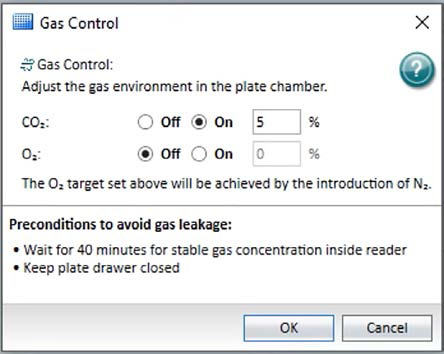
Figure 1. Gas control user interface in SoftMax Pro Software. CO2 levels from 0.1% to 15.0%, and O2 levels from 1.0% to 21.0%, can be set here. Image Credit: Molecular Devices UK Ltd
Results
Monitoring growth via hourly luminescence measurements (RealTime-Glo MT) generated the growth curves displayed in Figure 2. Cells seeded at higher densities exhibited a reduced growth rate during day three of growth, while cells seeded at the lowest density maintained a more constant growth rate.
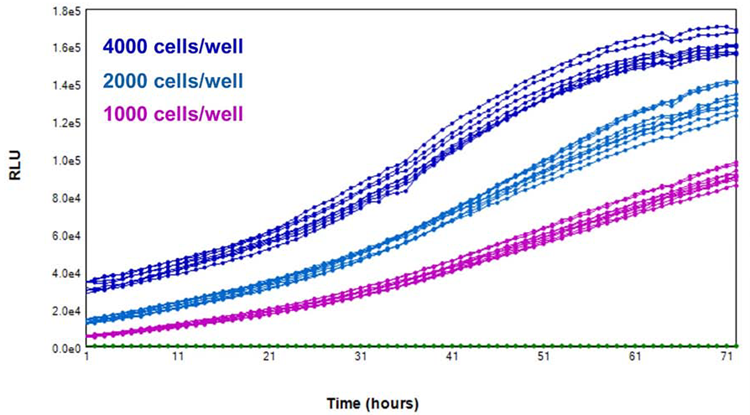
Figure 2. Growth monitored over the course of 3 days inside a SpectraMax iD5e reader with a SpectraMax aer gas mixer, using the RealTime-Glo MT assay. Image Credit: Molecular Devices UK Ltd
As anticipated, cells assayed using a luminescent ATP assay exhibited elevated signal at increased seeding densities after three days in culture. Compared to day-three endpoint readings from the RealTime-Glo MT-assayed cells, the ATP assay produced higher overall RLU magnitudes. However, trends for RLU versus cells seeded per well were similar, pointing to either assay’s suitability for evaluating viability (Figure 3).
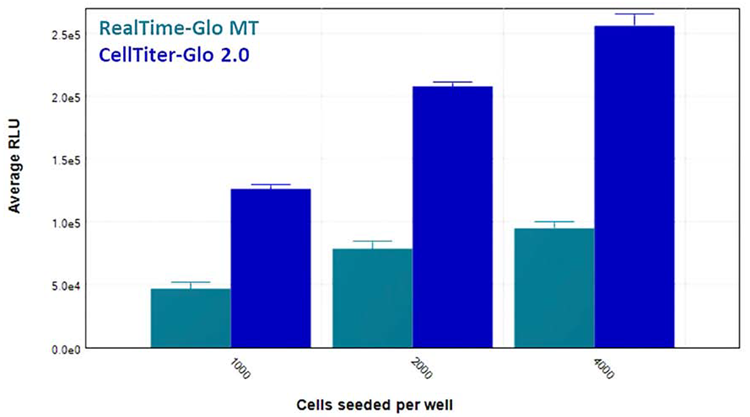
Figure 3. Cell viability after three days in a SpectraMax iD3s reader at 37 °C/5% CO2, with RealTime-Glo (light blue) and CellTiter-Glo (dark blue) readouts. Image Credit: Molecular Devices UK Ltd
Results
Incubating cells in the SpectraMax readers equipped with a gas mixer yielded better viability compared to those incubated in a plate reader lacking a gas mixer (Figure 4). By delivering 5% CO2 to the plate reader’s read chamber, the SpectraMax enabled cell health more comparable to that achieved when cells were maintained in a conventional cell culture incubator.
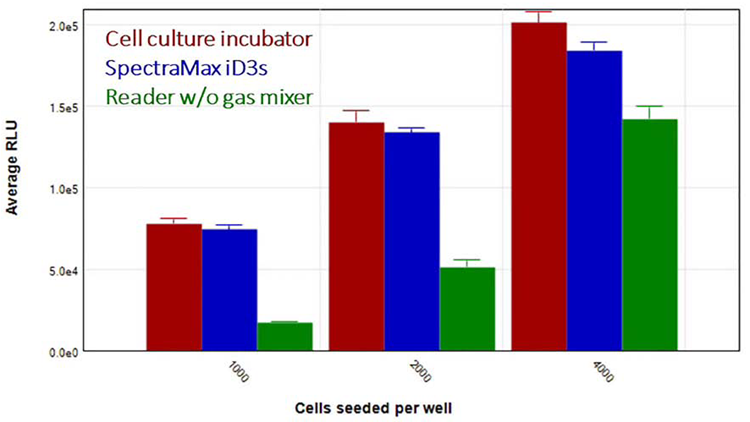
Figure 4. Comparison of cell viability after three days of incubation in a cell culture incubator (red), SpectraMax iD3s reader with SpectraMax aer gas mixer (blue), and a SpectraMax reader without a gas mixer (green). Data shown here were generated using the CellTiter-Glo assay. Image Credit: Molecular Devices UK Ltd
Conclusion
SpectraMax iD5e and iD3s readers equipped with SpectraMax aer gas mixers provide researchers with environmental control options that enable improved cell viability and growth for assays where result detection is performed for multiple hours or days.
SoftMax Pro Software can be configured to produce measurements at regular intervals during multi-day experiments, ensuring dependable data acquisition without requiring inconvenient user intervention.
Acknowledgments
Produced from materials originally authored by Cathy Olsen, PhD, Senior Application Scientist at Molecular Devices; Mark McPate, PhD, Senior Application Scientist at Molecular Devices; Stanimira Valeva, PhD, Field Application Scientist at Molecular Devices; Emanuele Giordano, MSc, Application Scientist at Molecular Devices; and Simon Lydford, PhD, Application Scientist Manager at Molecular Devices.
About Molecular Devices UK Ltd
Molecular Devices is one of the world’s leading providers of high-performance bioanalytical measurement systems, software and consumables for life science research, pharmaceutical and biotherapeutic development. Included within a broad product portfolio are platforms for high-throughput screening, genomic and cellular analysis, colony selection and microplate detection. These leading-edge products enable scientists to improve productivity and effectiveness, ultimately accelerating research and the discovery of new therapeutics. Molecular Devices is committed to the continual development of innovative solutions for life science applications. The company is headquartered in Silicon Valley, California, with offices around the globe. For more information, please visit www.moleculardevices.com.
Sponsored Content Policy: News-Medical.net publishes articles and related content that may be derived from sources where we have existing commercial relationships, provided such content adds value to the core editorial ethos of News-Medical.net, which is to educate and inform site visitors interested in medical research, science, medical devices and treatments.