Numerous labs worldwide conduct microbial growth assays in microplates to monitor multiple samples over time. This approach eliminates the labor-intensive process of pipetting samples from tubes to cuvettes, reduces the possibility of contamination, and increases assay throughput. In many cases, turbidimetry measurements are combined with fluorescence or luminescence readings to monitor marker expression.
The primary factors influencing microbial growth in culture include temperature, oxygen availability (aerobic or anaerobic conditions), and medium composition. For aerobic strains, cultures are shaken to aerate the medium, improving nutrient access, and to resuspend cells that might otherwise sediment. In addition, keeping the cells in suspension is essential for maintaining absorbance measurement consistency.
Cultures grown in flasks are generally shaken between 80 and 250 RPM during the assay. Microplate readers typically shake samples at higher RPMs, from 300 RPM to 1500 RPM, because the smaller surface area in a microtiter plate leads to greater surface tension.1 This helps overcome surface tension and provides adequate agitation of the medium.
Nevertheless, excessive shaking can harm cells and affect growth or production.2,3 In these situations, intermittent shaking may provide an alternative to prolonged continuous shaking in a microplate reader.
Brief shaking lasting a few seconds, performed every few minutes, may provide adequate oxygenation of the medium while also helping cells resuspend, thereby supporting sample health.
Molecular Devices has collaborated with researchers from the InBio.be group, which specializes in developing various microorganisms for bioproduction, to investigate the impact of intermittent or continuous shaking on the growth of several prokaryotic and eukaryotic strains at different temperatures and in different growth media.
Here, it is demonstrated that certain microorganisms can grow well with intermittent shaking, and different shaking intervals are recommended for testing. These intervals can be easily configured in a SoftMax Pro Workflow to establish an efficient procedure that combines multi-mode measurements.
Benefits
- Simple setup of customized workflows with shaking for microbial growth experiments
- High-throughput microbial growth assays supported by ready-to-run protocols for ease
- SoftMax Pro software streamlines growth curve data analysis with automated Vmax computation
Materials
- SpectraMax® iD3 Multi-Mode Microplate Reader (Molecular Devices, cat. #iD3) with:
- 96-well clear flat-bottom plates, sterile (Greiner cat. #655161)
- 96-well black flat-bottom plates (Greiner cat. #655077) used for fluorescence in Figure 5
- Bacterial or yeast strains cultivated by InBio.be (Ghent University) in their appropriate media. Strain identities remain confidential and are designated as prokaryote A, prokaryote B, and so forth.
Methods
Different prokaryotic and eukaryotic strains were grown in their appropriate media according to the SoftMax Pro workflows presented in Figure 1. Absorbance measurements were normalized using the SoftMax Pro software data reduction menu with the following equation: Ln (OD600/ODT0) by applying the formula Ln(!Lm1/Min(!Lm1)) as a custom setting.
Vmax was automatically computed using the maximum number of data points to provide the highest squared correlation coefficient (R2).
The following application note provides additional details on kinetic data analysis in SoftMax Pro: "Advanced kinetic analysis of a bacterial growth assay."
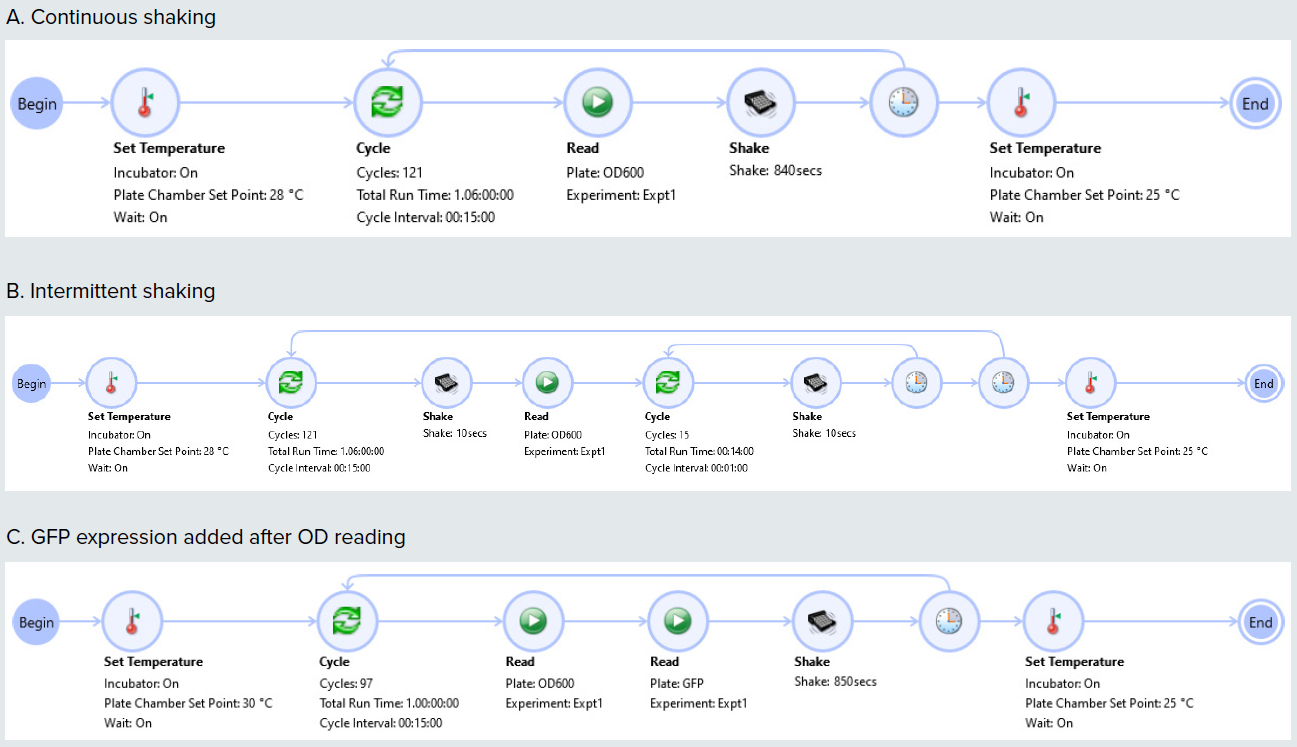
Figure 1. SoftMax Pro workflow protocols for continuous shaking (A) or intermittent shaking (B) with 10 seconds of agitation per minute and 50 seconds of idle time. Both types of kinetics were followed for 24 hours, taking a reading every 15 minutes. When GFP expression was followed, both in intermittent and continuous shaking, a fluorescence measurement was added after the absorbance reading (C). Shaking was done at 517 RPM with a 1.7 mm shaking diameter. Image Credit: Molecular Devices UK Ltd
Results
InBio.be evaluated four prokaryotic and three distinct eukaryotic species. All strains grew under continuous and intermittent shaking conditions. The shaking parameters had different impacts on the microorganisms depending on the species, temperature, and growth medium. Representative examples are presented here, while additional data is available upon request.
Prokaryotes A and B are aerobes and were grown at 28 °C. Prokaryote A displayed comparable Vmax values and growth curves under continuous and intermittent shaking (Figure 2). Prokaryote B exhibited a 30% greater Vmax value in continuous shaking conditions; however, growth began much faster under intermittent shaking (eight hours with continuous versus four hours with intermittent shaking) (Figure 3).
It should be noted that inoculation percentages were higher for the intermittent-shaking plate. Prokaryote B demonstrated a shorter lag phase and a smoother exponential phase with intermittent shaking. Both curves achieved identical final OD values.
A sample eukaryote data set is presented in Figure 4. Continuous shaking produced a slightly greater Vmax (1.2-fold), but the curves were largely overlapping and followed the same growth phases. Eukaryote A is a GFP-expressing strain.
Of note, the onset of GFP expression was earlier and exhibited a 1.2-fold increase in Vmax with intermittent shaking conditions (Figure 5) (note higher inoculation percentage as above). The earlier increase in GFP production may be attributed to more rapid adaptation of the strain to intermittent shaking conditions.
Another noteworthy example involved eukaryote strain C, which displayed growth in clumps. Under continuous shaking, this growth type exhibited multiple artifacts and highly variable ‘zigzagging’ OD traces (Figure 5). These irregular OD values are most likely artifacts.
Continuous shaking may encourage clumping, potentially affecting the optical path and/or contributing to the formation of air bubbles if the solution had a high amphiphilic particle content (similar to a soap solution).
Under these conditions, Vmax could not be calculated. The squared correlation coefficient (R2) for Vmax fit ranged from 0.56 to 0.92 across all replicates and the four different media evaluated under continuous shaking.
Intermittent shaking substantially enhanced signal stability, enabling reliable determination of growth rates of the samples (for the four media tested, the mean R2 values for Vmax fit were 1.0, 0.99, 0.97, and 1.0).
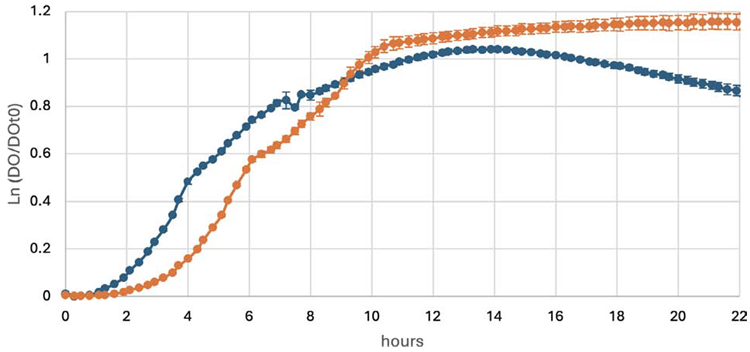
Figure 2. Growth curves of prokaryote A at 28 °C, with continuous (orange) or intermittent (blue) shaking. Shown are the means of triplicate wells, with error bars representing standard deviation. Continuous: Mean Vmax = 3.751 mU/minute, calculated using eight points with mean R2 = 0.996; CV (Vmax) = 1.3%. Intermittent: Mean Vmax = 3.737 mU/minute, calculated using eight points with mean R2 = 0.996; CV (Vmax) = 3.8%. Image Credit: Molecular Devices UK Ltd
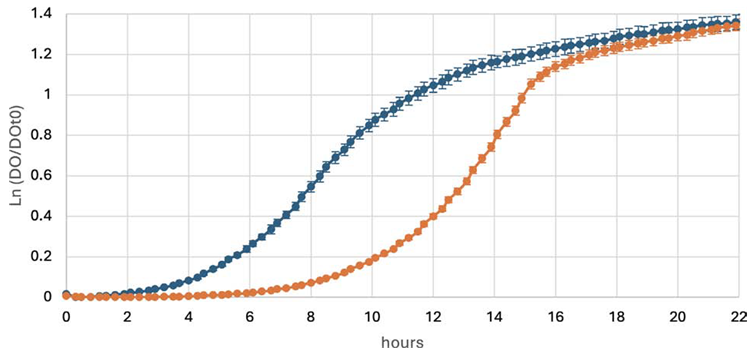
Figure 3. Growth curves of prokaryote B at 28 °C with continuous (orange) or intermittent (blue) shaking. Shown are the means of triplicate wells, with error bars representing standard deviation. Continuous: Mean Vmax = 4.028 mU/minute, calculated using eight points with mean R2 = 0.998; CV (Vmax) = 1.6%. Intermittent: Mean Vmax = 3.135 mU/minute, calculated using eight points with mean R2 = 0.993; CV (Vmax) = 3.1%. Image Credit: Molecular Devices UK Ltd
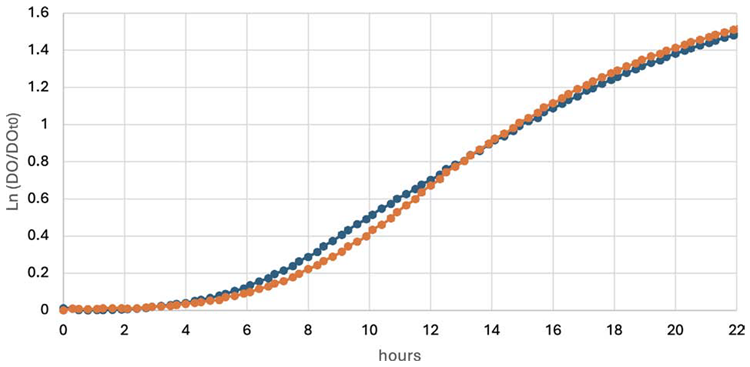
Figure 4. Growth curves of eukaryote A at 30 °C with continuous (orange) or intermittent (blue) shaking. Shown are the means of triplicate wells, with error bars representing standard deviation. Continuous: Mean Vmax = 2.338 mU/minute, calculated using 10 points with mean R2 = 1; CV (Vmax) = 0.6%. Intermittent: Mean Vmax = 1.926 mU/minute, calculated using 10 points with mean R2 = 0.999; CV (Vmax) = 0.5%. Image Credit: Molecular Devices UK Ltd
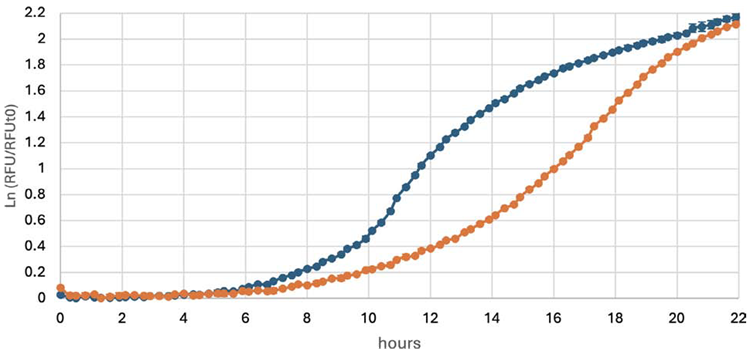
Figure 5. GFP expression in eukaryote A at 30 °C with continuous (orange) or intermittent (blue) shaking. Shown are the means of triplicate wells, with error bars representing standard deviation. Continuous: Mean Vmax = 4.541 mU/minute, calculated using 10 points with mean R2 = 0.997; CV (Vmax) = 0.6%. Intermittent: Mean Vmax = 5.469 mU/minute, calculated using 10 points with mean R2 = 0.997; CV (Vmax) = 2.3%. Image Credit: Molecular Devices UK Ltd
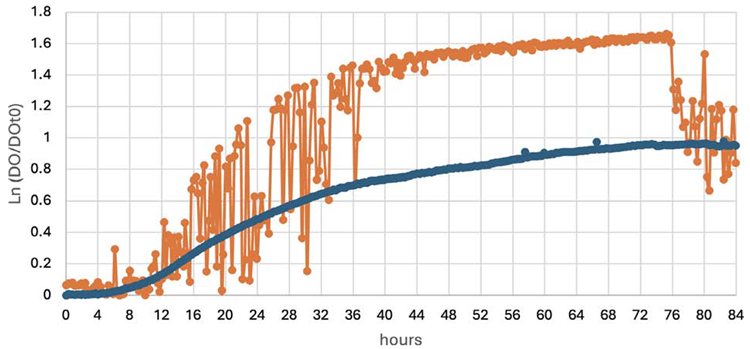
Figure 6. Growth curves of clump-forming eukaryote C grown at 25 °C with continuous (orange) or intermittent (blue) shaking. Four different media were tested. Shown is one example out of a set of triplicate wells for one medium; similar results were obtained with other replicates and other media.
Average data for continuous shaking was not considered due to high variability among triplicates (CV up to 154%); Vmax could not be reliably calculated due to artifacts. Vmax was calculated for intermittent shaking using 20 Vmax points: Mean Vmax = 0.612 mU/minute, R = 1, CV = 3.6%. Image Credit: Molecular Devices UK Ltd
Conclusion
The findings demonstrated that different microorganism strains require distinct shaking conditions to achieve optimal growth. Shaking intervals can also influence marker expression and alter the microorganism's growth phases.
Aerobic and fast-growing strains such as prokaryote A may require more robust shaking, whereas slower-growing or more delicate strains such as eukaryote A may grow more rapidly under intermittent shaking. Users are advised to test their individual strains to determine the most appropriate shaking intervals.
Using the intuitive SoftMax Pro software workflow editor, users can program a range of shaking intervals with ease using the SpectraMax iD series readers. With the advanced shaking upgrade available for SpectraMax iD3s and iD5e readers, users can further modify the RPM and shaking diameter to optimize growth conditions for specific strains, including vigorous shaking for long-term continuous shaking experiments.
In addition, SoftMax Pro software enables scientists to conveniently measure absorbance (OD600 values) for microbial growth and fluorescent marker expression within a single workflow. Fully automated data analysis provides additional convenience.
References and further reading
- Duetz, W.A. (2007). Microtiter plates as mini-bioreactors: miniaturization of fermentation methods. Trends in Microbiology, 15(10), pp.469–475. DOI:10.1016/j.tim.2007.09.004. https://www.cell.com/trends/microbiology/abstract/S0966-842X(07)00172-2?_returnURL=https%3A%2F%2Flinkinghub.elsevier.com%2Fretrieve%2Fpii%2FS0966842X07001722%3Fshowall%3Dtrue.
- Chung, C.-F., et al. (2020). Shaking Rate during Production Affects the Activity of Escherichia coli Surface-Displayed Candida antarctica Lipase A. Catalysts, 10(4), p.382. DOI:10.3390/catal10040382. https://www.mdpi.com/2073-4344/10/4/382.
- Sakil Munna, Md., et al. (2014). Influence of Aeration Speed on Bacterial Colony Forming Unit (CFU) Formation Capacity. American Journal of Microbiological Research, 2(1), pp.47–51. DOI:10.12691/ajmr-2-1-7. https://pubs.sciepub.com/ajmr/2/1/7/index.html.
About Molecular Devices UK Ltd
Molecular Devices is one of the world’s leading providers of high-performance bioanalytical measurement systems, software and consumables for life science research, pharmaceutical and biotherapeutic development. Included within a broad product portfolio are platforms for high-throughput screening, genomic and cellular analysis, colony selection and microplate detection. These leading-edge products enable scientists to improve productivity and effectiveness, ultimately accelerating research and the discovery of new therapeutics. Molecular Devices is committed to the continual development of innovative solutions for life science applications. The company is headquartered in Silicon Valley, California, with offices around the globe. For more information, please visit www.moleculardevices.com.
Sponsored Content Policy: News-Medical.net publishes articles and related content that may be derived from sources where we have existing commercial relationships, provided such content adds value to the core editorial ethos of News-Medical.net, which is to educate and inform site visitors interested in medical research, science, medical devices and treatments.