A cutting-edge simulator reveals the hidden driving challenges of Parkinson’s disease, uncovering deficits that routine cognitive tests overlook and highlighting the need for more realistic road-readiness assessments.
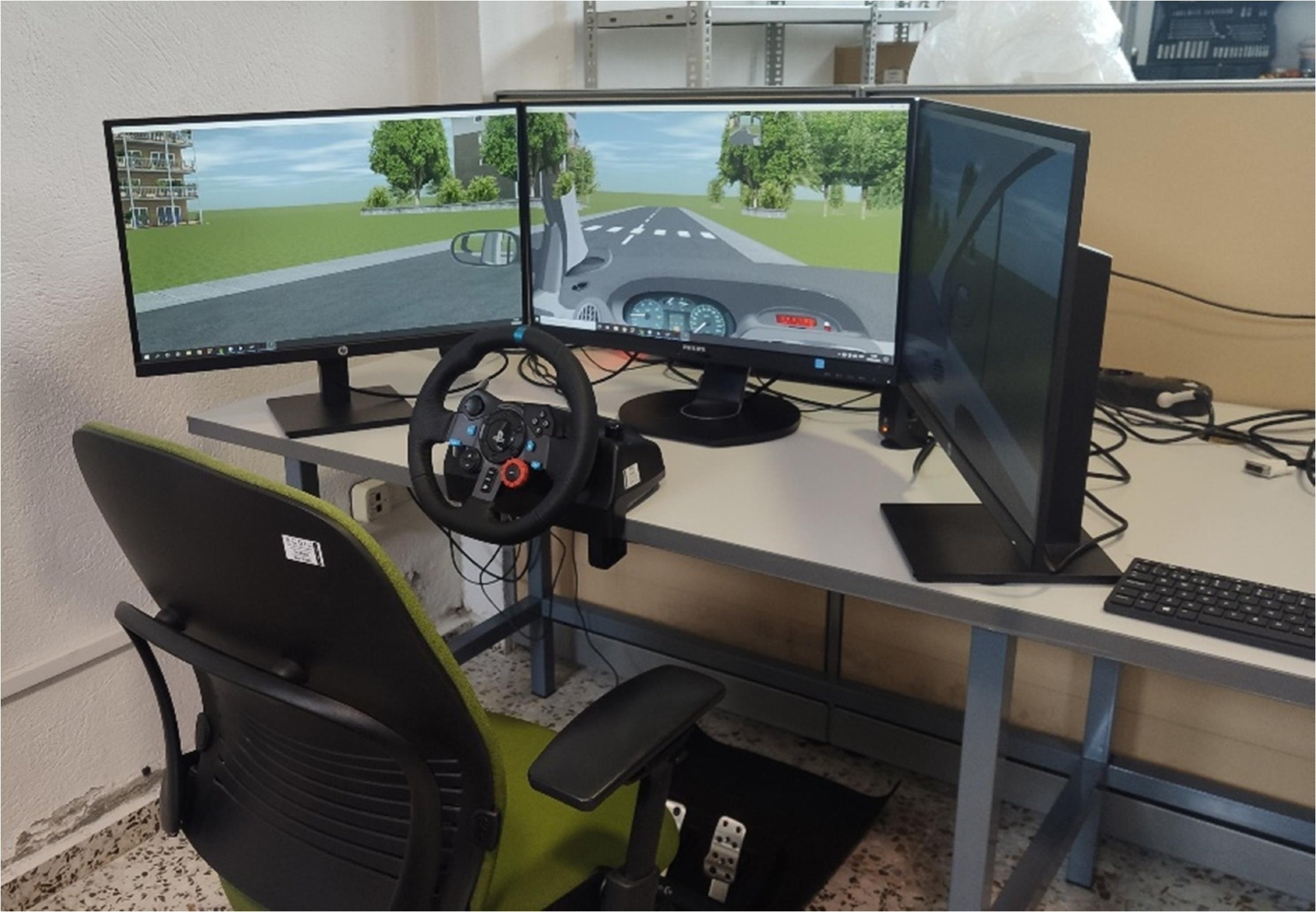
Driving simulator setup used in the experiments, consisting of a steering wheel with pedals, three monitors displaying the virtual driving environment, and a participant’s chair. Study: Cognitive alterations related to driving performance in Parkinson’s disease detected by a driving simulator
A recent Scientific Reports study tested whether a proof-of-concept driving simulator could detect subtle, early driving difficulties in people living with Parkinson’s disease (PD) who did not have dementia. They found that people with PD exhibited poorer lane control and slower reaction times than those without the condition, despite having similar average cognitive test scores. The simulator revealed driving impairments that were not fully captured by standard neuropsychological tests.
Driving Requires Complex Integrated Skills
Driving requires the rapid integration of cognitive, perceptual, and motor processes. To drive safely, individuals must divide their attention, maintain executive control, process visuospatial information, and manage risk. These skills support situational awareness, prediction of others’ behavior, and appropriate responses under changing traffic and emotional conditions. Many licensing systems, such as those in Spain, assess driving fitness using standardized tests that evaluate vision, coordination, reaction time, and attention. However, these tools often overlook higher-order cognitive abilities that contribute to safe driving.
In PD, a neurodegenerative condition marked by loss of dopaminergic function, motor symptoms are central to diagnosis. Cognitive issues such as executive dysfunction, impaired attention, and reduced working memory can appear during mild to moderate disease stages. These deficits affect driving by slowing reactions, reducing accuracy in multitasking situations, and weakening planning and adaptability. As a result, people with PD may struggle with sudden traffic events or complex driving environments, increasing the risk of collisions.
Traditional driving assessments rely heavily on simplified visuomotor and reaction-time tasks that lack ecological validity and rarely incorporate detailed cognitive evaluations. With advancements in simulation technology, driving simulators offer a promising way to measure nuanced driving behaviors that standard tests may miss.
Study Design and Participant Assessment
This cross-sectional study compared seven drivers with diagnosed PD to seven healthy drivers matched by age and sex. All participants were under 75, possessed valid licenses, and had regular driving experience. PD participants met additional criteria, namely stable medication for 30 days, mild-to-moderate disease severity, no visuo-perceptual deficits, and intact global cognition.
Each participant completed a single 120-minute session comprising cognitive testing and a driving simulation. The neuropsychological battery included a series of computerized reaction-time tasks assessing sensory-motor speed, sustained attention, inhibitory control, decision-making, and visual search.
Driving performance was evaluated using a three-screen, high-fidelity simulator with realistic pedal resistance and force-feedback steering. Five driving experiments assessed reaction times, lane keeping, steering precision, turning accuracy, and vehicle-following behavior. Each scenario generated quantitative metrics, including lane deviation, reaction times, and speed differences.
Statistical analyses included t-tests, Wilcoxon tests, analysis of covariance (ANCOVA) to separate cognitive from motor influences in reaction-time tasks, linear mixed models for repeated simulator measures, and correlations to explore relationships among simulator performance, cognitive task outcomes, and PD severity.
Simulator Reveals Subtle Driving Deficits
The cognitive assessments showed that most neuropsychological test scores were similar between people with PD and healthy controls. The only significant difference appeared in a symbol search test, where the PD group performed more slowly, indicating reduced processing speed. Reaction-time tasks generally showed no between-group differences, except in one task, where PD participants had slower responses; further analysis confirmed that this was linked to deficits in perceptual processing and sustained alertness.
In the driving simulator, the small sample size limited statistical significance, but clear performance differences emerged. PD drivers showed slower reactions in one experiment and tended to drive at different speeds in another. They also had more difficulty maintaining lane position, spending less time in the lane, and deviating further from the center.
These impairments were strongly linked to disease progression, higher levodopa dose, longer disease duration, and higher disease stage, all of which were associated with poorer lane-keeping and greater deviation. Additionally, poorer reaction-time performance correlated with difficulties in the reverse-driving task, suggesting that simple reaction-time measures reflect real-world driving behavior. Overall, the simulator detected visuospatial and attentional deficits not captured by standard cognitive tests.
Implications for Early Driving Evaluation
The study shows that while traditional cognitive tests may appear normal in people with mild to moderate PD, a driving simulator can reveal meaningful impairments in reaction time, visuospatial control, and sustained attention, all of which are essential for safe driving. The findings suggest that standard assessments could overlook subtle deficits that influence real-world performance. The simulator tasks were intentionally designed to mimic common driving difficulties in PD, such as lane keeping, left turns, and reversing, providing a more ecologically valid assessment environment.
Key strengths include integrating neuropsychological testing, computerized reaction-time tasks, and simulator performance. However, the small, non-random, and all-male sample limits generalizability, and simulation cannot entirely replicate real driving demands. Despite these constraints, the study demonstrates the feasibility and value of simulator-based assessments.
The results support the idea that immersive, targeted driving simulations could help identify early impairments that conventional tools miss, although several simulator differences did not reach statistical significance due to the small sample size. This represents a step toward more accurate evaluation of driving fitness in PD.
Journal reference:
- Cerezo-Zarzuelo, A., Sánchez-Cuesta, F.J., Trigo, C., Rocon, E., Villagra, J., Medina-Lee, J.F., Trentin, V., Romero, J.P. (2025). Cognitive alterations related to driving performance in Parkinson’s disease detected by a driving simulator. Scientific Reports. DOI: 10.1038/s41598-025-31585-y, https://www.nature.com/articles/s41598-025-31585-y
 Overweight dementia patients likely to live longer than normal weight peers