Study: The association between nationality, gender, age and running performance in endurance runners: an empirical analysis of worldwide multi-distance race data from 1999 to 2024. Image Credit: kovop / Shutterstock
In a recent study published in the journal Scientific Reports, a group of researchers examined how nationality, gender, and age are associated with running performance across 5 km, 10 km, half-marathon, and marathon events worldwide from 1999 to 2024.
Background
Why do Kenyan and Ethiopian runners dominate marathons, while there is ample participation from Japan or the United States? Millions of people enjoy endurance running, and their performance depends on factors such as age, gender, training culture, and geographic location.
A review of the existing literature reveals differences in peak athletic performance relative to age and shows that East African runners outperform other competitors in distance races in ways that may reflect unique physiological, environmental, and cultural advantages. However, limited research has compared these patterns across multiple race distances simultaneously. More studies are thus required to better understand how demographic factors interact across endurance events.
About the study
The researchers analyzed publicly available data from official records maintained by World Athletics (formerly the International Association of Athletics Federations) and the Association of Road Racing Statisticians.
The dataset consisted of eligible records reported for the 1999-2024 time period for 5 km, 10 km, half-marathon, and marathon races, with 5 km data supplemented from ARRS because World Athletics records were available only from 2018 to 2024.
After filtering and removing incomplete data, a final dataset with 152,943 runner records was established, comprising runners from 203 countries, regions, or representative teams, with 91,182 men and 61,761 women.
Cutoff points for performance were established in order to maintain consistency when comparing across races. Runners who did not finish, were disqualified from finishing, did not start, or had incomplete records were excluded from analysis. Neutral teams (the refugee team and the neutral athletes' team) were also removed to avoid statistical bias.
The researchers conducted mixed-effects modeling and multiple linear regression analyses of the relationships among an athlete’s nationality, age, gender, and running performance. A three-way analysis of variance (ANOVA) was used to examine the interaction between nationality and gender on running performance, while adjusting for the year of the competition.
Researchers used t-tests to compare males and females, and Pearson correlation coefficients to assess relationships between age and race results. Statistical significance was set at a probability value below 0.05. As this was an observational analysis of public race records, the findings identify associations rather than causal effects.
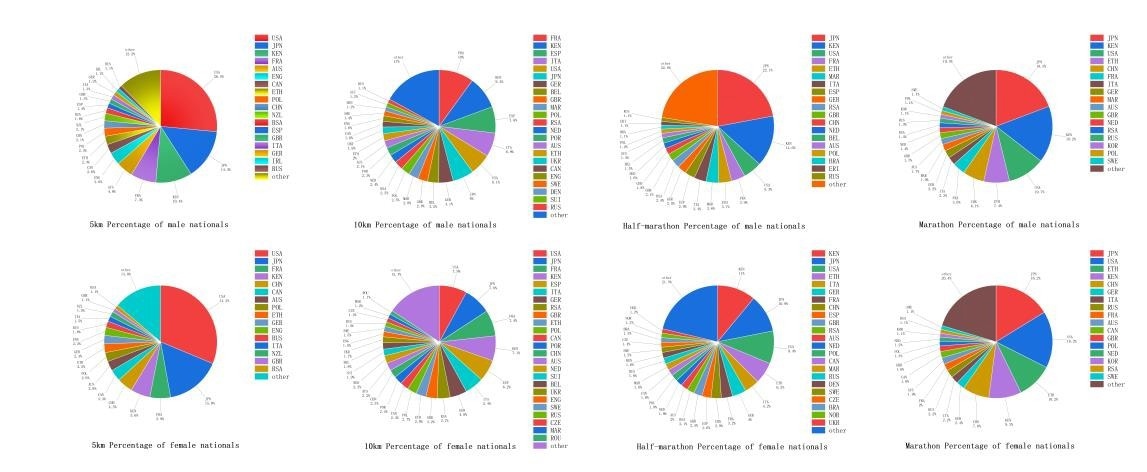
The proportion of runners' nationalities by race distance and gender. Countries with a proportion of less than 1% are included in "Others".
Study results
Results showed a consistent difference across gender, nationality, age, and distance-racing experience in endurance running performance. Across all four race categories, men consistently outperformed women.
The average running speed across all races was faster for males than for females; only the 5 km distance had an average combined speed greater than 20 km/h. Male runners were significantly faster than female runners at all distance levels; however, this performance gap became especially pronounced in half-marathon and marathon distances.
Participation patterns also differed by country and distance. In the 5 km event, runners from the United States and Japan formed the largest participant groups, followed by Kenya, France, and Australia. In the 10 km race, France and Kenya contributed many participants, while Japan and Kenya were prominent in half-marathon and marathon participation.
Kenyan and Ethiopian runners have consistently ranked among the top performers across all endurance events, confirming East Africa’s continued influence in distance running.
Bahraini athletes also demonstrated exceptional average race times across several events, although nationality-based findings should be interpreted cautiously, as some countries may include naturalized athletes.
Age patterns changed as race distances increased. In the 5 km race, men and women had similar average ages, around 25 years. However, women were progressively older than men in the 10 km, half-marathon, and marathon races. In the study, marathon runners were the oldest group, mostly aged 25-35. It was also observed that younger athletes were more common in shorter races, while older runners were more common in longer endurance events.
Running performance varied significantly by nationality. Runners from East Africa, particularly Kenya, Ethiopia, Uganda, and Eritrea, consistently recorded strong performances, especially in longer-distance events, which may reflect altitude adaptation, strong running culture, genetics, and long-term training systems. In contrast, Japan’s success was linked to organized corporate running teams and the nation’s deep-rooted “Ekiden” relay culture.
There were significant declines in race participation at all distances between 2020 and 2022 due to the COVID-19 pandemic, which resulted in the cancellation of races and the implementation of public health restrictions across countries. However, participation subsequently showed recovery, particularly in longer-distance events.
The study found strong links between age and race performance in half-marathons and marathons (especially among females). There were weak correlations between age and race performance in shorter events, such as the 5 km. Interestingly, female runners in the 5 km event showed a negative relationship between age and race time, suggesting that slightly older women in younger age groups often achieved faster times.
Conclusions
The study shows that endurance running performance is shaped by a complex interaction of nationality, gender, age, and race distance. East African athletes, particularly from Kenya and Ethiopia, remained especially prominent in long-distance events, while Japan and the United States contributed large numbers of participants across races. Men consistently achieved faster race times, whereas women participating in longer events were generally older.
The study data show that performance patterns varied by race distance and demographic background. These results are important for athletes, coaches, and sports organizations, as they can be used to help develop training programs, identify talent, and understand the evolving global endurance running culture.
Journal reference:
- Liao, G., & Wang, J. (2026). The association between nationality, gender, age and running performance in endurance runners: An empirical analysis of worldwide multi-distance race data from 1999 to 2024. Scientific Reports. DOI: 10.1038/s41598-026-46032-9, https://www.nature.com/articles/s41598-026-46032-9
 Core muscle activity rapidly regulates blood flow in the brain