From microneedles to nanocarriers, researchers are rethinking how GLP-1 medicines could become longer-lasting, easier to tolerate, and more patient-friendly, while cautioning that many next-generation systems remain years from routine clinical use.
Review: Advances in GLP-1 receptor agonists delivery systems for obesity and diabetes
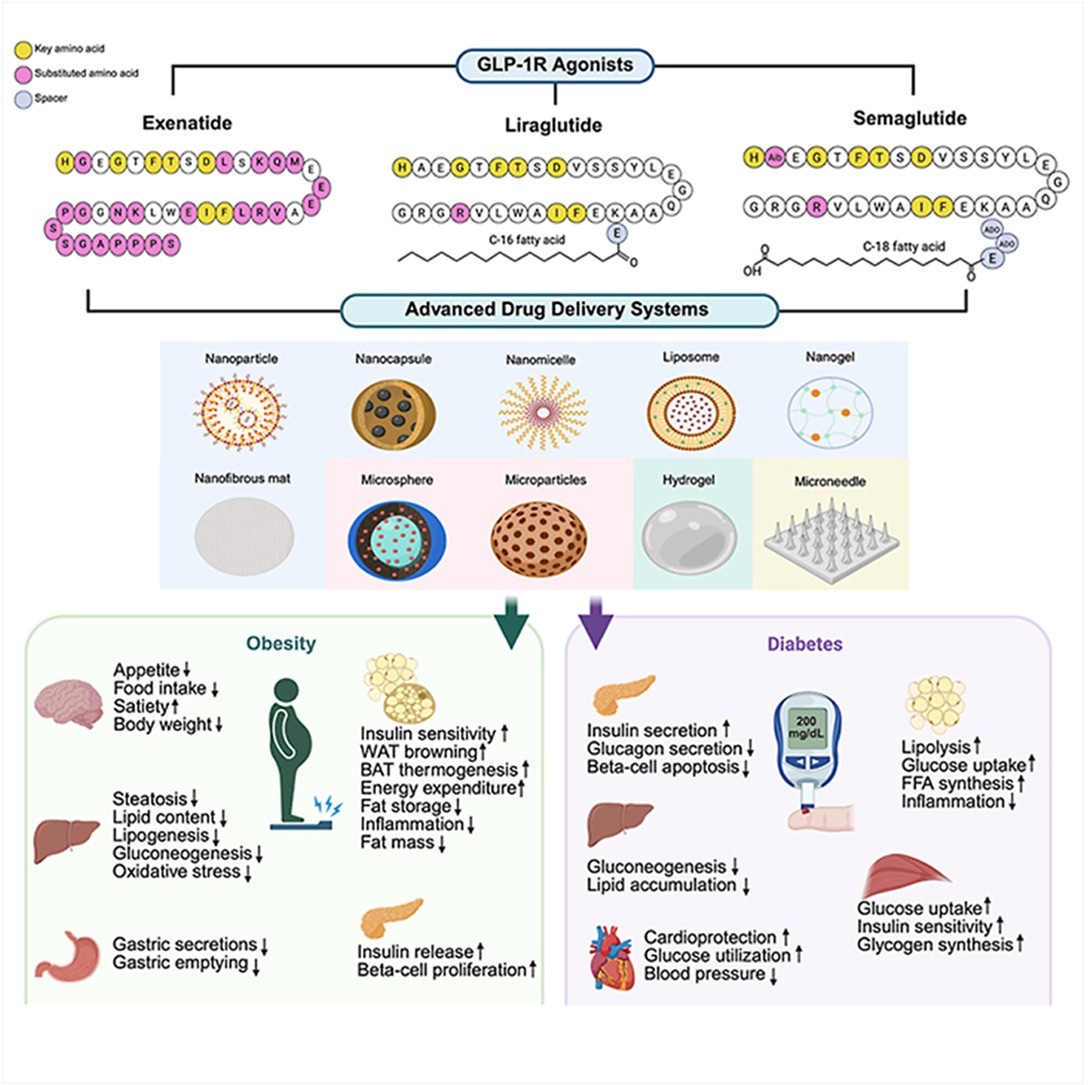
A new review article published in the journal Acta Pharmaceutica Sinica B summarizes advancements in drug delivery systems for three main glucagon-like peptide-1 receptor agonists (GLP-1RAs), which are recommended for selected patients with obesity or type 2 diabetes, depending on indication, comorbidities, and treatment goals.
Background
Obesity is a chronic metabolic disease characterized by excessive accumulation of body fat. Currently, over one billion people are living with this health condition worldwide. Because of its significant negative impact on almost all body systems, obesity increases the risks of several other chronic diseases, including diabetes, heart disease, kidney disease, and cancer.
Lifestyle modification and pharmaceutical medicines are two main treatment options for both obesity and diabetes. However, lack of long-term adherence to lifestyle modifications and adverse side effects, poor bioavailability, rapid clearance, and instability of many approved medicines make obesity and diabetes management challenging.
Glucagon-like peptide-1 receptor agonists (GLP-1RAs), including exenatide, liraglutide, and semaglutide, have shown promise in reducing body weight, improving glycemic control, and slowing the progression of cardiovascular and kidney diseases.
These medicines are generally well tolerated, although gastrointestinal side effects are common during treatment initiation or dose escalation. Most GLP-1RAs are administered via subcutaneous injections, although oral semaglutide is available. However, these methods have limitations, including low bioavailability, poor solubility, the need for high-dose administration, gastrointestinal side effects, and frequent dosing.
To overcome these limitations, novel drug delivery systems have been developed most recently, including nano- and micro-carrier-based delivery systems, hydrogels, microneedle-based transdermal delivery systems, and enhanced longer-acting or combined formulations.
This review provided an in-depth overview of the potential utility and remaining challenges associated with these drug delivery systems, focusing on three main GLP-1RAs, including exenatide, liraglutide, and semaglutide.
Nanocarrier drug delivery systems (NDDS)
Nanocarrier drug delivery systems (NDDS) have been developed to improve targeted drug delivery, increase drug efficacy, enhance bioavailability, and reduce side effects. In these systems, drugs are encapsulated or conjugated to nanoparticles that can penetrate biological barriers, thereby facilitating direct delivery to specific tissues or cells.
Major challenges in NDDS include biocompatibility, biodegradability, immune-evasion efficacy, solubility and stability in biological environments, and the potential for off-target effects.
Exenatide-loaded nanoparticles have been shown in cell and animal studies to improve glycemic control, reduce insulin resistance, improve lipid profiles, reduce organ damage, and support weight management.
Liraglutide-loaded nanoparticles have been found in preclinical or early-stage studies to improve patient adherence, enhance bioavailability, sustain glucose-lowering effects, reduce food intake and body weight, and prevent cardiomyopathy and lipotoxicity.
Semaglutide-loaded nanoparticles have been found in experimental models to improve glucose homeostasis and insulin sensitivity, reduce liver inflammation and oxidative stress, and manage diabetic cardiomyopathy and other metabolic disorders.
Microsphere and microparticle systems
Microspheres are organic and inorganic spherical, free-flowing particles that can retain shape and structural integrity even when loaded with drugs. Their high surface area-to-volume ratio facilitates controlled and sustained drug release.
Microparticles are composed of a range of materials, including polymers, ceramics, glass, metals, and composites. These solid, porous, or hollow particles are widely used due to their versatility and biocompatibility.
Major challenges in microsphere and microparticle systems include complex, costly manufacturing processes, product variability, and environmental degradation of certain components.
A new sustained-release microsphere formulation of exenatide, known as DA-3091, has shown promise in managing obesity, diabetes, and nonalcoholic fatty liver disease, offering effective metabolic control with less frequent dosing, potentially improving patient compliance.
Liraglutide-loaded microspheres have shown promise for sustained drug release over 1 month. These microspheres have demonstrated therapeutic efficacy comparable to daily liraglutide injections, improving pancreatic and hepatic function while achieving high drug loading and encapsulation efficiency.
Hydrogel-based delivery systems
Hydrogel-based delivery systems are composed of highly hydrated, physically or covalently crosslinked polymer networks, which enable hydrogels to efficiently encapsulate and protect a wide range of bioactive substances.
Hydrogels can mimic the brain's extracellular matrix, potentially supporting central nervous system delivery strategies, though blood-brain barrier penetration remains a major technical challenge.
Major challenges in hydrogel-based delivery systems include difficulties with large-scale production, difficulties in precisely controlling gelation, the risk of immunogenicity, and the possibility of uneven drug distribution and retention within brain tissues.
A long-acting injectable exenatide-loaded hydrogel has shown promise in preclinical research for minimizing initial burst release, achieving steady, sustained drug delivery over 1 week, and improving glucose tolerance and weight management.
Semaglutide-loaded hydrogel has shown promise in experimental studies in maintaining therapeutic drug levels and effectively controlling blood glucose and weight for over six weeks through a single injection.
Transdermal Drug Delivery Systems (TDDS)
Transdermal drug delivery systems (TDDS) are non-invasive methods of drug delivery through the skin. These systems are particularly suitable for avoiding gastrointestinal side-effects, bypassing first-pass metabolism, and maintaining consistent drug levels in the blood.
Distinct advantages of TDDS over other drug delivery systems include self-administration, sustained drug release, and reduced dosing frequency. These systems also enhance patient adherence by overcoming barriers associated with injections or oral medications.
Major challenges in TDDS include limited drug-loading capacity and inadequate skin penetration, due to the low mechanical strength of polymeric microneedles or variations in skin properties between individuals.
Exenatide-loaded TDDS have shown enhanced skin permeation, improved long-term storage stability, sustained blood concentrations for up to 48 hours, increased bioavailability, rapid reduction of blood glucose levels, and suppression of food intake in experimental studies.
In diabetic and obese mouse models, liraglutide-loaded TDDS has shown promise in increasing drug absorption, improving bioavailability, and effectively controlling glucose homeostasis and weight management.
Long-acting or combined formulations
Long-acting formulations have been developed to release drugs steadily over extended periods, ranging from weeks to years. These formulations are particularly effective for improving compliance and therapeutic efficacy in patients living with chronic diseases.
Major challenges associated with long-acting formulations include high material costs, limited biomaterial availability, and system complexity.
A combined drug delivery system is a novel method that combines two or more therapeutically active agents, such as biologics and small molecules, into a single formulation. This method helps target multiple disease pathways at the same time.
Major challenges in this method include maintaining stability and compatibility of multiple agents, avoiding unwanted interaction, and optimizing pharmacokinetics and pharmacodynamics.
Once-weekly long-acting exenatide formulations have shown promise in significantly improving glycemic control and promoting weight loss in patients with inadequately controlled type 2 diabetes.
Combined formulations containing a liraglutide nanoformulation and an SGLT-2 inhibitor have been shown to significantly improve blood lipid profiles in patients with type 2 diabetes. Fixed-ratio insulin and GLP-1RA co-formulations have stronger clinical-trial support than many newer nanocarrier, hydrogel, and microneedle systems.
Take-home message
This review highlights the potential clinical benefits and tolerability of novel GLP-1RA delivery systems. However, many of these technologies remain preclinical or are early in development, and larger-scale, longer-term studies are required to more conclusively assess their long-term effectiveness, safety, and cost-efficiency before routine clinical use.
Download your PDF copy by clicking here.
 Brain activity study reveals five distinct profiles for depression